Wednesday, November 29, 2017

CLAIR LAIRD- PRISONER OF WAR

Clair Blossom Laird was the youngest child of J. R. and Ella Laird.  J.R. had run a thriving furniture and undertaking business in Algona until his death in 1913 when Clair was only 18 and a senior in high school.  In August of 1917, at the age of 21, Clair enlisted in the U.S. Army Air Corps.  He participated in 22 missions with the French and was brought down during his eighth mission with the Americans.

In the February 6, 1919 edition of the Bancroft Register, Clair gave an account of his plane crash behind enemy lines and his experience as a prisoner of war.  Here is his story in his own words:

In August, 1917, I was sent to the University of Texas where we were trained in the Aeroplane school.  In November we were sent to New York and across.  After several weeks’ waiting, I volunteered as an observer, whose duties are to drop bombs and signal the pilot on his course.  There is little sensation in flying, in fact it was a great disappointment to me.
With the French.
On June 10 I was attached with my pilot to the French escradrille 127 group de bombardment 5.  We were located at Plessis Bellville below Chateau Therry.  My pilot was Roger Chapin of Boston, and we were together to the finish.  We made several flights over the lines when we were transferred on August 21st to the American aero squadron, First bombardment crew.  “Dud” McDonald, the Burt aviator, had been with squadron number 96, of the same group but was lost in July.  I did not get to see him in service.
On September 18 ten left the field, all practically new pilots.  Roger Chapin and I were in the lead.  We had two objectives or targets upon which we were ordered to drop bombs.  One was a village with a number of troops and the other an aerdome, then kilometers across the line.  Our machines were D.H. 4s equipped with Liberty motors.  Four of the planes turned back because of engine troubles and but six crossed the line.  It was very cloudy and the first target to be bombed, the barracks, was hidden from view so we went on over to the second, the aerdome.


Crashed to Earth
        We did our bombing and had started home when we were attacked by about fifteen Fokkers from the front.  Usually an attack is made at the rear.  One machine got right under our plane and the rattling of their guns sounded like the explosion of a bunch of firecrackers.  I was slightly wounded on the shin by fragments of an explosive bullet but during the excitement paid no attention to it.  Our gas tank was punctured badly and full of holes.  To make matters worse my right gun jammed and was useless, and all the while the German machine was right under our tail doing their utmost to down us.  I gave them all I had with one gun.  It was just a matter of a few seconds and we were close enough to see the expressions on the faces of our enemy.  It was something awful while it lasted.  Our tank was shot to pieces and it is a miracle that the explosive bullets did not set the gasoline on fire.
        Our motor, getting little gas, was practically useless and Chapin was forced to leave formation and managed to volplane into a cloud.  We were in this cloud a couple of minutes.  Coming out of the cloud we saw nothing more of enemy planes or our own formation.  We had lost a great deal of altitude.  Anti air craft guns opened on us from the ground and continued shooting at us until we crashed.  Our motor was giving us little aid and Chapin was forced to keep it in a continual glide.  We were working air pumps on the gas tank and at times the motor would pick up a bit only to practically stop again.  Getting closer to the ground “Chape” attempted to pull up over some telegraph wires but the motor failed again and crashed into the wires.  I remember nothing more until I came to under the plane.  The plane was lying upside down with Chapin hanging from a leg hooked under the rudder bar.  I thought he was dead but after unfastening his clothing and rubbing his face and hands he began moaning and finally came to.  I could not set the plane on fire as we had been instructed to do in case of accident or capture, with him hanging there.  He is a big man and it was some job to get him down.


Military registration cards of Clair Laird

Germans Appear.
        Just as I had finished this I looked down and saw boche boots all around the machine.  They did not walk around the wings but cut their way through and said, “Kamrade.”  One of them asked if we were hurt and helped Chapin up.  There must have been two or three hundred about by this time and they were all laughing as though they considered it a great joke.  An officer then appeared and took us to a village.  Here another officer appeared who spoke English and said we should be thankful that the war was finished for us.  We couldn’t exactly see it that way with the stories of German camps in our minds.  They questioned us and asked what we were doing over there and you may bet we did not tell them we had been bombing but just reconnoitering.
Germans Very Polite.
        They were very polite, too d- -m polite, and searched us carefully.  We asked how far we were from the line and they told us one hours’ walk. 
        Then appeared an officer who stated that the anti-aircraft guns or “Archies” as they are called, wanted to know if they were entitled to the credit of bringing us down and we told them yes, signing a paper to that effect, they might as well have it as anyone.  We were then taken to the Division headquarters.  We were also asked why we were in the war and we replied, President Wilson’s Peace terms explained it.  It was about 5:00 p.m. when we were brought down and it was 9:00 p.m. when we reached division headquarters.  Two huns marched back of us with fixed bayonets and a sergeant in front leading the way.  He was an old farmer and had some feeling for us.  My leg hurt badly and he permitted us to rest and gave me a first aid bandage.  With our big coats and my leg hurting badly, it got very hot, but I kept going for fear that Chapin and I would be separated.  Believe me I was good and scared and on this march I never expected to reach headquarters and from stories we had been told of how prisoners were shot down, Chapin and I both thought our end was near.  The sergeant allowed us to rest several times and generously gave us a German made cigarette.  In about one half hour we were taken into another room.  It was a fine room full of maps and desks and several fine looking officers, and one who spoke perfect English appeared.  “Come to spend a while in Germany?” he asked, “But you may not be here long as a prisoner of war exchange conference is now on in Switzerland.”  He said, “I have no questions to ask but wish to talk for a while.”  He asked why America entered the war and said he lived in this country for five years and that Americans were in it for the money.  He said he could not understand the feeling that existed.  At one time he said he was engaged to wed a Philadelphia girl.  He wanted to know why America confiscated docks and ships and asked us if we thought a commercial war against Germany would result.
German Atrocities
        He spoke of the atrocities reported as having been committed by German troops and said they were difficult to control, especially when they were making rapid gains.  He said many atrocities had been committed by Americans.  He told of an American raid over the top and how a number of prisoners taken were questioned and later taken to a woods and shot.  We declared it could not be as Americans did not fight in that manner, so he said he had absolute proof and sent out for a private who come in and vouched for the story.  When we continued to express our disbelief the German bared his back showing three flesh wounds and told of how he was one of the captives and fell when shot slightly wounded and later made his escape.  The officer then said they knew the regiment that did this and that they had captured two men out of that same regiment.  Well maybe we did not feel creepy, thinking perhaps we were the two men and that we would be dealt with accordingly.  He asked us, “What would
Algona Upper Des Moines
January 29, 1919
you do?” and we could only answer we didn’t believe the story.  He said, however, that these men would have a fair trial.  He then said, “You are lucky to have been captured by troops of this division.” But we doubted it.  During this time we had no food and were pretty hungry.  Mr. German officer apologized very profoundly promised us better treatment and something to eat.  We had been warned in school, however, of how the first few days we would receive excellent treatment until all information possible had been gotten from us and were suspicious.  We were taken to a building and locked in a room in the cellar with board cots, but no meal was in sight.
        In the morning one of these “pleasant” officers called and took us to breakfast.  We were given black coffee, made out of chestnuts, no milk or sugar, some black, sour, soggy bread and a jam, which they told us was a coal tar product, although it did not taste bad then.  He then opened a little tin box and gave us a small slice of meat.  He asked what we usually ate for breakfast and we told him ham and eggs, bread and butter, coffee and milk and sugar.  He did not believe us but questioned us no further about food.  He then told us we would be taken back from the lines and as they had not conveyance we would have to walk.  Of course he was “very sorry.”  We stated about9:00 a.m. with two guards and the sergeant and walked to Joeuf, a small place near Metz, where they had an aviation headquarters.  Here they asked plenty of questions, told us they had heard of us before when we led a flight over the lines September 14. They said they had had two or three of our men there and that one of them had papers on him giving a great deal of information.
Eight days at Joeuf.
        The officer here told us that we would be there at least eight days and that they placed us upon our honor that we would not attempt to escape during that time.  We at first refused to sign an agreement to that effect but finally did so upon threat of continual guard and solitary confinement, we were both so tired and worn out.  They gave us pretty good quarters except for beds, there were too many inhabitants of foreign nature.  Here they told us that one man had been killed in our raid but we refused to answer their many questions.
Germans Tell Lies.
        They named several of our men and said they were in a nearby hospital and asked us if we would like to see them.  We asked for food and drink.  They asked what we would have to drink and we replied water.  Here they treated us well and one officer asked in very good English, “How do you like Germany?”  Another officer then asked for the number and location of our aviation field that they might drop a note to our friends telling them that we were well and safe but Chapin suggested that they might drop some pills, at which the officer replied, “O no,” and finally became angry and put us in a cell in a Kaiserlich gendarmerie.  There we remained all night with no food.  This officer was one of those surly ones with the Heidelberg scars on his face and as I later learned was a good way to tell a Prussian.  About 9:00 o’clock the next morning the first officer “called,” apologized for the treatment we had received, stating that the man who had locked us in this hole had a bad temper.  He took us to better quarters, but the beds there were also occupied by vermin.  We were in this town for five days and were questioned thoroughly twice each day.
Invited Out For Dinner.
One day we were taken to the officer’s home for dinner and while he did not ask questions direct, his conversation kept us on the alert so completely that we could not enjoy the dinner.
Hear American Music.
        He had a phonograph and played several American pieces which I presume he thought would have its effect and it surely did make us good and homesick.  He then asked again for the location of our air squadron and we told him he could not expect us to answer that question, when he remarked that he had other ways of securing the desired information, which would not sound very good to us.  But after we again refused he did not put his threat into action.  We asked to go to the hospital.  He then said our friends had died that morning, which was all a lie as three of the planes in our flight had come down in flames, we later learned.
Very Poor Food.
        All of these only made our spirits lower and we could not talk of them for days.  The first five days we were captives we had little to eat, one and a half loaves of black, soggy bread, a two days’ ration for five, two Americans and an Englishman having joined us, chestnut coffee for breakfast, a little soup for dinner and what soup that was left over with a little coal tar jam for supper.  There appeared to be plenty of good food in the country, with a shortage of sugar, all fats and meat.
Moved to Karlsruhe.
        From here we were taken to Karlsruhe, which city is a wonderful place, and told that we would be quartered in a hotel.  Here is where we thought our promised good eats would come in.  I was there one night.  The wound on my leg having become infected with no attention in Joelf, but promises, and I was taken to the camp for treatment.  I was there six days and fared pretty well through the Red Cross.
Meets Captain Hall.
        The hotel is said to have been full of Dictaphones in order to secure information from prisoners.  Capt. Norman Hall of Colfax, Iowa was at Landshut, the second camp I was sent to.  He, at that time, was writing a book on German prison camps, which will be, I am sure, a true account so far as he knows prison life.
        A few days after the armistice was signed we were informed of the fact and day after day were promised our release.  It was on November 29 that we left travelling through Switzerland to France.


By the end of his service in WWI, Clair Laird had attained the rank of lieutenant.  He continued his military career, serving during WWII and finally retiring as a Major.  He then settled in Des Moines where he lived until his passing in 1979.

I hope you have enjoyed the posts about area WWI veterans.  There are so many more stories to tell--don't be surprised if I share more in the future!

Until next time,

Kossuth County History Buff


If you enjoyed this post, please don’t forget to “like” and SHARE to Facebook.  Not a Facebook user?  Sign up with your email address in the box on the right to have each post sent directly to you.

Be sure to visit the KCHB Facebook page for more interesting info about the history of Kossuth County, Iowa.

Reminder:  The posts on Kossuth County History Buff are ©2015-17 by Jean Kramer.  Please use the FB “share” feature instead of cutting/pasting.


Wednesday, November 8, 2017

NELLIE MAE STAHL, BURT WAR NURSE - PART II

The Kossuth County Genealogical Society is hosting an exhibit entitled “WWI-Kossuth County Answers the Call” through November 19th at the Algona Public Library.  As a part of that salute to the 100th anniversary of the entry of the United States into the war, we are sharing stories of a few of the brave men and women who served.  Here is Part II of a two part installment.

As you will recall from Part I, Nellie Mae Stahl had just completed a tour of duty as a nurse working in France for the British government.  Without hesitation she enlisted in the U.S. Army Nurse Corps when the U.S. declared war on Germany. July of 1917 found her once again on her way to France.  The passage this time was conducted even more cautiously than before.  The entire ship was painted the color of the water including windows to prevent light from shining out.  Boat drill was conducted each day so that everyone knew what to do in an emergency. 

NELLIE MAE STAHL, BURT WAR NURSE - PART II - kossuthhistorybuff.blogspot.com
Nellie's 1917 passport photo

Just before arrival they had close encounters with two submarines.  The alarm sounded for the passengers to go to the life boats.  As they complied, they discovered it was not a drill but that there was the imminent possibility of attack.  Nellie wrote, “They sighted a submarine not over 200 feet from our ship when it started to come up and they fired at it and think they sank it, at least we hope so.  During all the excitement someone sighted our convoy coming – it was only a speck, but it was by us in ten minutes, you may know we were pretty glad to see her just at that moment, and before she got to us another sub appeared between us so neither could fire before she went down and never showed up again, but our little convoy, a torpedo destroyer zigzagged around us all night.  Is it any wonder that we never went to sleep?”    

Upon reaching their destination Nellie Mae wrote home to let her parents know that the nurses had been made Lieutenants which raised her stipend to $108 a month.  She was now assigned to a large hospital with 2,000 beds which were normally full to the limit.  Nellie seemed unfazed by the hard work involved, but spoke of a yearning for home.  “Yesterday we walked down to the sea.  It was a beautiful day.  We sat and talked and tried to imagine how far across the deep was home, but it seems impossible, so we decided that we will not attempt to cross it again until ‘Fritz’ comes to the top or until we get him out entirely.  Everybody here seems to think the war will end this year.”


This time around the nurses were living in tents rather than the canvas huts.  Nellie wrote in October that the wind was much harder on those and the women were hoping that they would actually have huts before winter set in.  It had been an unusually cool summer and Nellie spoke of wearing sweaters every day and most of the time a raincoat, hat and boots besides.  The hospital itself consisted of numerous huts, tents and simple wooden structures – no brick and mortar buildings of any kind.  They housed 2,000 patients in the hospital to which Nellie was assigned.

She went on to describe how much help the Red Cross provided especially with the making of all of the surgical supplies for their operating room, stating, “The nurses don’t have to make any dressings at all any more.  Of course we should hardly have time, when we average 25 to 30 operations per day.”  Nellie wrote, “I want help from home for my Christmas for the boys.  Send me some American cigars, playing cards, chocolate bars, and anything else you can think of that we can use for gifts.  I have fifty boys now, and remember that by Christmas we shall have American boys.” 

Mail and package delivery was very intermittent.  Nellie’s letters often expressed her disappointment in having gone several weeks with no letters at all.  The next would speak of having received “heaps” of mail.  Many, many packages of items “for the boys” were sent to her from this area thanks to the publication of her letters. 

Work at the hospital ebbed and flowed but was never dull.  In the fall of 1917 they were the subject of an air raid causing injuries.  At a later date a wind storm caused havoc.  “When we wakened yesterday morning the wind was blowing a perfect gale, and half of our tents were half down.  Can you imagine the sight!  Patients on all sorts of frame cots unable to help themselves, and the tents just being torn to shreds about them.  Of course a few tents were new, and they were standing up under the gale all right.  We had to carry boys, beds and all from the other tents and crowd them into other wards.  We have a few hut wards, and moved our worst cases into them.  I landed in one of the huts with 38 chest cases, and all very sick.  Believe me, we worked!  Everybody thinks of this war as taking off arms and legs, but the men who suffer worst and are the most uncomfortable all through are those shot in the chest or abdomen.  We have two of the dearest boys, each about 19 years old, with bad chest wounds, and they have to sit up straight all the time.  We have sent for their mothers.”

As summer approached, Nellie wrote: “Our British hospital is gradually becoming Americanized.  We now have more than 100 American patients.  As I have told you before, we get all the American wounded who are brought into this district.  As yet we have not lost a single American.  Most of them have been really ‘sick’ cases, though there have been a few wounded.  We have one boy from Seattle with both legs broken and a broken jaw.  We try hard not to show any partiality as between our boys and the Tommies, but it is very hard not to.”

From a letter dated December 17, 1917:  “Today is the first day it has begun to look like winter.  About three inches of snow fell last night and has been slush and slip all day today, but the wind is so cold.  I know we feel it much more than we did at home.  It certainly did look pretty this morning, all the tents and hills covered with a white blanket, and you may know it is hard to keep warm in tents.  We have more coal now than we had a while ago, so we can have four fires in the tents and be fairly comfortable, and we can have 5 lbs. per person every day for our room, so being two in a room, we get 10 pounds and we can keep nice and warm for the few hours we are off duty and not in bed.”  She closes that same letter with these words:  “Well, my 5 lbs. of coal is about gone and my hands are cold and stiff so guess I better go to bed.  Heaps of love and do write soon and often.”

It was not all work however.  The staff was allowed seven days leave every four months.  In February of 1918, Nellie went to Paris.  “I just returned from seven days’ leave in Paris, seven whole days without even thinking about patients or work.  It certainly was quite a change from camp life and did seem good to see the life of a real city again, though we don’t see Paris now as it is in peace time—so many places of interest are closed or covered with sand bags.  Never-the-less, we had a good time.”

Rationing of sugar and dairy products had been a constant during the war, but by early 1918, there was little left to ration.  Nellie wrote, “I have told you before that we had three sweetless days per week, but now they are all sweetless.  In Paris, the girls say, everybody has to carry his own sugar to the table or go without.  Milk cannot be had, and there is no butter, cheese, or cakes in any of the French cities any more.  Of course the nurses still get their rations from the government, and I do not think our supply will be entirely shut off.

“We tried to buy some eggs for our mess last week, however, but the French said no, they could not sell them, except to soldiers in the hospitals, so I suppose we shan’t have many eggs to eat from now on, at least for a time.  We have had our last issue of coal too, and are therefore hoping it will soon warm up.”

The war began to ramp up as the weather warmed.  On April 9, 1918, Nellie shared the following:  “I am on night duty and as you know there is a big Hun push on, we have plenty to do, and all of our convoys and evacuations come at night.  I am making coffee for our American boys carrying stretchers, and you never did see a more appreciative bunch of boys in your life.  Some nights they are up all night and for two and three nights at a time, but seldom hear them complain, and they are so careful with the boys, always ready to help them (or rather help us) undress them and bathe them, and believe me, they sure need a bath.  They bring down half of Belgium with them.  One told me last night he hadn’t had his boots off for fourteen days and his face washed for longer than that and I could believe him.  There is a little cemetery about two miles from us.  It is the only military cemetery of the district and one day last week was the record for the war.  They had seventy-two burials in one day.”


NELLIE MAE STAHL, BURT WAR NURSE - PART II - kossuthhistorybuff.blogspot.com

The loss of American life was inevitable.  “We lost our first American boy in our ward this morning, as the result of nephritis.  He was an awful nice boy, only 22 years old.  He was from Maine.  We had a funeral for him, and all the American patients who were able went to it, as well as a few of the Tommies, the medical officers, and all the nurses who could get away.  It wasn’t much to do, but it was a little more than poor Tommy gets when there are 50 to 60 burials per day.”

A close call came in late spring while Nellie was writing a letter home.  “I had to stop when I had written the last preceding paragraph, for we had a ‘visitor.’  A ‘dud’ dropped only about ten feet from our back door, and buried itself in about four feet of earth.  The hole is being guarded.  I don’t know whether or not there is any danger of it going off, but they seem to think it might.  Our visitor is gone.  He didn’t hurt us; neither did we hurt him.”

Again in May of 1918, their hospital was the target of an air raid.  “We had many visitors who came about 10:30 p.m., and didn’t leave till 1 a.m.  And believe me we were glad when they left!  The Fourth of July had nothing on us that night for fireworks and noise.  In fact, we really thought our time had come.  There were about a thousand casualties in this district, including five Canadian nurses. 
        “Our boys succeeded in bringing down one Boche plane.  The pilot was killed, but there were two other men in it, and they were only wounded.  They said they had been ordered to bomb this district for three consecutive nights.  However, no planes came over the next night.
        “The third night we had another visit and everybody took to the hills.  High places seem to be the safest spots in an aerial bombardment; but for my part I should rather be in bed and cover up my head, where I could not see it.
        “Since then trenches have been dug around our huts, and henceforth we shall be expected to go into them as soon as we get an alarm, and remain until ‘all clear’ is sounded.”

The news of the armistice reached the hospital early in the day on November 11th, but many refused to believe it.  Recalling the day in a letter to her parents, Nellie wrote:  You must have enjoyed the demonstration of Nov. 11.  We had noise enough here but I imagine much different from that at home.  We got the news early in the morning but couldn’t make the Tommies believe it was true.  At 6 P.M. the bells began to ring and whistles to blow.  And the Yanks and Australians yelled and pounded every tin pan they could find until we could hardly hear ourselves think.  The poor Tommy who had been here four years never made a sound, but said:  ‘Sister, it’s too good to be true, and to think I have been here four years and this is my first time in the hospital just as it’s all over.’  He has one leg gone and the other badly wounded.”

In one of her final letters home, Nellie told of a recent furlough during which she went to Paris and also visited interesting points along the old battle line.  “We did not see a living thing, not even a tree more than six feet high.  Where big villages had been there remained nothing but piles of brick.  The fields were full of shell holes, and there was scarcely a foot of level ground.  The thing we appreciated most of all was to see large parties of German prisoners helping to clean up the mess they and their comrades had made.  I can’t begin to describe the desolation the Huns left.”

Nellie sailed home upon the Prince Frederick Wilhelm, a vessel confiscated from the Germans.  Upon arrival in New York City, the nurses were held for a few days so they could participate in the Victory Loan parade held in May of 1919.  The parade route was about 8 miles in length and was filled with grateful Americans cheering their service.

Her arrival in her hometown on May 7, 1919, was just as memorable.  Nearly the whole town of Burt met her as her train pulled into the station, celebrating her patriotic service. 

In 1927, Nellie Mae Stahl married Dr. Sidney V. Barteau, a dentist from Chicago that she had first met while in France.  They became the parents of a daughter, Celia, who carried on the family military tradition by enlisting in the Navy Waves.  Nellie died at the age of 62 after a short illness.  At her request, her cremated ashes were buried in Arlington National Cemetery on August 26, 1952.


Be sure to visit the exhibit “WWI – Kossuth County Answers the Call” which is on display through November 19th at the Algona Public Library during regular library hours and on Sundays from 1-4 p.m.


Until next time,

Kossuth County History Buff


If you enjoyed this post, please don’t forget to “like” and SHARE to Facebook.  Not a Facebook user?  Sign up with your email address in the box on the right to have each post sent directly to you.

Be sure to visit the KCHB Facebook page for more interesting info about the history of Kossuth County, Iowa.


Reminder:   The posts on Kossuth County History Buff are ©2015-2017 by Jean Kramer.  Please use the FB “share” feature instead of cutting/pasting.

Wednesday, November 1, 2017

NELLIE MAE STAHL, BURT WAR NURSE - PART I

The Kossuth County Genealogical Society is hosting an exhibit entitled “WWI-Kossuth County Answers the Call” November 4th-19th at the Algona Public Library.  As a part of that salute to the 100th anniversary of the entry of the United States into the war, we are sharing stories of a few of the brave men and women who served.  Here is Part I of a two part installment.


Although the United States did not officially enter World War I until 1917, many American citizens found ways to serve early on.  One of those from Kossuth County was Burt native, Nellie Mae Stahl.  After graduating from high school, she entered training to become a nurse.  The beginning of the war found her working at a hospital in Chicago. 

NELLIE MAE STAHL, BURT WAR NURSE - PART I - kossuthhistorybuff.blogspot.com
Nellie Mae Stahl

The British Armed Forces were desperately seeking medical personnel to staff their war hospitals and made a plea to the Chicago hospital where Nellie was employed.  Single and 26, volunteering to serve must have seemed like the adventure of a lifetime to a girl who grew up in small town Iowa.  She would go on to document her service in the letters that she wrote to those back home, many of which were published in county newspapers.  They contained interesting descriptions of her life despite censorship and were eagerly anticipated by local readers.

On June 11, 1915, Nellie was one of a group of 110 Chicago doctors and nurses who boarded the Dutch passenger ship, Nieuw Amsterdam, in Hoboken bound for Falmouth, England.  The voyage itself was fairly uneventful.  Nellie mentions that she did not suffer from seasickness, but the precautions taken to avoid submarine attack during the last night left her somewhat unsettled.  Everyone on board was instructed to sleep fully dressed and all lights on the ship were extinguished with just a few exceptions.

Upon arrival at Falmouth, the group immediately boarded a night train bound for London.  Nellie described it as the fastest train she had ever seen.  To avoid aerial attacks, the train traveled in complete darkness.  Once in London, the doctors and nurses were quartered in a hotel and were given a week to enjoy the sights and sounds of London.  They were even entertained at a traditional English tea by the Duchess of Marlborough, Lady Churchill, and other members of the “Upper Crust.” 

At the end of the week they entered Boulogne, France after crossing the English Channel.  They were taken by motor cars to their station.  As they traveled they saw the poppy fields in full bloom which added to the beauty of the French countryside.  The camp was located 20 miles from Boulogne near Etaples on the coast.  The hospital itself was situated about a quarter of a mile from the sea.  Their housing consisted of a series of canvas “huts” they came to call shacks which were set up in the middle of a poppy field.  They had board floors but Nellie noted “I can lie on my cot, and pick poppies.”


NELLIE MAE STAHL, BURT WAR NURSE - PART I - kossuthhistorybuff.blogspot.com
Nurses in front of a "hut" tent 
similar to those described by Nellie

Our dining room—‘mess tent’ they call it—is a big tent like a circus tent.  It has a partition, and on the other side is our living room.  We have room for just about fifty at a time at the dining tables.  The food is quite good.  Our life here is just like camping out all the time.  I am getting to be as brown as an Indian.”

By the end of August the group had settled into their new homes.  Their huts were located near the rail yards and they observed an average of ten to fifteen troop trains a day pass by headed to the front.  Laughing and singing, the men would wave as they passed.  Nellie wrote of knowing that some of them would soon be back, but in a different condition.  “It makes my heart ache when I see them and hear the tread of their feet marching off to the front.  I always think of that old song, ‘Tramp, Tramp, Tramp, the boys are marching.’”

NELLIE MAE STAHL, BURT WAR NURSE - PART I - kossuthhistorybuff.blogspot.com
Headline from one of
Nellie's letters

Nellie described the camp church:  “It was in a hut built for a rude, plain board altar, and board benches, a little organ about the size of a cracker box.  One of the patients played while everybody sang without books.  All services are closed with ‘God Save the King.’”  She also gave the following description of a nearby cemetery.  “In my other letter I told you about the little cemetery not far from here.  It was little then, as it was just started, but is growing fast, and when we think of two in each grave we realize how large it really is.  It is kept up beautifully by the boys.  Each grave is marked by two wooden crosses, each has a metal plate with their name and regiment number.  I wish I could take a picture of it home, but as I told you before our cameras have been taken from us.”

By November of 1915 the British government issued an “urgent invitation” to the Chicago Unit to extend their service.  Their group had received high praise for the caliber of care provided to their patients—so much so that some of the British hospitals were quite jealous of them.  Nellie mentioned that “Our hospital is very busy now, so much rheumatism, pneumonia and frosted feet and hands and we are all working hard these days.”  Another letter stated, “We had another big convoy last night and forty some were frozen, feet and hands, standing in mud and water to their knees and sleeping in those wet clothes.  It certainly is a wonder how they live at all.”

NELLIE MAE STAHL, BURT WAR NURSE - PART I - kossuthhistorybuff.blogspot.com
The hospital where Nellie served.

The doctors and nurses (referred to as Sisters by the boys) were still living in their little canvas huts.  It rained nearly every day and the nights were cold and damp.  However, each hut had a small oil stove which kept them quite comfortable and they often slept with the doors open.  They were delighted to have had green vegetables all summer and were still enjoying lettuce and radishes in November.  They did miss American coffee and almost every letter pleaded for more to be sent.  Sadness did settle over their camp when they lost one of their own Sisters to illness.  She was buried in the officers’ section in the same cemetery described above with a full military funeral.  The black box in which she was buried was wrapped in the Stars and Stripes and topped with a blanket of green leaves and white chrysanthemums made by her fellow nurses.

After particularly heavy fighting, patients would be brought in with gunshot, shrapnel or bayonet wounds.  Others were treated for injuries from breathing mustard gas.  Still others were suffering from shellshock.  The nurses became much more to the boys they cared for than simply a medical caregiver.  The Sisters shared their coffee and sweet treats from home, held parties and dances for entertainment, and often took the patients for walks.  They read the letters from home to them, wrote letters for those who were not able to write their own and too often had to write to the mothers of soldier boys who did not survive.  Nellie wrote to her own mother, “Mamma, you may be more than thankful that you haven’t any boys to go off to war.  All of these nice, young boys, that go home, are going with an empty coat sleeve or pants leg.  And of course very few go home compared with the number that go out.”

Nellie was a well-respected nurse and must have shared stories of her family back home with her soldier boys.  Her young nephew, William Mann, received a letter from one of Nellie’s patients praising her care.  “Well, I think you are a very lucky boy to have such a nice aunty.  Do you know she makes me all kinds of nice things to drink and when she dresses my wounds she is so good and gentle that she hardly hurts me at all.”  The soldier, George William Ashbrook, went on to tell the youngster some stories of his own youth and encouraged him to be a good boy.

The medical unit did stay on into June of 1916 to assist with casualties.  Nellie sailed home on the S.S. Lapland later that month, arriving in the States on June 30th.    Over the next few months, she shared the stories of her experiences.  We do not know whether or not she had any intention of going back, but when the U.S. declared war on Germany in April of 1917 whatever her prior intentions were, she immediately felt compelled to return—this time as a member of the U.S. Army Nurse Corps.  One adventure may have ended, but another was about to begin.


Watch for Part II of the story next week.  And plan to attend the exhibit “WWI – Kossuth County Answers the Call” which will be on display November 4th-19th at the Algona Public Library during regular library hours and on Sundays from 1-4 p.m.   Join us at the opening reception this Sunday, November 5th, at 2 p.m. in Room A of the Algona Public Library to hear Darrek Orwig present on his best selling book, "Somewhere Over There - The Letters, Diary, and Artwork of a World War I Corporal."  


Until next time,

Jean, a/k/a Kossuth County History Buff


If you enjoyed this post, please don’t forget to “like” and SHARE to Facebook.  Not a Facebook user?  Sign up with your email address in the box on the right to have each post sent directly to you.

Be sure to visit the KCHB Facebook page for more interesting info about the history of Kossuth County, Iowa.


Reminder:   The posts on Kossuth County History Buff are ©2015-2017 by Jean Kramer.  Please use the FB “share” feature instead of cutting/pasting.

Tuesday, October 17, 2017

THE SINKING OF THE S. S. TUSCANIA

To commemorate the 100th anniversary of the entry of the United States into World War I, the Kossuth County Genealogical Society has been gathering the names of the men and women from this county who served.  Over 1400 names have been identified to date.  KCGS is researching and gathering information on each and every one.  Many interesting stories have emerged.  Over the next few weeks, I want to share a few with you.  Here is the first.


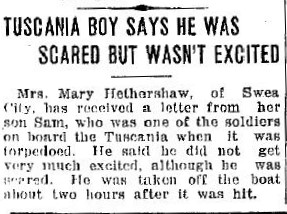
The S. S. Tuscania began its life in 1915 as an English luxury liner that accommodated 2,500 passengers plus crew.  It became a valuable asset to the British war effort in September of 1916 when it was requisitioned by the British Admiralty for war service as a troop transport.  Several successful crossings followed as the ship moved forces across the ocean.  On January 24, 1918, two Kossuth County boys, Sam Hethershaw from Swea City and Lewis Rist of Algona, boarded the ship in Hoboken, New Jersey, along with over 2,000 other troops bound for France.

The Sinking of the Tuscania - Kossuth County History Buff
1913 graduation photo
of Lewis Rist

Lewis came from deep roots in Kossuth County.  He was a descendant of Luther and Betsey Rist, very early settlers who were the grandparents of his father, Dr. Alfred Rist.  His mother, Mary Smith, was the daughter of Captain L.M.B. Smith, Civil War veteran and local hardware store owner.  Lewis was a member of 20th Engineers, Company E, Forestry Battalion.  His company was headed to Europe with lumber to be used for wartime needs including barracks, hospitals, bridges, defensive fortifications and even coffins.


The Sinking of the Tuscania - Kossuth County History Buff
Sam Hethershaw
Sam was born in Swea City, the son of William Hethershaw who died when the boy was 4 years old.  He was raised by his stepmother, Mary Hethershaw.  With a letter of consent from his stepmother in his pocket, Sam enlisted at the age of 17, one of the youngest volunteers from Kossuth County.  An article in the October 31, 1917 issue of the Upper Des Moines Republican telling of his enlistment described Sam as, “Full of ‘pep’ and a leader in the town’s mischief, nevertheless Sammy is as good and sound at heart as a Liberty bond of 1917.”  He became a member of the 158th Aero Squadron.  His talent with the trombone had won him a position in the American Air Service Band.  He also served as a bugler. 

The ship joined a convoy of troopships and freighters at Halifax, Nova Scotia, and proceeded toward her destination of Le Havre.  On February 4th eight British destroyers met the convoy to guide the ships between the cliffs of Scotland and the Irish coast.  Around 5 pm the next day, they entered the submarine zone just off the coast of Scotland.  All of the ships were on high alert due to the area in which they were sailing.  After sighting the convoy seven miles north of the Rathilin Island lighthouse, German submarine UB-77 quietly sliced its way through the choppy waters toward it without detection, despite the watchful eyes of 15 separate lookouts.  At 5:47 p.m., the German sub fired two torpedoes at the ship.  The first charge passed harmlessly by the Tuscania, but the second blew a hole in starboard side between the engines and the boiler room.  The ship began to rapidly take on water.

Passengers were scattered throughout vessel.  Lewis Rist was in the mess hall when the torpedo struck.  As lights flickered and eventually died, hundreds of soldiers made their way to their cabins to grab their life preservers and then back up to the deck for rescue. 

The Sinking of the Tuscania - Kossuth County History Buff
Algona Courier
February 7, 1918

Lewis later described the confusion that followed.  Efforts to lower lifeboats were disastrous in many cases due to the inexperience of the men.  Some boats were let down on others below, crushing those beneath it.  Others were let down so quickly that they were upset, throwing their passengers into the frigid water.  In some instances, men who did not know how else to get the boats loose, cut the ropes used to lower them to the water.  Men began jumping overboard and were soon overcome by hypothermia if they weren’t picked up quickly. 

Lewis did make it on to one of the lifeboats.  Tossed on the rough sea, the tide carried the leaking boat toward the rocky Irish coast.  The men watched in horror as three lifeboats washed up on the rocks, dumping their cargo into the sea to drown.  After floating for about six hours, the passengers on his boat were rescued by a minesweeper and taken to Ireland.

Sam stayed on the Tuscania, awaiting rescue.  After being picked up by a British destroyer, he was taken to the shore of County Donegal in Northern Ireland.  Two hundred and thirty-one Tuscania passengers lost their lives that day, including 17 from Sam’s company.

The Sinking of the Tuscania - Kossuth County History Buff
Picture of the sinking of the Tuscania
from Sam's personal scrapbook

Several days after the incident, Lewis wrote his parents sharing what he was allowed to about his experiences on that cold February night.  As a part of that letter, he stated:  “Have lived and seen much in the last two weeks that makes me take a more serious outlook on life.  Circumstances, events and environment have all left their impression upon me and I begin to realize as I never did before what we are up against.”

Lewis was stationed in England and then served in France.  At the end of his service, he sailed from Bordeaux, France on the ship Santa Paula on May 14, 1919 and arrived at Camp Merritt in Brooklyn, New York, on May 28, 1919.  Following the war he returned to college to finish his teaching degree. He was serving as superintendent of the Hannaford, North Dakota school system when he met and married Pearl Gaball, a teacher there. After serving as a school administrator at several schools in the Dakotas and Minnesota, Lewis became superintendent of the Eau Claire, Wisconsin school system. The couple had one child, Richard “Dick” Rist.  Dick was killed while serving in WWII.

The Sinking of the Tuscania - Kossuth County History Buff
Kossuth County Advance
March 17, 1918
Sam too was shipped to England following the Tuscania incident.  He spent the summer playing with the American Air Service Band including a six week tour which took him back to Ireland for several weeks.  During his service in Great Britain he stood honor guard for King George, Queen Mother Mary, and Prime Minister Lloyd George.  The band was waiting orders to move across the channel into France when the armistice was signed on November 11, 1918. 

Following the war, Sam became a barber in Swea City.  He was married twice, with a son being born to each union.  He belonged to the Tuscania Survivors Association and was a founding member of American Legion Fisher Post 14.  Music continued to be a big part of his life.  He played trombone in the town band, church orchestra, dance bands and the Estherville Drum & Bugle Corps.  He played taps at funerals.  The Swea City Centennial (1895-1995) book contains this paragraph about the old soldier.  “Although not as smooth or eloquent in later years as they once were, one could often hear the notes of an old World War I bugle as they walked down main street.  The sounds, filled with memories and love, drifted out the door of Sam Hethershaw’s barber shop.”


I invite you to visit the exhibit “WWI-Kossuth County Answers the Call” produced by the Kossuth County Genealogical Society which will be on display Nov. 4th-19th at the Algona Public Library during regular library hours and 1-4 on Sundays.

Until next time,

Jean 


If you enjoyed this post, please don’t forget to “like” and SHARE to Facebook.  Not a Facebook user?  Sign up with your email address in the box on the right to have each post sent directly to you.

Be sure to visit the KCHB Facebook page for more interesting info about the history of Kossuth County, Iowa.

Reminder:   The posts on Kossuth County History Buff are ©2015-2017 by Jean Kramer.  Please use the FB “share” feature instead of cutting/pasting.

Thursday, September 28, 2017

AN EXTRAORDINARY OBITUARY

I think anyone who is interested in family history will agree that one of the first things searched for is the obituary of an ancestor.  Although an obituary is only as good as the informant, it is usually a helpful source to learn a little about the decedent, his or her survivors and those who passed before them.  If you are truly lucky it will contain a birth date and the names of parents. 

Every now and then you find an extraordinary obituary which is almost a biography of the subject.  Such is the obituary of Eugenia Kennedy Rist Smith published in the Upper Des Moines Republican on October 27, 1909.  Although a little longer than a normal post, I had to share it with you in its entirety.


MRS. LEWIS H. SMITH

Pioneer Algona Lady Whose Death Last Week Is Deeply Mourned

Passing of a Good Woman

        After an illness of several weeks, Mrs. Lewis H. Smith passed into rest last Friday morning.  In her death Kossuth county loses one of the oldest woman settlers, Mrs. Tom Robinson, Mrs. C. Hackman, now living at Ortonville, Minnesota, with her children, and Mrs. Smith being the oldest survivors among the women who came to the county to impress their influence upon its development.  Members of the family had been summoned and all save three were present when the end came.  Mrs. Sam B. Baker of Tacoma, Washington, Dick Rist of North Yakima, Washington, and Mrs. Howard J. Wallace of Tooele, Utah, were unable to reach home before her going, though they arrived later in the week.


AN EXTRAORDINARY OBITUARY - kossuthistorybuff.blogspot.com

        The funeral was held Sunday afternoon in the Congregational church, of which Mrs. Smith was one of the charter members.  Rev. O.H. Holmes conducted the services.  Dr. Alf Rist, a nephew of Mrs. Smith, and Prof. Benjamin furnished the music.  Those of the family present from away were:  Mr. and Mrs. Henry B. Smith, Minneapolis; Mrs. S. B. Baker, Tacoma; Charles Rist, Lincoln, Neb.; Dick Rist, North Yakima, Washington; Mr. and Mrs. George R. Horton, Chicago; Mrs. H. J. Wallace, Tooele, Utah; Earl Humlong, Minneapolis; Alonzo L. Kennedy, Des Moines.
        The church was filled with friends of the family, the old settlers, in particular, being present in numbers.  The services were preceded by a short service at the home for the members of the immediate family.  Interment was at Riverview cemetery.
        Gastritis was the cause of death.  Mrs. Smith spent several weeks in August visiting in Chicago, but has not been well since she returned.  She grew weaker very slowly and for almost a week before she died was unconscious most of the time.  Because of her inability to take sufficient nourishment her strength gradually was sapped and she slept her life away entirely free from the pain which was present earlier in her illness.
***
        Eugenia Kennedy Smith was born October 23, 1835, in Whitinsville, Massachusetts, a village near Boston, then a quiet country town, today a manufacturing center.  She came of Puritan stock and carried with her through life those high ideals which were inborn.  That sterner quality of Puritanism which knows little of tolerance, she did not have.  She was tolerant of others in a marked degree.  None was ever turned from her doors though in the early days, in the new western home, actual want was not always far from the cabin in which she lived.  Through her life she clung closely to those ideals which were instilled in the New England home, though her idea of right and justice was ever tempered for others.
        It was not her privilege to have other than the common school education.  The great cotton industry was in its infancy and the mills were springing up in the villages about Boston.  The place where she lived had a mill, and the looms afforded a convenient income to the children of the community.  With others of her family she worked in the factory, many of her spare moments being spent, however, in the garden at home where blossomed the sweet, old-fashioned flowers of which she never tired.  When she went to the Rose Garden in Jackson Park a few days before she left Chicago, in August, she renewed her acquaintance with some of the flowers she had known in the home at Whitinsville, and they brought to her the memory of the days when her mother taught the love of growing things—of “good in everything.”
***


AN EXTRAORDINARY OBITUARY - kossuthistorybuff.blogspot.com

        On August 23, 1954, she was married to Francis C. Rist, a brother of Sylvester S. Rist.  They decided to make their home in the west and in 1855 the husband left Whitinsville for Iowa.  A year later, in 1856, making the trip from Dubuque in a stage, the wife came to Kossuth county.  They took up their claim south of town on the farm where Alonzo E. Kennedy lived for so many years.  The original log cabin was not built where the present house stands.  It was farther down the road, about half way to the old Paine house, where the site still may be seen in the edge of the woods.  There was a cabin on the Rist place where the father-in-law lived while on the town site of Algona stood the “Bachelors’ Hall,” the Call cabin and one or two others scattered through the woods.  Across the river was the cabin where the Brown family lived.  The rest was unbroken prairie and virgin forest.
        Only those who have suffered the privations and the peril of pioneer life can appreciate what the first winter in Iowa was to the woman who came from one of the suburbs of Boston.  “If we had only known,” Mrs. Smith often said, “if we had only known enough to build our cabin back in the woods where we might have dug into a side hill and been protected, we might have been so comfortable.”  But they did not know, these two, and the cabin was built in the open on the edge of the woods overlooking the prairie.  The winter came as only Iowa winters came in those early days, bringing with it untold suffering.  Mr. Rist, the husband, drove a stage between Algona and Fort Dodge.  Two or three days each week he was away, and in addition to the other suffering was the constant, unspeakable dread of Indians, added to the homesickness which gnawed at the heart in those fearful days.
        Wood there was to burn, of course, and a stove in which to burn it, but the little woman from Boston found it difficult indeed even to keep herself and baby from freezing, to say nothing of keeping comfortable.  “We kept on all our wraps as we worked in the room,” she said as she talked of the early days.  “I wore continually all the outer wraps I could find and still we were cold.  I have sat with my feet on the rail of our little stove while my heels nearly froze.  The wind swept over the prairies and through the walls of our cabin as though there were nothing to keep it back.”


AN EXTRAORDINARY OBITUARY - kossuthistorybuff.blogspot.com

        While her husband was away his father was a frequent visitor at the home and did his best to keep the wife and baby comfortable.  Many times she abandoned her home entirely and went to stay with the older people in the cabin, which was a center for the settlers south of town.  Night after night, too the settlers crowded into the “Father” Rist cabin, haunted by a terrible fear of Indians.  Many were the alarms and many were the days and nights of suffering as they waited for the dreaded visits.
        But out of it all they had their fun, and even incidents which seemed grave enough at the time game them sport.  “One night as we were all in the Father Rist cabin waiting for the Indians, we heard very strange noises outside.  The men waited with rifles in hand because we thought the Indians had surely come,” she said.  “The noises continued but they seemed to come nearer, and finally the suspense was so great that my husband declared that he was going out to find out whether the Indians were there or not.  So he and another slipped away into the darkness.  We all expected to hear the war whoops, but in a moment we heard them laugh and shout for us to come.  We streamed out and found the cattle had gotten out of the barn and the noises were coming from them.  We had no Indians that night.”
         As others of the pioneers came into the county more social life became possible.  They were rare souls, those pioneers, ready with heart and hand to welcome a newcomer, quick with sympathy to those in trouble, and happy and full of cheer in spite of their vicissitudes.
        They were great visitors, and one description of a drive taken by the young couple never failed to furnish amusement to those who loved to listen as Mrs. Smith told of the early days in Algona.  “We hitched the cattle (oxen) to a stone boat one afternoon and my husband put a chair on the boat.  Then we drove off as comfortable as you please to visit some people across the river, I with my baby in my arms and he walking along beside the cattle.”  It is a picture that will not fade from the memory of those who caught the spirit of that ride from the white-haired woman that told it like the queen she was, riding forth in her chariot.
        Father Taylor came in those years and shortly came his daughter Harriet, known to most of the younger Algonians as Mrs. J. E. Stacy.  And how thoroughly appreciated were these new comers!  What an addition they made to the little settlement!
        “I will never forget the first day I saw Harriet,” said Mrs. Smith.  “She came right from the East, and to our eyes, which had long been unaccustomed to eastern things, she seemed to have stepped right out of a picture.  She came to church on Sunday morning with her father and we were all so glad to see her.  I remember just how she was dressed because we were all so far behind the fashions that every change was noted.  That Sunday was in 1857, and Mrs. Stacy, then Miss Taylor, had arrived only the previous day.”
        Father Taylor, “his head white as the almond blossoms,” he of “the mild, grey eye, gentle voice, alert motion and unbent form,” had joined the settlers the year before and none was more active in his assistance than Mrs. Smith.
        A year after Mrs. Stacy came the Congregational church was founded.  Mrs. Smith, Mrs. Stacy, Mr. and Mrs. George D. Wheeler and Father Taylor were the charter members.  Of the five only Mrs. Stacy now is left.  Through many years Mrs. Smith has labored in the church and in the society.  In no other institution did she take such deep interest as in its welfare.  She was a constant attendant through adversity and prosperity.  Her loss will fall heavily upon the society with which she has been so intimately connected for the past fifty years.
***
        This social life of which the church played a considerable part, brought these pioneers together more closely than it is possible as we live today.  In the grove near the Free Methodist church was a favorite picnic ground, and one Fourth of July celebration held there was always a source of enjoyment.  The settlers gathered and spread out their lunch under the oaks.  Then women, men and children went to the town to join in the procession to march to the grounds.  Astride a large horse rode the marshall of the parade bedecked in a great scarlet scarf which streamed behind him as he galloped up and down the line.  “There wasn’t a soul to watch us as we were all in the parade,” said Mrs. Smith.  “But we marched bravely down to the picnic grounds, the marshall shouting his commands from his horse.  But when we got there he found no words military enough to disperse us.  So rising in his stirrups he cried:  ‘We are a-goin’ for to go to the tables.’  And we went.”
        Of such incidents her remarkable memory was filled.  They were burned in her mind and softened by the years which intervened they came to her pleasurably enough and relating them she delighted her friends.
***
        Five children were born into the family, three of whom are still living, Charles W., Hiram Edwin and Dick Rist.  But in 1873 (KCHB note: actually 1872), on Washington’s birthday, the father died.


AN EXTRAORDINARY OBITUARY - kossuthistorybuff.blogspot.com
Lewis Smith
        Another member of this pioneer colony, one of the first “bachelors” in fact, was Lewis H. Smith, now the oldest survivor of the settlers on Algona townsite.  He was also from Boston and a friend of the Rist family.  He married Abbie L. Rist, a sister of Francis Rist, and three children, Mary, now Mrs. H. B. Smith of Minneapolis; Nellie E., now Mrs. S. B. Baker of Tacoma; and Annie S., Mrs. W. H. Kennedy, now survive of that family.  Mrs. Abbie Rist Smith died before her brother, Francis C. Rist, was taken, and December 8, 1872, the marriage occurred of Mr. Smith and Mrs. Rist.  Three children came to this union, Mabel Francis, (Mrs. George R. Horton), Rubie Evans (Mrs. Howard J. Wallace), and Hortense Morgan Smith, who lives at the home in Algona.
        Only the immediate members of the family can know with what infinite tact and patience the mother brought into this family a wonderful, enduring happiness—and of the devotion which repaid this faithful service.


AN EXTRAORDINARY OBITUARY - kossuthistorybuff.blogspot.com
L to R:  Ed Rist, Mary Smith, Fannie Smith, Eugenia, 
Dick Rist, Charles Rist, Nellie Smith and Ed Smith
Photo taken shortly after marriage of Lewis Smith and Eugenia Rist

        Mrs. Smith was a member of the Eastern Star order, the Women’s Relief Corps and the Library Aid Society, to all of which she gave freely of her time.
***
        Though few outside her family have known it, Mrs. Smith for a number of years has been a sufferer from pain which medical skill seemed powerless to counteract.  This pain she had borne with such patience that her work in the home and in the societies of which she was a member was never neglected until within the past month.


AN EXTRAORDINARY OBITUARY - kossuthistorybuff.blogspot.com
The Lewis Smith home
        The malady which caused Mrs. Smith’s death seized her late in August.  All through September she fought against its ravages but without avail.  Relief from pain came only with an advanced stage of the disease, but it was a relief which brought sleep.  Through the last days she awakened at intervals which became rarer as time wore on.  She smiled and joked with the children.  She seemed to believe that she would stay with the family that worshipped her.
        But on Friday morning she was at rest.  The members of the family who were in Algona were with her.  On Saturday she would have been 74 year old—years that brought to her a happiness which comes to those rare souls who have so lived that there is nothing that may be spoken of them but words of good and love and tenderness.    


An extraordinary obituary about a remarkable life.  May she continue to rest in peace.

Until next time,

Jean


If you enjoyed this post, please don’t forget to “like” and SHARE to Facebook.  Not a Facebook user?  Sign up with your email address in the box on the right to have each post sent directly to you.

Be sure to visit the KCHB Facebook page for more interesting info about the history of Kossuth County, Iowa.


Reminder:   The posts on Kossuth County History Buff at ©2015-2017 by Jean Kramer.  Please use the FB “share” feature instead of cutting/pasting.