Showing posts with label Civil War. Show all posts

Saturday, March 10, 2018

SAVING THE MUSEUM


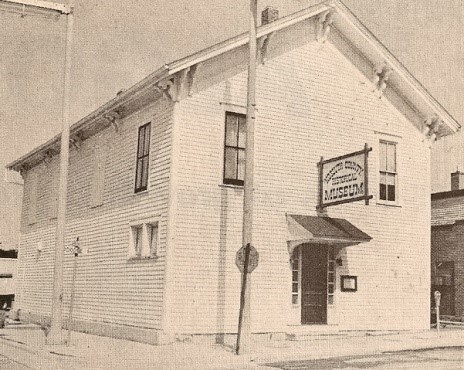
A few years ago I served a term on the board of the Kossuth County Historical Society.  One of our main concerns was the condition of the foundation of the main museum building.  The foundation dates back to 1887 when it was moved to its present location and it shows every bit of the wear and tear of those 130 years.  Large cracks, leaks and settling have compromised the entire structure.  The basement itself was never fully excavated adding to its problems. 

The museum building is located on Dodge Street which is being reconstructed by the City of Algona in 2018.  This street project will involve the removal of all sidewalks in the area.  Putting a new basement under the building will also involve removal of sidewalks, so it is a very appropriate time to give this grand building a new foundation.  Of course any project of this nature is expensive and a fundraising campaign is underway.    

The other day I came across an article I wrote for the 2013 autumn newsletter for the historical society.  We had just begun to raise funds with the hope of restoring the building to its original glory.  One day as I worked in the museum, I began to wonder what it would say if the walls could talk.  I was inspired to write a letter to Santa and although it is not the Christmas season, I hope its sentiments might inspire you as well.


Dear Santa:

It has been a while since you heard from me.  The last 20 years or so, although I have tried to be a good building, it seemed as though I had been forgotten.  Occasionally I would feel someone walking across my floors, but no one stayed for long.  Eventually my furnace was shut off and I was left dark and alone, a far cry from where I began.

Saving The Museum - kossuthhistorybuff.blogspot.com

Do you remember the first time you came to see me?  As I recall it was near Christmas in 1867.  Of course, I knew you as St. Nick back then.  I was the brand-spanking new school filled with young minds ready to learn.  As the holidays approached, the children worked for weeks preparing a program for their families.  When the big evening arrived, parents’ buttons were popping with pride as they watched their students (even though some were shaking as they stood to do their recitations and needed a little prompting from teacher).  Everyone joined in to sing the old Christmas hymns with gusto.  My rafters rang with music and laughter that evening.  And when you arrived at the close of the program and handed out gifts—well, let’s just say that my windows got a little foggy with happiness.

Saving The Museum - kossuthhistorybuff.blogspot.com

Time has a habit of moving on and soon a larger schoolhouse was needed.  I was worried what might happen to me but after Central school was erected, I was moved from that location to my permanent home here at 122 South Dodge.  Throughout the years you continued to visit me, Santa, as I served the community in many different ways.  The first library was located within my walls and I hosted services for the Methodists while they were building their church.  Later I was honored to be chosen as the home for the Grand Army of the Republic and the Women’s Relief Corps.  Oh, the stories those veterans told!  They were such brave men and generous to a fault.  They adopted your spirit and helped many families at Christmas with food and gifts for the youngsters.  I know you remember Santa because you helped with their cause.  My service to our area veterans continued as I was passed from the G.A.R. to the American Legion.  The lights from my windows guided you to many a Christmas party during those times as well.

Saving The Museum - kossuthhistorybuff.blogspot.com

By 1967 I was 100 years old, an age when most buildings have been laid to rest.  My outsides had undergone many changes, but my bones were still strong.  Many of the stately homes and business buildings of my early memory were gone.  The American Legion had moved to a more modern building and so I thought my days were coming to an end.  But to my astonishment, a new adventure awaited me.  An enterprising group of citizens who believed in preserving the past decided to purchase me.  A bright new sign was hung outside telling the world I was the “Kossuth County Historical Museum.”  They filled me up to the brim with interesting artifacts and historical information.  The hum of activity over the next few years just did my heart good.  Best of all, the children were back—I felt young again!
Saving The Museum - kossuthhistorybuff.blogspot.com

But then Santa, things changed.  The wonderful citizens who saved me passed on and no one came along to take their place.  Although a skeleton crew kept me from the wrecking ball, I kept wondering why did no one care? What will become of me and all the treasures that I hold?  I stood silently waiting for an answer. 

Two years ago about this time, I woke up with a start when I once again felt footsteps across my floor.  I thought I heard voices say it was important that I be opened again to the public.  Could I be?  I had to clean the dust out of my windowsills so I could hear more clearly.  It was true!  Another generation wants me to live again.

My new friends have been working so hard.  Through their fundraising efforts and generous contributors I have heat and air conditioning.  They have moved all of the photographs and documents that I held to the second floor of my sister, the Wells Fargo building, and created a document storage/research center.  Two very special people, Phil and RosaLee, have given me so much tender loving care—cleaning, painting and repairing—helping to make me ready for visitors.  With rearranged displays, I am becoming quite handsome once again.  My list of friends continues to grow as new members join and in next year’s Christmas letter I will be able to tell you that I am on the National Register of Historic Places. 

Saving The Museum - kossuthhistorybuff.blogspot.com

And so Santa we come to the reason for my letter to you.  Although I am still strong and sturdy, arthritis has attacked my foundation and it is cracked and deteriorating.  I may be old, but I still have an important job to do and need a good foundation to stand on.  It has been a long time since I asked you for anything Santa, but I know that with your encouragement your elves would come forward to help in my hour of need. 

Thanks to my new friends, I believe in the future again.  So, dear St. Nick, please spread the word that there is a fundraising drive to raise enough funds to take care of me.  A donation of any size would be welcome.  In fact I have a new mailbox all ready for the mailman to fill with contributions and membership applications.  Once I have my new foundation, I will be ready to serve as proudly as the veterans who used me for so many years. 

Saving The Museum - kossuthhistorybuff.blogspot.com

Thank you Santa and Merry Christmas to you!

Kossuth County Historical Museum


I hope you will consider a contribution to this very worthwhile project.

Until next time,

Jean

Sunday, February 5, 2017

CHARLES E. PUTNAM, EARLY PIONEER

Charles E. Putnam was an early pioneer of Kossuth County and although he did not remain a citizen for long, he spent three enjoyable years living with W. H. Ingham, Andrew Seeley, and Thomas Covell in the Ingham cabin along Black Cat Creek.  Putnam was born in New Hampshire in 1839 and moved with his parents to Cedar Rapids when he was 15 years old.  The very next year, 1855, he accompanied Covell on an expedition to Kossuth County where he remained, enjoying frontier life—hunting, fishing and living off the land.

In 1897 he responded to a request by Harvey Ingham to share his memories of an Indian encampment in the county in the summer of 1855.  His response was published in the Upper Des Moines June 16, 1897 and was later included in Harvey’s book, Old Indian Days.  Putnam recounts those carefree days as follows:

CHARLES E PUTNAM, EARLY PIONEER - kossuthhistorybuff.blogspot.com

       “Since receiving your letter of recent date, asking about the movement of Indians in your county in the summer of 1855, I have endeavored to recall some of the incidents of my life as a pioneer of Kossuth county.  While I have an indistinct recollection of a party of Indians camping on, or near Plum Creek during the fall of 1855, the event is not clear enough in my mind to give any particulars, for which you asked.

        “I think it was that fall that a band of Sioux came down from Minnesota, and deploying to cover as much territory as possible, made a wide detour through Kossuth county, driving all the large game ahead of them, expecting to round it up in southern Minnesota that they might have game all winter.  They went around Algona, and about three or four miles southeast of town killed a buffalo.  That night they built a large bonfire, and called in all the braves; feasting, dancing, and pow-wowing being indulged in the greatest part of the night.  I think that they remained the next day to give the squaws time to “jerk” the meat.  If Mr. King (David King) is still with you he can tell who the parties were that visited the Indians and ordered them to leave the county, and let the game remain; and he can also tell how near he came to being a charge upon the county, when, the next day, he came upon two Indians carrying off all the provisions in his cabin.

        “It will be forty-two years on May 8 since I landed at the little old cabin, built by your father (William Ingham) and Mr. Seeley (A. L. Seeley) on the Black Cat.  And while my life has seen many varied years since, I think those three on the frontier were the happiest, because of youth, and the absence of all care and responsibility.  When I recall the years so long ago, the memory of the incidents of that life so fills my mind that it would, with elaboration, fill a book.  But it is the memory of the home-life in that little cabin which remains most distinctly in my mind.  And while, of course, I remember in general the movements of the Indians and the events which transpired, I was too young to appreciate the fact that we were making history.

        “The winter of ’55 Covell came to Cedar Rapids for provisions, and when he returned with the supply of winter stores there was a banquet at the Ingham cabin.  Covers were laid for four:  Ingham, Seeley, Covell, and myself.  Delmonico never spread such a feast; oysters and crackers, sardines and cheese, corn bread with butter, and after all cigars.  Could mortal man want more, especially after having tasted nothing for three weeks but parched corn, ground in a coffee mill, and made into something we called bread?  About midnight, while the meal was still in progress, being the kid, I was requested to go for a pail of water.  As I approached the well—a hole in the ground a few rods from the cabin—my hair bristled at the sounds of distress which came from the well.  I rushed back to the cabin with the news that somebody was drowning.  An adjournment was quickly declared, four would-be heroes going forth to the rescue.  After an hour of very damp and slippery labor, strong arms had raised Nellie, the pet elk—and the baby of our household—from what might have been a watery grave.  She was taken to the cabin fire, and, by vigorous rubbing, her life was saved, only to end in a violent death the next fall.

CHARLES E PUTNAM, EARLY PIONEER - kossuthhistorybuff.blogspot.com


        “Although Seeley was the acknowledged chef of the Ingham hostelry, by a flash of culinary inspiration I made a gooseberry pie that spring which was the beginning of Seeley’s downfall.  After that triumph my wits turned kitchenward and I was forever seeking new dishes in that land of wild meat and cornbread.  One day I went down to the settlement and discovered Smith (Lewis H. Smith) making doughnuts.  Could it be another Richard had come onto the field!  I beheld my new laurels tremble—I must make doughnuts.  I started home formulating a recipe in my mind; it was certain that flour was the basis; then the fat in which they were fried would make them short; then something to make them light; molasses would furnish the sweetening; and a little cream of tartar coming in contact with the molasses would create an effervescence, and surely the deed was done.  Luckily, no one was in the cabin when I got home, and I set at once to work on my doughy problem. It was the work of a few minutes to have the twisted beauties in the skillet of hot lard, but they never grew light nor brown.  They were still pure and white and tough when in despair I buried them in the ravine behind the hill.  I found out the next day that saleratus or yeast was the missing quantity that would have made them light, and all that could be desired.  The remains of that first batch, I have no doubt, may still be found in the deep ravine back of the old cabin.  And when the future scientist explores the hills and valleys of old Black Cat he will undoubtedly discover fragmentary ore that will trouble him to classify, or to tell whether it belongs to the Paleozoic or to the Tertiary period.

        “Craw and Linderman, who had built a cabin over on the East Fork, about two miles from the Ingham claim, occasionally made us a call, when we would send them home laden with game or fish to enrich their scanty larder.  It was early in June when we told them if they would come over some night we would give them all the fish that they could carry home. They responded one moonlight evening when the fish were “running” well.  We all went down to the ford a few rods above the mouth of the creek.  The water at the ford was shallow, and it was difficult for the larger fish to pass over it.  Craw and Linderman were told to take off their boots, roll their pants, and wade to the middle of the creek at the ford, while Seeley and myself went below to drive the fish up stream.  Armed with sticks we went where the water was deep, and started toward the expectant fishermen, striking the water with our sticks, driving everything before us.  When the school of fish, many of them so large that they were half out of the water, came to the ford, Craw and Linderman began the slaughter.  Grabbing them with their hands they excitedly threw them to the banks.  Ingham, who laughed from a safe shelter, afterwards declared that they threw the fish eighty feet in the air.  We continued to thrash the water until we had nearly drowned the poor fellows.  Then with their fish strung on withes and hanging from a pole, the happy fisherman, drenched to the skin started home.  And I was afterwards told that they had fresh fish, and fish not so fresh, all summer.

        “Poor Craw, I wonder in what vineyard he is working now.  He was of a very religious turn of mind, guileless and innocent of the world as a child.  Once when he complained of the unreliability of the weather prognostications of Ayer’s almanac, and was told that he must not expect correct predictions of the weather in a country that had not been surveyed, he accepted the explanation as good logic, and was never heard to criticize the weather man again.”


At the end of his stay here, Putnam moved back to his father’s farm west of Cedar Rapids.  He taught school while attending Western college until the Civil War broke out.  He enlisted in Company G. Thirteenth Iowa infantry in September of 1861 and served with honor until he was mustered out November 2, 1864, having attained the rank of Captain. An article giving a sketch of his successful career was published in the Cedar Rapids Evening Gazette in 1892 and contained the following tribute:

        “Captain Putnam was a brave and gallant soldier.  He participated in all the battles and campaigns of the army of Tennessee from Shiloh to Atlanta.  He especially distinguished himself Oct. 3, 1862, at the battle of Corinth and in the official report was particularly mentioned for his fearless service.  He was right in the hottest of the fight and his enthusiasm and thoughtlessness of self did much toward keeping up the spirits of his men.  In the battle of Atlanta the 13th Iowa was in the thickest of that baptism of blood which lasted from noon until 7 o’clock, June 22, 1864, and out of 427 men present for duty, 247 were killed or missing.  During these seven hours Captain Putnam fought bravely.  He was in the midst of the carnage, losing both his lieutenants, and out of the 42 men who entered the battle but nine were left to answer at roll call.  The balance, except four who were captured, were either killed or wounded.  Company G also distinguished itself at Shiloh and Vicksburg.  The regiment marched through Georgia to the sea, and was the first to enter Columbia, S. C., and their colors were the first to wave over the old southern capitol.

        “Captain Putnam was considered a fine officer, was a strict disciplinarian and loved by his men.  By his manly, soldierly qualities he won their hearts and always has retained their respect and friendship.”

After the war, Putnam ran a mercantile for a few years and then was elected Linn County recorder where he served four terms.  He then became cashier at Merchants’ National Bank where he was employed for many years until being appointed a state bank examiner.

He married Mary A. Fawcett on March 29, 1864 while home on furlough from the army.  Three children were born to the couple, two of whom survived to adulthood.  Captain Putnam passed away May 23, 1913, at his home in Cedar Rapids after a long battle with heart disease.  His funeral was held on the lawn of his residence with the minister speaking from the front porch, and his body was then interred in Oak Hill Cemetery.  

I think you would agree that an outdoor funeral seems a fitting tribute to the young teen who so enjoyed his three years living the frontier life on the prairies of Kossuth County.  

Until next time,

KC History Buff


If you enjoyed this post, please don’t forget to “like” and SHARE to Facebook.  Not a Facebook user?  Sign up with your email address in the box on the right to have each post sent directly to you.

Be sure to visit the KCHB Facebook page for more interesting info about the history of Kossuth County, Iowa.


Reminder:  The posts on Kossuth County History Buff are ©2015-17 by Jean Kramer.  Please use the FB “share” feature instead of cutting/pasting.

Thursday, December 1, 2016

THE PICTURESQUE SIMPKINS HOUSE

One of the most distinctive homes of its day is located at 504 East McGregor in Algona.  It is another of the houses featured in the book “Picturesque Algona.”  Most recently it has served as an apartment house, but at the time of construction, it was considered a “model of architecture and an ornament to that part of our growing young city.”

The owner at the time of publication of “Picturesque Algona” in 1900 was George Simpkins and his wife, Hulda.  They had purchased the home in 1889 when they retired from the farm. 

THE VAUGHN FAMILY


The Picturesque Simpkins House - kossuthhistorybuff.blogspot.com
The house itself began its life in 1884 when it was built by attorney H.S. Vaughn and his spouse, Ella.  Harrison Samuel Vaughn had been born in New York State in 1846.  He enlisted in Company A of the 8th New York Heavy Artillery, completing his service as a Colonel, but not before losing his right arm at the battle of Cold Harbor.  After receiving an honorable discharge from the army, Harrison went to law school at Wisconsin State University.  He came to Algona in 1870 and hung out his shingle.  The 24 year old was soon busy building his reputation as a litigator.

Vaughn’s personal life was blossoming as well.  In 1872 he married Maine native, Ella Delano, and their lives were soon filled with a growing family.  First daughter Mary Winifred was born later that year, followed by sons, Sidney, in 1876, and Harold in 1882.  With three children, it was definitely a busy household.  The young couple also enjoyed entertaining and often hosted gatherings including ice cream socials to raise funds for the Ladies’ Aid Society of the M.E. Church.

By 1884, it was time for a larger house.  Construction began soon after the Vaughns purchased the lots.  The new residence was described as 26 x 40 foot with 20 foot posts.  The cost of creation was estimated at $3,000.  The family moved in to their new dwelling in October, just in time for the birth of daughter, Florence, on December 20th.  One more son, Courtland, would join the family in 1888.  The home was filled with the noise of their busy, bustling clan.

They were busy in the community too.  Harrison served one term as county auditor, helped to organize the Northern Iowa Normal School and served as president of its board, was on the committee to bring the Iowa Central railroad to Algona, and was a member of both the local G.A.R. post and the Odd Fellows’ Lodge.  It was a true loss to the community when the family decided to move to Denver, Colorado in 1889.  A farewell banquet was held at the Thorington Hotel in their honor, a silver berry dish was presented to Ella by her friends as a token of remembrance, and her Sunday school class from the Methodist Church (which consisted of all young men), arranged to have their photo taken with her at the Hudson & Shadle Photography Studio.

The house next passed to Charles Dexter who, it appears, never lived in the house.  Within a few months of purchase, he rented the house to George Simpkins who desired to rent for a year before purchasing.  He and his wife would go on to reside there for 10 years.

THE SIMPKINS FAMILY


George Simpkins was born in England and traveled with this parents to Wisconsin at the age of 7.  The journey was indeed precarious.  The drunken captain caused a shipwreck while on Lake Ontario and the family lost all of its worldly goods.  Devastated by this loss, the seven children went without shoes and had very little clothing the first winter spent in Wisconsin.  All of the children who were old enough were required to work to help support the family and at a young age George got a job on a farm.  While oiling a threshing machine, his clothing became entangled and he was pulled into the contraption, severing his left arm above the elbow.  Much like Harrison Vaughn, he would never let his disability hamper his future.

On July 4, 1864 he was married to Huldah Peck in Madison, Wisconsin and they moved to Kossuth County seven years later, settling in Union Township.  They went on to acquire 400 acres of land and built a large cattle operation despite the devastation caused by the grasshopper plague in 1872-73.  The couple had four children:  Henry, Nellie and Nettie who reached adulthood and little Charlie who died in infancy. 

The family was very active in the Baptist church.  George served on the building committee in 1892 when a new church was constructed and Huldah was active in its women’s group.  George was also an enthusiastic member of the Odd Fellows for 25 years. 

After spending almost 20 years on the farm, the couple moved into the Vaughn house on McGregor Street.  They enjoyed living in the beautiful home.  Unfortunately, by 1900 Huldah’s health began to fail.  It was recommended that she move to California in the hope that the moderate temperatures would be improve her situation.  By the time the book “Picturesque Algona” was actually published, the Simpkins had sold the house to E.J. Gilmore and left for California.  The move proved to be successful.  The Simpkins enjoyed their years there until Huldah’s passing in October of 1919.  After her death, George wintered in California and came back to Algona in the summer to spend time with their daughter, Mrs. Hugh Herman, until he died in December of 1923.

THE GILMORE FAMILY


Edwin J. Gilmore had come to Kossuth County from Illinois in 1881 with his parents, settling on a farm in Riverdale township.  He married Minnie Smith in 1884 and they farmed together for a few years.  In 1888 they came to Algona where E.J. opened a grocery store.  The turn of the century was indeed an eventful time for the Gilmores.  Besides purchasing the large attractive new home, Gilmore sold his store and opened a real estate and insurance agency in partnership with his friend, Archie Hutchison. 

Ed and Minnie were described as “staunch” members of the Methodist Church in Algona where Ed served for decades on the board of trustees, had served as church treasurer for many years and also was on the committee when the present church was constructed. Minnie participated in all activities of the congregation wherever she was needed.

The two had one child, Harold Gilmore, and two very loved grandchildren, Edwin and Mary Louise. 

The Gilmores spent the rest of their married life together in the home on McGregor Street until E.J.’s passing in 1939.   Minnie moved to a smaller cottage on South Minnesota Street where she died in her sleep in December of 1950.


The Picturesque Simpkins House - kossuthhistorybuff.blogspot.com
The house in 2016


As I research these stories there often appears one or two facts or incidents that pull at my heartstrings.  In this particular situation, I find it interesting that this home served two men with devastating disabilities—the first who lost his right arm in battle to preserve our union and the second who lost his left arm working as a child to build a better future for his family.  The lives they went on to lead are a testament to their courage and resilience. The house itself has had many other residents since their day and will likely serve many more in the future, but none more remarkable than Vaughn and Simpkins.

Until next time,

Jean


If you enjoyed this post, please don’t forget to “like” and SHARE to Facebook.  Not a Facebook user?  Sign up with your email address in the box on the right to have each post sent directly to you.

Be sure to visit the KCHB Facebook page for more interesting info about the history of Kossuth County, Iowa.

Reminder:  The posts on Kossuth County History Buff are ©2015-16 by Jean Kramer.  Please use the FB “share” feature instead of cutting/pasting.

Thursday, April 28, 2016

THE PICTURESQUE DODGE HOUSE

One of the houses featured in “Picturesque Algona” was the residence of Captain Dana D. Dodge at 721 East McGregor.  This history of this house is somewhat baffling as information gathered does not seem to point to the fact that the house belonged to Captain Dodge in 1900 when “Picturesque Algona” was printed.

The Picturesque Dodge House - kossuthhistorybuff.blogspot.comIt appears the house was actually built by Maggie Wartman who purchased the property in 1894.  Mrs. Wartman took quite a circuitous route to get to Algona.  Born at Newberg, Ontario, Canada, she came to Newton County, Indiana with her husband in 1865.  By the fall of 1880, they had moved near Hardy in Humboldt County, Iowa.  From there they moved to LuVerne and opened a mercantile which they ran for several years.  For a short time they moved to Marshalltown after which they finally came to Algona, purchasing the property in question. 

The obituary of Mrs. Wartman printed in 1908 states that they built the “cozy residence now occupied by Capt. and Mrs. D. D. Dodge.”  However, this is where the history of the house gets a little foggy.   The obituary goes on to intimate that the Wartmans were living in the house at the time her husband died in 1904.  Real estate transfer records show that Mrs. Wartman deeded the house to Captain Dodge in the same year.  I have been unable to find any confirmation of death of a Mr. Wartmen during that year in Algona.  So, were the Dodges dwelling there in 1900 when “Picturesque Algona” was printed?  I guess there is no way to confirm that one way or the other, but they must have had some connection to it to have it identified as their home in the book.  Perhaps the Dodges were renting the residence and ended up buying it a few years later.

CAPTAIN AND MRS. D.D. DODGE

The Picturesque Dodge House - kossuthhistorybuff.blogspot.com
Capt. D.D. Dodge
Photo from Find-A-Grave
Dana and Lydia Dodge also took a meandering route to Algona.  Captain Dodge was born in Tunbridge, Vermont.  He was married to Lydia Curtis on May 26, 1855 in Illinois.  The new Mrs. Dodge was born in Rome, New York, where she grew up.  When she was 20 years old, she had moved with her parents to Aurora, Illinois.  She and the captain were married the next year.

After five years in Illinois, the young family moved to Janesville, Wisconsin.  When the war between the states erupted, Dana heard the call to serve so he left his wife and children and enlisted in Company D, Second Wisconsin Infantry as a second lieutenant.  Eventually he rose to the rank of captain, but he suffered a sunstroke at the first Battle of Bull Run and had to resign his commission in early 1862.  Returning to his family, they moved to Minneapolis where they resided until 1875 when they moved to Kossuth County, settling on a farm near Irvington.

Retiring from farm life in 1892, the couple moved to Algona.  They were already well known in the area.  Captain Dodge had been an active member of the G.A.R. and the Knights of Pythias for many years.  In his retirement he served as president of the fair board.  Lydia was a valued friend and neighbor who was a faithful servant to her church and the Women’s Relief Corps.

On the occasion of their golden wedding anniversary, a large group of friends
The Picturesque Dodge House - kossuthhistorybuff.blogspot.com
Lydia Curtis Dodge
Photo from Find-A-Grave
gathered at the couple’s home.  The G.A.R. and the Women’s Relief Corps presented Capt. and Mrs. Dodge with elegant gold pins bearing the emblems of the two organizations.  The Knights of Pythias presented a gold headed cane to the captain and a gold handled umbrella to Mrs. Dodge.  Many other fine gifts were given by family and friends including a string of gold beads that had belonged to the grandmother of Mrs. Dodge, which she had not seen for fifty years.  Local attorney Timothy Harrington made the presentations and Capt. Dodge expressed their thanks, but was almost too overcome to do so.

The Dodges continued to live in the house until Dana passed away in 1913.  In his obituary published in the Kossuth County Advance on April 16, 1913, Captain Dodge was described as “a sturdy type of citizen whom everybody respected.  He was big in body and must have been a very handsome man in his prime.  He had a soldierly bearing which he maintained until the last.  His voice was heavy but kind.  He loved his close friends and was by them in turn beloved.  Nothing pleased the Knights of Pythias better in his later years then to have him present at a meeting of the lodge.  On these rare occasions he shook off his years and was again a boy with the boys.  When he was 83 or 84 years of age he would still meet with them to enjoy special events, and none stood more erect than he when the Chancellor Commander’s gavel rapped out an order to arise.  When the meeting was over he would stalk off through the dark to his home, scorning all offers of company unless someone happened to be going his way.  He was a fine, self reliant old man, a true Knight and a brave gentleman.”

A few years before her death, on the occasion of her 75th birthday, twenty-five of Lydia’s closest friends came to the house to surprise her.  The house rang with merriment as the guests reminisced and shared their memories of years past.  A special poem written especially for Lydia by Caroline Ingham was presented to her.  It was published in the Upper Des Moines-Republican on March 17, 1909, and reads as follows:

Backward, turn backward, O Time in your flight,
Make me a child again, just for tonight.”

Why turn backward to the things that are lost?
What if the golden hair is tinged with the frost?
What if the eyes that once sparkled are dim?
The true life undaunted is all radiant within.

The hope that outlasts the storm’s rigor of years;
The love that knows nothing of failure and fears;
The joy that soars up as the bird on the wing
And finds its true home where the glorified sing.

O the peace that comes gently to those who obey;
Who walk in the spirit with God all the way;
Who let go the earth-chords without murmur or sigh,
When the vision grows brighter and the heavens draw nigh.

Thus may life’s sunny landscape fade softly away,
And blend its sweet colors with the bright dawning day,
And may the loved pictures of youth come once more,
To greet you—all glorified—on the evergreen shore.

Lydia Curtis Dodge sold the residence in May of 1915.  She moved in with her daughter, Helen Paxson, where she died in December of that same year.

A HOUSE FULL OF MEMORIES
The Picturesque Dodge House - kossuthhistorybuff.blogspot.com
Northwest corner of the house.
Door in addition aligns where
bay window was located.

The Picturesque Dodge House - kossuthhistorybuff.blogspot.com
The front of the house in 2016


There have been several structural changes to the house through the years including an addition on the back of the house, removing the bay window.  The photo in "Picturesque Algona" shows the back of the house taken from a northwesterly direction.  I found it surprising that the photo in the book was not the front of the house.  However, when researching these stories, I try to remember that the streets and neighborhoods did not look like they do today and perhaps what we see as the back of the house was actually the front of the house for the Dodges. Due to garages built in the area today, I was unable to get a photo from the exact direction from which the old one was taken, but I hope you can make the comparison.


The house went on to be owned by many others, including the current owner, Nancy Yeoman.  The Yeoman family has a long history in the house, covering three generations.  George and Jennie Yeoman purchased the house in 1919 and lived there until 1945.  For two years it was owned by another party until it once again returned to the family when it was purchased by Mary Helen Yeoman, the wife of George and Jennie’s son, Bernard.  In May of 1971, the next generation, Richard and Nancy Yeoman, became the owners. 

Almost one hundred years of memories have been made by the Yeoman family in this house.  It has also hosted many gatherings by other owners with music by the Algona Harp Orchestra and guests such as Mr. and Mrs. Lewis Smith, Mr. and Mrs. David King, and Captain and Mrs. W.H. Ingham.  Oh, the stories this house could tell!

Until next time,

Jean, a/k/a the Kossuth County History Buff


If you enjoyed this post, please don’t forget to “like” and SHARE to Facebook.  Not a Facebook user?  Sign up with your email address in the box on the right to have each post sent directly to you.

Be sure to visit the KCHB Facebook page for more interesting info about the history of Kossuth County, Iowa.

Reminder:  The posts on Kossuth County History Buff are ©2015-16 by Jean Kramer.  Please use the FB “share” feature instead of cutting/pasting.


Thursday, April 7, 2016

A.M. AND G.M. JOHNSON WAGON, PLOW AND SHOEING SHOP

One of the early businesses in Algona was the A.M and G. M. Johnson Wagon, Plow and Shoeing Shop, an implement store.  Located just west of the courthouse square, the company did a thriving business.  It was run by a Civil War veteran, Augustus M. Johnson, and his son, George M. Johnson.

THE JOHNSONS COME TO KOSSUTH COUNTY

A.M. and G.M. Johnson Wagon, Plow and Shoeing Shop - kossuthhistorybuff.blogspot.com
Augustus M. Johnson was born in Meredith, New York, in 1820.  He was married to Elizabeth M. Fish on February 6, 1844.  Twelve years later the young family moved to Jackson County, Iowa.  In 1859 Augustus caught gold fever.  He left for California, traveling across country by team.  Luck was not in his favor and after two and a half years, he returned home by way of Panama, crossing the Isthmus on the newly built railroad.  His stay at home was short, however, as that same year, 1862, he enlisted in Company F, 31st Iowa Infantry.  He was 42 years old.

Mr. Johnson took part in the battles of Lookout Mountain, Missionary Ridge, Kenesaw Mountain and the siege of Atlanta.  He spent time in the hospitals in St. Louis and Quincy, Illinois.  On February 26, 1864, he was honorably discharged at Quincy on account of disabilities and returned to his family in Iowa.

In May of 1865 the family moved to Kossuth County.  They purchased the homestead of Abram Knight in Section 5 of Sherman Township.  Knight had come to the county in 1858 and built a log cabin where he lived until his death in 1861.  Although the property had been for sale since that time, no one had purchased it.  The Johnson family purchased the property for $4 per acre and immediately moved into the house.  Shortly thereafter Augustus built a sod blacksmith shop on the property and began business pounding iron for himself and his neighbors.  

COMING TO ALGONA

In 1879, he and his son, George M. Johnson, opened a blacksmith shop in Algona and by 1882 put up the shop which was used for wagon making and the sale of farm implements.  They became well known for the Johnson wagon which was manufactured by them.  In the photo below, you can see many implements on display in front of their building.


A.M. and G.M. Johnson Wagon, Plow and Shoeing Shop - kossuthhistorybuff.blogspot.com
The shop located just west of courthouse square

They carried a wide-range of farm implements and advertised their merchandise in the local newspapers.  The company also had a large display at the county fair, one year featuring a various models of buggies sold by their firm.

Augustus was a very devout, lifelong Methodist.  He was a trustee of the United Methodist Church in Algona, serving on the board when the beautiful stone church was built in 1898.  He finally retired that year as well with George fully capable of running the business.  By that time George’s son had also joined the operation.  It was decided that he would remain in Algona while George built a new implement house in Kanawha and would operate the second location.  He and his wife moved to the new community in May of 1899 and were just settling in.

GEORGE’S ACCIDENT

The warehouse was soon ready and on Saturday, May 27th, George was hauling equipment from Britt.  He was on his second load of heavy machinery when he stopped to water his team.  George was attempting to get back on the wagon when the team started suddenly and with a jump.  He was thrown to the ground.  Both the front and back wheel of the fully loaded wagon passed over his chest, breaking ribs and causing massive internal damage. 

The injured man was taken to a nearby farmhouse and his wife and a local doctor were summoned.  Due to the extent of his injuries, there was nothing that could be done to save him.  He lingered until the following Tuesday evening when he at last succumbed to his wounds.  He had been fully conscious throughout the ordeal.

His body was brought back to Algona by train the next day.  Services were held at his former residence and burial was in the Irvington cemetery, near where his family first settled in Sherman township.  At the time of his death, George was 54 year of age and left behind a wife and five children to mourn his passing. 

Augustus and Elizabeth Johnson were devastated by the accidental death of George.  At the age of 79, Augustus no longer had the stamina to run the family business.  George’s son Charles attempted to operate the business, but was unable to maintain control.  It passed to several owners before the entity was finally acquired by Pettibone & McDonald.

The site as it looks in 2016
The elderly Johnsons continued to reside in Algona until April of 1907.  They then moved back to the farm to live with their son Edward.  Elizabeth’s health failed first and she died on Valentine’s day in 1908.  Augustus continued to live with Edward following Elizabeth’s death.  A few years later he suffered a stroke leaving him paralyzed and unconscious.  He died a week later on June 6th, 1913.  The Johnsons were both buried in the Irvington cemetery near their son George.

A LITTLE SOMETHING MORE . . .

While this might seem to be the end of the story, I do have an additional tale to add.  Two years ago, the Kossuth County Genealogical Society was contacted by representative of the television series, “Who Do You Think You Are?” requesting research on several members of the Johnson family.  The show traces the genealogy of a celebrity guest and then tells the story of one or more of his or her ancestors.  Only two members of the society were allowed to even know about this request and had to sign confidentiality documents.  The celebrity’s name was not revealed to them.  The research was completed and sent off to Los Angeles and the waiting began.

Finally on April 2, 2015, an episode aired featuring singer Josh Groban.  It turns out that A.M. Johnson was his third great grandfather and George his second.  Unfortunately very little of the local research was used in the actual episode as the producers chose to follow the ancestors of George’s wife, Mary Ann Zimmerman.  Nevertheless the information did not go to waste.  Josh Groban was presented with all data gathered about his family.  So, don’t be surprised if one day you see Mr. Groban walking in the footsteps of his ancestors in downtown Algona.

Until next time,

The KC History Buff


If you enjoyed this post, please don’t forget to “like” and SHARE to Facebook.  Not a Facebook user?  Sign up with your email address in the box on the right to have each post sent directly to you.

Be sure to visit the KCHB Facebook page for more interesting info about the history of Kossuth County, Iowa.


Reminder:  The posts on Kossuth County History Buff are ©2015-16 by Jean Kramer.  Please use the FB “share” feature instead of cutting/pasting.

Thursday, March 31, 2016

THE PICTURESQUE SWETTING HOUSE

The Picturesque Swetting House - kossuthhistorybuff.blogspot.comOne of the most unique homes in “Picturesque Algona” – in fact in all of Algona even today – is the Swetting home located at 331 North Thorington Street.  Looking much like an old Italian villa, it was owned in 1900 by Ernest Volney Swetting and his wife, Bernice.  The superior craftsmanship of the mason is shown in the brick crowns over the windows and other features which give this house so much character.

E.V. SWETTING

The Picturesque Swetting House - kossuthhistorybuff.blogspot.com
E. V. Swetting first came to Algona in 1878 as a school teacher.  He also taught for a short time at Estherville.  His dream of becoming an attorney was realized when he began to study the law in the offices of Coolbaugh & Call, well-known Algona attorneys.  He passed the bar in 1886 and was admitted to practice. 

That same year he was married to Mrs. Bernice P. Johnson, a widow with a young daughter.  They lived briefly in Emmet County, but moved permanently to Algona in 1891.  By the time “Picturesque Algona” was published in 1900, the Swettings were living in this lovely brick abode.

In talking to its current owners, Harley and Anne Kohlhaas, I was told that their research indicated that the structure was likely built in the late 1860s or sometime in the 1870s.  That period falls within the time frame when the Italianate style of home was most popular in the United States, but was certainly earlier than 1891 which is when the Swettings permanently settled in town.  I found it hard to reconcile the difference in dates because I assumed the Swettings had built the house (a rookie mistake).  Once I realized my error, I attacked the search with a broader mind.  I was hopeful that as I researched the house, I would be able to discover the truth.

My first stop was at the Kossuth County courthouse.  Records there revealed that Lelia E. Benham deeded the real estate on which the house sits to E. V. Swetting on March 30, 1894.  An article from the Algona Republican published on April 4, 1894 states that “E. V. Swetting has bought the Mrs. Benham place on Thorington street and will make it his future home.  There is a pretty and commodious brick house and four desirable lots.  He got the property cheap at $1600.”  A piece of the puzzle fell into place as I now knew the house was in existence in 1894.

THE BENHAMS

So who was Lelia Benham and how did she become owner of the house?  By 1894 Mrs. Benham was a widow.  Her husband, Napoleon Bonaparte “Poley” Benham had died in May of 1890 at the age of 47 years.  I knew a little about Mr. Benham from a Civil War project that I had contributed to for the Kossuth County Genealogical Society several years ago. 

Benham had enlisted in the 106th New York volunteers in 1862 at the age of 19.  While serving under General Sheridan at the battle of Winchester on September 19, 1864, he was shot in the right lung while his regiment was charging a rebel battery.  His obituary published in the Upper Des Moines on May 14, 1890, states:  “The bullet went in just below the collar bone, and was not found for two weeks.  But with the indomitable grit that characterized him, he picked up his musket and walked to the hospital three miles distant.  Parts of his coat and shirt were taken from the wound, and probably some were never found but remained to poison his blood.  In December he had recovered sufficiently to go back to the front, where he was made a second lieutenant, and where he served till the war closed.”  He would never truly recover from his wound.

Following the war, Mr. Benham settled in Clayton County, Iowa, where he met and married his wife, Lelia Benham.  A short time later he drove across the prairies with fellow veteran Adam Sawvel to Kossuth County.  Liking what he saw, he took a homestead in Lotts Creek township and also took one for A. A. Brunson, a childhood friend and army comrade.  In 1870 he moved his family to a sod house he had built on the property.  They remained on the farm for several years where they added a barn, but always lived in the sod house.  The grasshopper plague brought their farming venture to an end.  The family then moved to Algona where Benham became manager of Lockwood’s Store. 

Knowing that the Benhams moved to Algona in the mid-1870s gave me a further clue.  I have to admit that tracking the chain of ownership to the property in question was not easy.  Legal descriptions had changed through the years as areas of the town were platted.  The legal description used at the time the property was sold to E. V. Swetting was not the same description used when it was purchased by the Benhams.  After several hours of searching through courthouse records and receiving the helpful and knowledgeable assistance of the personnel at the Assessor’s and Recorder’s offices, I was able to determine that N.B. Benham purchased the property July 16, 1878 from Asa C. Call.  I do believe that the property would have been unimproved at the time Benhams purchased it since Asa Call owned mostly unimproved lots which he would sell for development.

In 1878 Benham was elected Clerk of court where he continued to serve for ten years.  At that time the office of Clerk was an elected position.  In the campaign of 1882, the Upper Des Moines newspaper ran an editorial which came out in favor of Benham’s competitor.  The article states, “Mr. Benham has also had the office for four years.  He is a good man, but he is not the only good man in the county, and having held the office two terms he has no further claim upon it.  Before taking the office he held a lucrative position in the “Dollar Variety Store,” and is in independent circumstances, having one of the costliest residences in Algona, so that he will hardly make the claim of being entitled to sympathy.  Experience shows that it is better to change officers once in four years at least, and this rule has usually been recognized in this county, but, of course, Mr. Benham wants to hold onto a good thing just as long as he can.”  (Emphasis mine).

After gathering all of this circumstantial evidence, it is my theory that this distinctive, one-of-a-kind home was built by Napoleon and Lelia Benham in the late 1870s following his election as Clerk of Court.  This time frame corresponds with the estimated age suggested to Harley and Anne Kohlhaas. It is unknown where the Benhams lived when they first moved to Algona, but it had to be quite a transition going from a sod house to a more traditional home.  Moving to this brand new magnificent structure just a few years later must have been a dream come true for its residents.


The Picturesque Swetting House - kossuthhistorybuff.blogspot.com
N.B. Benham
Despite anything in the editorial to the contrary, Benham was well liked and an efficient public servant.  His health continued to decline, however, when the poison in his lung spread to his neck.  Leaving office in 1888, his last two years of life until he passed away were spent as an invalid.  It is mentioned in several sources that no matter his circumstances, Poley always maintained a genial spirit and greeted everyone with a smile and kind word.  He died May 8, 1890.  His funeral was held at the residence with a large attendance.  Following the service, a large group of Masons wearing white crepe led the long procession which wended its way to Riverview cemetery where his body was laid to rest.  He left behind a wife, a daughter and two sons to mourn his passing.


THE SWETTINGS

The house became a fine home for the Swettings as well.  Both were involved in the community and the Congregational Church.  Bernice was a member of the Woman’s Library Aid Society and enjoyed homemaking and entertaining her friends, hosting various meetings in her home.  Besides being a member of the local bar, Mr. Swetting was an active Mason.  He, too, enjoyed entertaining at his home and would often invite lawyers visiting from other areas to his home for a pleasant evening and sometimes a game of skat.  E. V. loved the outdoors and was an avid fisherman.  He never quite lost the love of teaching as he continued to have a great deal of interest in young people and never missed a high school debate or declamatory contest.

E. V. also deeply loved Bernice’s daughter, May, who grew up to marry T.P. Harrington, another local attorney.  He was a doting grandfather to her children.  Bernice passed away from an illness with cancer in 1921 leaving a large void in E. V.’s life.  The untimely death of May’s son, Howard Harrington, in October of 1926 was a significant blow to him as well.  A few months later on a Thursday evening while playing cards with his friends Judge Quarton and Dr. Alf Rist and others, he suddenly fainted.  He was taken to the Harrington home.  He remained on bed rest even though initially feeling better on Friday, but was seized with a fatal heart attack early Saturday morning, February 20, 1927, and died around eleven o’clock that morning.


The house in 2015

The house has seen many owners and many changes through the years—even serving as an apartment house for a period of time.  The structure has undergone numerous alterations to both its interior and exterior during its lifetime, but still retains its very unique character.  Thorington Street would not be quite the same without this irreplaceable residence.  It truly does make Algona more “picturesque.”

Until next time,

KC History Buff


If you enjoyed this post, please don’t forget to “like” and SHARE to Facebook.  Not a Facebook user?  Sign up with your email address in the box on the right to have each post sent directly to you.

Be sure to visit the KCHB Facebook page for more interesting info about the history of Kossuth County, Iowa.


Reminder:  The posts on Kossuth County History Buff are ©2015-16 by Jean Kramer.  Please use the FB “share” feature instead of cutting/pasting.