Showing posts with label Veterans. Show all posts

Monday, October 14, 2019

A SOLDIER'S GOODBYE

Chris and Freda Kain stood at the train station.  His leave was coming to an end and it was time to return to duty.  The two found it especially hard to part this time.  Exactly one week before—on September 10, 1918—they had been married quietly in the Catholic parsonage with their friends, Frank and Segrid Kohlhaas, as their witnesses.  The wedding was the culmination of a long courtship. 

* * * * *

Chris Kain was born in 1881, the ninth child of Patrick and Anna (Wall) Kain.  He grew up on their farm in Plum Creek Township and graduated from Algona High School.  He began his higher education at Collegeville, Minnesota, but in 1899 transferred to Highland Park College in Des Moines from which he graduated with a pharmacy degree.  He had already been working at Sheetz Pharmacy in Algona when he passed his exam and became a registered pharmacist in late 1902.

By 1905 Chris was seeing an unknown young woman in the Minneapolis area.  How long their romance lasted or how serious it became could not be determined.  Did it end in heartbreak?  It is likely we will never know, but an article published on February 13, 1908 in The Algona Advance may give us a clue.  A humorous expose entitled “List of Eligibles – A Survey of Those Who Have No Wives, But Who Would Have Them if the Ladies Proposed,” gives a list of local eligible bachelors and their availability.  It states, “Chris Kain was once on the string, but the string broke.  He is open for sealed bids at the earliest possible date.”

A Soldier's Goodbye - kossuthhistorybuff.blogspot.com
Christopher Kain

For a time after that, Chris was somewhat footloose.  News articles place him working in Guthrie Center, Westgate and Sumner until March of 1915 when he returned to Algona and became employed at the Rexall drug store. 

* * * * *

Born in Bancroft in 1884, Freda Sjogren was the daughter of Peter and Caroline (Fehrm) Sjogren.  The family moved to Algona when she was a child and after completing her schooling, Freda began working at the Chrischilles Store as a cashier.  She also served as an organist at the Swedish Lutheran Church.

At the time Chris returned to Algona in 1915, Freda was working as a cashier at the Quinby & Krause store in downtown Algona.  Did she frequent the lunch counter at the drug store?  Did he shop at Quinby & Krause?  Whether his good looks caught her attention or her charming smile caught his, the two soon became an item.

* * * * *

When the United States entered the war in 1917, Chris was 36 years old—too old to be drafted.  Nevertheless he knew that medical personnel were sorely needed in the ranks.  He was at the time working in the Kraft-Misbach Store.  He and four other male employees of the firm heard the patriot’s call to serve.  In early December Chris went to Camp Dodge with a group of other local men to enlist.  Soon he was back home having sprained an ankle.  Determined, he returned to Camp Dodge when the ankle was healed and re-entered the service on December 24, 1917.

He was originally assigned to the ordnance division and in the spring of 1918 he was stationed at Camp Hancock which was near Augusta, Georgia.  That camp which had been established in July of 1917 was referred to as a “great city of tents.”  Because of the warm weather, it was decided that buildings to house the soldiers were not required.  The camp was a major ordnance training ground preparing its soldiers for the frontlines. The noise of gun and cannon fire filled the air throughout the day. 

Eventually, Chris did request a transfer to the medical corps which was granted.  The base hospital was housed in a succession of wooden buildings, but the field hospital—where many of the patients were housed—was a series of tents.

* * * * *

By September of 1918 when Chris came home on leave, the momentum of the war appeared to have shifted to the Allies who had pushed back the offensive of the Germans in the second battle of Marne in July and launched their own counteroffensive.  If this progress continued, there was strong hope that the war would soon end. 

Was this hope voiced between Freda and Chris as they said their farewells at the train station?  Did they speak of the plans they had for the life they would share when the war ended?  Or did they simply gaze at one another whispering endearments knowing that these memories had to last until Chris came home to stay?  All too soon it was time to board.  The two embraced each other one last time.  As Chris climbed on to the train, he turned and waved.  Freda raised her hand in reply.  She watched the train pull out of the station continuing to wave until it could no longer be seen and then she turned, her eyes filled with tears, and went home.

A Soldier's Goodbye - kossuthhistorybuff.blogspot.com
Private Christopher Kain

* * * * *

Since the spring of 1918, the H1N1 influenza (otherwise known as the Spanish flu) had been spreading worldwide.  While most types of influenza were dangerous for those under the age of 5 or 65 and older, this specific strain was particularly deadly for those between the ages of 20 and 40.  Overcrowded hospitals, poor hygiene and global troop movement caused the rapid expansion of the disease.  No vaccines or antibiotics existed at the time so treatment consisted of isolation, quarantine, use of disinfectants and limitation of public gatherings.  Many large cities closed theaters, schools and churches.  Funerals were limited to 15 minutes.

Some who died of the illness passed within hours of their first symptoms.  For others it was a slow, agonizing passage from pneumonia as their lungs filled with fluid, causing them to cough up blood and struggle for air until they suffocated.

On September 30, 1918, only two soldiers were in the Camp Hancock infirmary.  By the end of the next day, 716 reported with flu-like symptoms.  In just four more days—by October 5th—3,000 cases were reported and 52 soldiers had died.  Chris entered the hospital that same day.

Word of his illness was received by his wife late Thursday, October 10th. Freda, along with his sister, Mary, who was a nurse, left the next day for his bedside.  Upon reaching Augusta, they were informed that they were too late—Private Christopher Kain had died Saturday, October 12th, of pneumonia resulting from influenza.

* * * * *

His body arrived in Algona on Thursday, October 17th, and was immediately interred in Calvary Cemetery.  Open air services were performed graveside by Father Coffey of St. Cecelia’s parish.  He was buried next to his parents and two brothers, Patrick, Jr., and James.

A Soldier's Goodbye - kossuthhistorybuff.blogspot.com
The Kain family burial plot at Calvary Cemetery


A Soldier's Goodbye - kossuthhistorybuff.blogspot.com


For Freda, a widow after 32 days of marriage, the grief must have been almost unbearable as she stood by his grave that day.  She was now saying a permanent goodbye to the husband she had watched board a train exactly one month earlier.  She closed her eyes and pictured him so handsome in his uniform smiling and waving to her as the train pulled away from the station.  She would remember him that way always.


* * * * *

Epilogue:  Freda Kain did go on to marry again.  Three years later she married Sever Christensen who was a rural mail clerk in Algona and a veteran of World War I.  They were married a little over 15 years when Sever died suddenly while they were on vacation in California.  They had no children.  Freda died in August of 1962 after a long illness.  She is buried next to Sever in Riverview Cemetery.

My thanks to Barbara Darling, a relative of Chris Kain, for sharing photos and family history with me.

Until next time,

Kossuth County History Buff


If you enjoyed this post, please don’t forget to “like” and SHARE to Facebook.  Not a Facebook user?  Sign up with your email address in the box on the right to have each post sent directly to you.

Be sure to visit the KCHB Facebook page for more interesting info about the history of Kossuth County, Iowa.

Reminder:  The posts on Kossuth County History Buff are ©2015-2019 by Jean Kramer.  Please use the FB “share” feature instead of cutting/pasting.

Saturday, November 10, 2018

CARL HAGG, WWI CASUALTY


The eleventh hour of the eleventh day of the eleventh month, 1918.  The end of the war to end all wars. Today we celebrate the 100th anniversary of that historic moment when the armistice agreement took effect, ending WWI.  The first Armistice Day was celebrated in 1919 on November 11th.  In 1926 Congress passed a resolution for an annual remembrance on that date and in 1938 it became a National holiday.  President Eisenhower changed the name from Armistice Day to Veterans Day in 1954.  A full century later, we continue to commemorate those who have served our nation in the military.

Carl Hagg was the first Algona soldier killed in action during WWI.  He along with his brother, Arthur, and cousin, Fred Hagg, served bravely during the war.  It is an honor for me to share their story.  My thanks to Brian, Kent and Rex Hagg (Arthur's grandsons) for sharing family photos and memorabilia with all of us.

Carl Hagg, WWI Casualty - kossuthhistorybuff.blogspot.com


Carl and Arthur were the two oldest sons of Charley and Hulda Hagg. They grew up on a farm in Union township just north of Algona.  Both of their parents were immigrants from Sweden.  They married here in Kossuth County in 1887 and settled on the farm.  Swedish was spoken at home until the boys were old enough to go to school when English became their second language.  Charley and his wife were hard workers and saved as much as they could to put back into the farm.  Unfortunately about the time the youngest child was born, Charley contracted tuberculosis.  He traveled as far away as Chicago seeking treatment, but never found a cure.  He died in January of 1908 after several years of illness.

Fred was the son of Peter Hagg, Charley’s brother, and the two families were very close.  Although the boys were cousins, they spent so much time together they felt like brothers.

As the oldest son, it became Carl’s responsibility to keep the farm running during his father’s illness and following his death. He was 18 years old when Charley died—old enough to take on a man’s responsibilities.  Just two years younger, Art pitched in too to help with all the chores and farming duties.  Their four younger brothers helped as they could but the youngest, Hjalmer, was only four years old when their father died.


Carl Hagg, WWI Casualty - kossuthhistorybuff.blogspot.com

Working together they farmed the land owned by their mother and rented some additional farmland which helped them to expand.  During the years before the war they started a milk route in Algona which fit into the operation very well.  When the war broke out in Europe in 1914, they watched with interest but it did not appear that the United States would enter the war.  As time passed though, U.S. government policies began to change and they came to believe it would not be a matter of IF the United States got involved, but WHEN.

When the time came, Carl, Arthur and Fred all went up to the draft board together on June 5, 1917, and registered.  Although she never talked about it, as the mother of six sons, Hulda Hagg must have worried that several of her sons might be called into action.

Carl Hagg, WWI Casualty - kossuthhistorybuff.blogspot.com
Arthur, Carl and Fred Hagg
The first two contingents were called in September of that year but none of Hagg boys were included.  They knew many of the men who left and were part of the crowds that gathered to send them off.  It was such a patriotic time!  The whole town was so supportive of those who were called to serve.

As news of the fighting began to filter back to the States, it became apparent that one or more of the Haggs would soon be drafted.  On April 8, 1918, Fred and Carl were inducted.  They were sent directly to Camp Dodge where they became privates in the 163rd Depot Brigade.  Camp Dodge was a bustling city of its own—neither of the boys had ever seen so much activity!  They had just settled in and had begun basic drilling when after a mere two weeks they were transferred to Camp Mills, New York.

Carl Hagg, WWI Casualty - kossuthhistorybuff.blogspot.com
Carl Hagg in his uniform

There was such a need for troops in France that they had virtually no time for training there either—on May 3rd they boarded ship out of New York harbor headed for France after having been reassigned to Company G of the 138th Infantry Regiment of the 35th Division of the National Guard.  They had only been in service 25 days.  By July they would be on the front lines.

Carl wrote frequently to his mother but never wrote much of his war experiences.  Of course all mail was censored to prevent the enemy from receiving any military strategy, but he likely tried to shield her from the horrors that he was witnessing.

Life in the trenches was dreadful.  On several occasions Carl spent as many as 20 days in a row in them.  When not fighting the enemy, they had to fight off rats and other vermin who wanted to make their homes there.  Lice were a constant nuisance.  When it rained the trenches would fill with water and turn to mud.  Many soldiers suffered from foot rot as a result.  Being confined together did one thing though.  They did get to know their comrades well as they spent any idle time they had talking about home and what they were going to do with their lives when they left that forsaken place.

Carl actually saw service in the trenches several days before Fred did, but by mid-July of 1918 they both felt like old veterans.  In a letter home to his father Fred wrote, “I have been in the front line trenches for two weeks.  That sure is some place.  Had my rifle hot more than once.  Now I am at resting camp but may be called back at any time. . . It takes good eyes and ears to be in No Man’s Land.  I have been over here a few weeks now but will be glad when it’s over with so I can come home again for this is no place for me.”

Arthur Hagg, Carl’s brother, and Gustaf Hagg, Fred’s brother, were drafted with the local contingent that left in July of that year.  They were sent to Camp Gordon as privates with the 330th Infantry Regiment, but Arthur was later reassigned to Company A, 11th Infantry Regiment which was part of the 5th Division while Gus fought with Detachment 12A of the 337th Infantry.  They did not receive much training either and sailed for France in late August, 1918.  After arriving in September, Art wrote to Carl, but was unsure if he was receiving the letters as he received no response.  Both Gus and Art were hoping to meet up with Carl and Fred in France.  What a reunion that would have been!

As word filtered down through the ranks, Carl learned that a big push would soon be coming against the enemy.  He did not have long to wait.  On September 26, 1918, the battle of Meuse-Argonne began at 5:30 a.m. after a six-hour long bombardment.  The 138th Infantry led the division into battle.  They stepped off a line near Vasquois Hill and advanced toward Charpentry under cover of darkness, vegetation and the combination of fog and smoke created by the earlier cannon bombardment.  Suddenly they were caught out in the open as they made contact with the German line. 

Enemy fire came in from all directions.  Fred saw Carl fall around 11 a.m. and rushed to his side.  His last works were, “I guess I have done my duty.  This is as far as I can go.”  Fred had no choice but to leave him there and continue to fight as the battle raged on.  They were able to take the enemy main line of resistance about 12:30 p.m. with the assistance of tanks.  Due to the high number of casualties, several Battalions assembled in the town of Cheppy and reorganized.  They then made another push mid-afternoon, advancing further into enemy territory.  This battle proved to be a crucial push against the Hindenburg Line, but the casualties were so numerous that it came at a very high price.

The extraordinary number of casualties from this battle caused notification of next of kin to be delayed.  Thinking that Carl’s mother had received notice of his death, Fred wrote a letter of consolation to her on October 7th, letting her know that he had been with Carl in his final moments.  Sadly, his letter was the first news she had received about his passing.  She continued to hold out hope for his return until a telegram finally arrived from the War Department in late November regretfully informing her of Carl’s death.


Carl Hagg, WWI Casualty - kossuthhistorybuff.blogspot.com


Arthur did not learn of Carl’s death until sometime later.  He too fought in the Meuse-Argonne offensive for several weeks just prior to the signing of the armistice on November 11th.  He remained in France until the following July when he sailed for home. 

The fighting also ended for Fred when the armistice was signed.  He left France the following April and was discharged from the army shortly after his return to the States.  He was so happy to come home to Algona.  On July 29, 1919, a Homecoming celebration was held for veterans in downtown Algona.  A huge victory arch had been constructed in front of courthouse square.  Fred was one of over 600 servicemen who marched in the parade led by the 168th Infantry (Rainbow) Band.  The parade wound through Algona all the way to the fairgrounds where a special dinner was served in Floral Hall for men in uniform.  Many events were held that day including a baseball game, harness races, and two different dances with spectacular fireworks to close out the day. 

Carl Hagg, WWI Casualty - kossuthhistorybuff.blogspot.com
Hagg Post #90
American Legion building

When the American Legion was established in Algona, the Hagg family was so touched that it was named “Hagg Post Number 90” in honor of Carl’s ultimate sacrifice.  In fact, when his body was eventually returned to the States for burial in 1921, it was first taken to the Legion Building for examination.  Members of the Legion acted as pallbearers, marching first to the church with the remains and then to his grave following the service.  They made sure that Carl received a full military funeral including firing a salute and sounding Taps.

Fred later married Dora Heiderscheidt and worked for the City of Algona most of his life.  He died at the age of 81 in 1975 and was buried in Calvary Cemetery in Algona. 

A few years after his return, Arthur married Emma Johnson and they became the parents of five children—two girls and three boys.  He farmed until his death at age 52 in 1944.

Just 29 years old when he died, one can only imagine what Carl would have done with his life.  Instead he rests peacefully near his parents in Riverview Cemetery, far from the French countryside where he bravely fought and died. 

Carl Hagg, WWI Casualty - kossuthhistorybuff.blogspot.com


Following the end of the war, a promise was made by a weary world.  That promise was symbolized by a poppy and the words, “Lest We Forget.”  Unfortunately, the meaning of that promise has faded over the last 100 years.  Today, please spend some time thinking about the sacrifices made by the brave men and women who have served our country in military service, thank them for their service, and the next time you purchase a memorial poppy, renew your pledge to never forget.


Until next time,

Jean


If you enjoyed this post, please don’t forget to “like” and SHARE to Facebook.  Not a Facebook user?  Sign up with your email address in the box on the right to have each post sent directly to you.

Be sure to visit the KCHB Facebook page for more interesting info about the history of Kossuth County, Iowa.

Reminder:  The posts on Kossuth County History Buff are ©2015-18 by Jean Kramer.  Please use the FB “share” feature instead of cutting/pasting.

Wednesday, April 18, 2018

COL. T. F. COOKE

From his birth at Center Grove near Dubuque on January 29, 1863, to his death in Hollywood in 1941, Thomas F. Cooke lived a full and vibrant life in his 78 years.  Born while the Civil War was raging, he would never get to know his father, David Grant Cooke, who was killed in battle near Cottage Grove, Tennessee in December of 1864, at the age of 30.  Raised by his widowed mother, Thomas grew to manhood.


From the Upper Des Moines Republican
September 28, 1904

It is not known exactly when Cooke came to Algona, but as a young man he entered into the land business in the area.  By 1888 he had joined A.D. Clarke who had been in various aspects of real estate and insurance business since 1870 in Algona.  An article which ran in the Algona Republican on June 6, 1888 described the A D. Clarke & Co. partnership as follows:  “The present firm, consisting of Hon. A. D. Clarke and Thos. F. Cooke was organized in 1870 although Mr. Clarke has been in business here since 1866.  Their office is on Dodge street between State and Call streets and is nicely fitted up.  They do a general land business and have 50,000 acres on their lists, mostly in this county.  They can sell wild land at from $7 to $14 per acre, and improved farms at from $16 to $40 per acre.  They also have a complete set of abstracts to the lands of the county, pay taxes for non-residents, make real estate loans on long time at low rates of interest.  They are also large dealers of land on their own account.  Mr. Clarke was a member of the assembly from Kossuth County last winter, and has a large acquaintance in this section of the state.  The firm represents the German-American, Continental and Queen Insurance companies and do a large business in that line.” 

NEW HOME

With business success came the need for a home large enough to entertain.  In June of 1886, Cooke purchased two lots from J. B. Jones for the erection of a new residence prior to winter.  They were located at 302 East Call. Local contractor Sam Plumley began the construction in July.  By late fall, the house was ready for occupancy.  Cooke continued to improve the look of his stately home, grading the lots and landscaping and in 1894 he installed concrete walks.  The residence was later featured in the book “Picturesque Algona.”


COL. T.F. COOKE - kossuthhistorybuff.blogspot.com


COMPANY F, IOWA NATIONAL GUARD

In the spring of 1889 A.D. Clarke was notified that there was a vacancy in the Sixth regiment, Iowa National Guard.  The letter inquired as to whether or not Algona would like to become its home base.  Clarke passed the correspondence to Thomas Cooke who quickly organized a group of young men to join the proposed company.  A short time later, members of the group gathered in the G.A.R. Hall and were reviewed by Col. L. B. Raymond of Hampton who found favor and recommended acceptance.

A muster of Company F took place on the evening of July 2, 1889 in the courthouse hall.  The forty-nine men present took the oath “to support the constitution of the United States and of the state of Iowa and to obey the orders of the commander-in-chief and of such officers as may be placed over you.”  The fiftieth man—Will Naudain—was unable to attend the muster and took the oath on his own three days later, bringing the total membership to an even fifty.

An election immediately followed the muster and Thomas F. Cooke was elected Captain by the men.  The recruits were required to purchase their own uniforms which consisted of a helmet; dark blue, single-breasted frock coat, piped with white; and sky blue trousers.  A fatigue cap could be worn in place of a helmet for drills and fatigue duty.  It wasn’t until the next year that the citizens of Algona joined together to raise money for the purchase of working uniforms consisting of blouses and leggings and to buy equipment for the rifle range.  The men were quite thankful to have working uniforms so that they no longer needed to wear their dress uniforms for drills and policing.

At the time of the muster the annual encampment was only six weeks away.  Most of the recruits had no formal military training so there was much to do.  Lieutenant Benjamin Haggard, who had been a member of the state university battalion, became the instructor in the manual of arms.  The group drilled almost every evening and was pleased to be second only to Company H of Sioux City when judged at the encampment.  Early in 1890, Sergeant Stahl of Second U.S. Infantry from Fort Omaha came to Algona and conducted a month-long special drill.  At the end of the month, Company F performed an exhibition drill in the courthouse which old timers declared had never been equaled in Algona.  Their drilling exhibitions were also well received at the Kossuth County Fair each year.

Captain Cooke must have been very good with firearms both in uniform and out.  He was an avid hunter who often traveled to Union Slough or other area hunting areas along with friends Otto Falkenhainer, Edgar Butler and Harry Wilson in search of game.  In 1892, Governor Boles appointed him general inspector of small arms practice for the state and his rank increased to lieutenant colonel.  Cooke would go on to hold this position for about ten years.

CAPTAIN COOKE MARRIES

By the time he reached his thirtieth birthday in 1893, Cooke was established in a profitable career, had built a beautiful home and was climbing the ranks of the National Guard.  The next year he erected a small two room cottage for use as a summer residence at Arnold’s Park.  The only thing that seemed to be missing was someone with whom he could share his life.  Once again his partner, A.D. Clarke, perhaps inadvertently, provided the answer.  Nellie Elizabeth Ford, a long-time friend of the Clarkes, came for a visit in 1894.  Was she invited specifically to meet Clarke’s young partner?  Or did Thomas hear of a delightful young female guest at the Clarke home and invite himself over for dinner?  We will never know, but Nellie and Thomas were eventually married on March 27, 1895 in her hometown of Whitewater, Wisconsin.  They settled into life in the house at 302 East Call where they would add a son, Edwin, and a daughter, Elizabeth, to their family.

With the outbreak of the Spanish American War, Company F was called to serve.  They were ordered to Camp Geo. H. Thomas at Chickamauga in Walker County, Georgia.  They would never be called to actual battle, but one of their own, Edgar Winkel, died of illness while stationed there.  Colonel Cooke himself almost lost his life to typhoid fever while stationed at Chickamauga.  It took several years for him to fully recover.

Cooke was a very active volunteer in the community.  One project near and dear to his heart was the establishment of a free public library.  His wife served as president of the Algona Women’s Library Aid Society and he himself spent more than seven years as president of the Algona library board.  He worked diligently on the committee for the erection of a Carnegie Library in the city.  Without his guidance, it is likely that Algona would not be the home of a Carnegie library building.  He continued to build his business interests as well.  Cooke organized the Algona Deposit & Loan Association serving as its president, and also helped to organize the Algona State Bank, Burt National Bank, and the Whittemore, Lone Rock and Fenton state banks.


LEAVING ALGONA

In 1902 Col. Cooke purchased a half interest in the Benham Garment Company which was located at Sixth Avenue and Center Street in Des Moines.  The family initially rented a home in Des Moines, but traveled back and forth to Algona frequently.  Elected Lieutenant Colonel of the 56th Regiment, Iowa National Guard in 1904, the family then permanently moved to Des Moines, selling their home in Algona to Professor Benjamin for $3,000.  One thousand dollars from the sale was donated to the library association for the new library.


House site in 2017

By 1907, Nellie Cooke’s asthma caused the family to seek residence in a better climate.  They moved to Hollywood, California.  Cooke headed several banks and also served as a Captain in France during World War I.  He was a member of the Hollywood Board of Trade which later became the Chamber of Commerce when Hollywood became a part of the city of Los Angeles.

The Colonel evidently had friends in the movie industry as he was accompanied by a film crew when he took a trip around the world in 1927.  It is said that the entire trip was recorded on “many reels of film.”  Wouldn’t it be delightful to view some of that footage?

He gained notoriety in 1928 as the foreman of a one of the most famous grand juries in the history of Los Angeles.  Under his guidance, indictments were brought against several prominent businessmen for bribery.  Cooke himself was described as “cool, courageous and determined to fight for honor in government.”  He was then elected to public office himself, serving as city councilman from the Hollywood district 1929-1931.

Colonel Thomas F. Cooke passed away May 14, 1941, and was buried at Hollywood Forever Cemetery.  His wife, Nellie, survived him by 32 years, dying at the age of 99.  She is buried beside him. 

From the Carnegie library building still standing today to bringing the National Guard to Algona in 1889, Cooke left his imprint on Algona.  A full and vibrant life indeed.

Until next time,

Jean


If you enjoyed this post, please don’t forget to “like” and SHARE to Facebook.  Not a Facebook user?  Sign up with your email address in the box on the right to have each post sent directly to you.

Be sure to visit the KCHB Facebook page for more interesting info about the history of Kossuth County, Iowa.


Reminder:  The posts on Kossuth County History Buff are ©2015-18 by Jean Kramer.  Please use the FB “share” feature instead of cutting/pasting.

Saturday, March 10, 2018

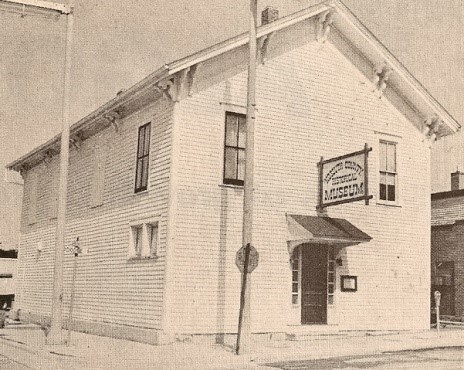
SAVING THE MUSEUM


A few years ago I served a term on the board of the Kossuth County Historical Society.  One of our main concerns was the condition of the foundation of the main museum building.  The foundation dates back to 1887 when it was moved to its present location and it shows every bit of the wear and tear of those 130 years.  Large cracks, leaks and settling have compromised the entire structure.  The basement itself was never fully excavated adding to its problems. 

The museum building is located on Dodge Street which is being reconstructed by the City of Algona in 2018.  This street project will involve the removal of all sidewalks in the area.  Putting a new basement under the building will also involve removal of sidewalks, so it is a very appropriate time to give this grand building a new foundation.  Of course any project of this nature is expensive and a fundraising campaign is underway.    

The other day I came across an article I wrote for the 2013 autumn newsletter for the historical society.  We had just begun to raise funds with the hope of restoring the building to its original glory.  One day as I worked in the museum, I began to wonder what it would say if the walls could talk.  I was inspired to write a letter to Santa and although it is not the Christmas season, I hope its sentiments might inspire you as well.


Dear Santa:

It has been a while since you heard from me.  The last 20 years or so, although I have tried to be a good building, it seemed as though I had been forgotten.  Occasionally I would feel someone walking across my floors, but no one stayed for long.  Eventually my furnace was shut off and I was left dark and alone, a far cry from where I began.

Saving The Museum - kossuthhistorybuff.blogspot.com

Do you remember the first time you came to see me?  As I recall it was near Christmas in 1867.  Of course, I knew you as St. Nick back then.  I was the brand-spanking new school filled with young minds ready to learn.  As the holidays approached, the children worked for weeks preparing a program for their families.  When the big evening arrived, parents’ buttons were popping with pride as they watched their students (even though some were shaking as they stood to do their recitations and needed a little prompting from teacher).  Everyone joined in to sing the old Christmas hymns with gusto.  My rafters rang with music and laughter that evening.  And when you arrived at the close of the program and handed out gifts—well, let’s just say that my windows got a little foggy with happiness.

Saving The Museum - kossuthhistorybuff.blogspot.com

Time has a habit of moving on and soon a larger schoolhouse was needed.  I was worried what might happen to me but after Central school was erected, I was moved from that location to my permanent home here at 122 South Dodge.  Throughout the years you continued to visit me, Santa, as I served the community in many different ways.  The first library was located within my walls and I hosted services for the Methodists while they were building their church.  Later I was honored to be chosen as the home for the Grand Army of the Republic and the Women’s Relief Corps.  Oh, the stories those veterans told!  They were such brave men and generous to a fault.  They adopted your spirit and helped many families at Christmas with food and gifts for the youngsters.  I know you remember Santa because you helped with their cause.  My service to our area veterans continued as I was passed from the G.A.R. to the American Legion.  The lights from my windows guided you to many a Christmas party during those times as well.

Saving The Museum - kossuthhistorybuff.blogspot.com

By 1967 I was 100 years old, an age when most buildings have been laid to rest.  My outsides had undergone many changes, but my bones were still strong.  Many of the stately homes and business buildings of my early memory were gone.  The American Legion had moved to a more modern building and so I thought my days were coming to an end.  But to my astonishment, a new adventure awaited me.  An enterprising group of citizens who believed in preserving the past decided to purchase me.  A bright new sign was hung outside telling the world I was the “Kossuth County Historical Museum.”  They filled me up to the brim with interesting artifacts and historical information.  The hum of activity over the next few years just did my heart good.  Best of all, the children were back—I felt young again!

Saving The Museum - kossuthhistorybuff.blogspot.com

But then Santa, things changed.  The wonderful citizens who saved me passed on and no one came along to take their place.  Although a skeleton crew kept me from the wrecking ball, I kept wondering why did no one care? What will become of me and all the treasures that I hold?  I stood silently waiting for an answer. 

Two years ago about this time, I woke up with a start when I once again felt footsteps across my floor.  I thought I heard voices say it was important that I be opened again to the public.  Could I be?  I had to clean the dust out of my windowsills so I could hear more clearly.  It was true!  Another generation wants me to live again.

My new friends have been working so hard.  Through their fundraising efforts and generous contributors I have heat and air conditioning.  They have moved all of the photographs and documents that I held to the second floor of my sister, the Wells Fargo building, and created a document storage/research center.  Two very special people, Phil and RosaLee, have given me so much tender loving care—cleaning, painting and repairing—helping to make me ready for visitors.  With rearranged displays, I am becoming quite handsome once again.  My list of friends continues to grow as new members join and in next year’s Christmas letter I will be able to tell you that I am on the National Register of Historic Places. 

Saving The Museum - kossuthhistorybuff.blogspot.com

And so Santa we come to the reason for my letter to you.  Although I am still strong and sturdy, arthritis has attacked my foundation and it is cracked and deteriorating.  I may be old, but I still have an important job to do and need a good foundation to stand on.  It has been a long time since I asked you for anything Santa, but I know that with your encouragement your elves would come forward to help in my hour of need. 

Thanks to my new friends, I believe in the future again.  So, dear St. Nick, please spread the word that there is a fundraising drive to raise enough funds to take care of me.  A donation of any size would be welcome.  In fact I have a new mailbox all ready for the mailman to fill with contributions and membership applications.  Once I have my new foundation, I will be ready to serve as proudly as the veterans who used me for so many years. 

Saving The Museum - kossuthhistorybuff.blogspot.com

Thank you Santa and Merry Christmas to you!

Kossuth County Historical Museum


I hope you will consider a contribution to this very worthwhile project.

Until next time,

Jean

Sunday, May 28, 2017

A SOLDIER'S POEM

As perhaps many of you already know, 2017 marks the 100th anniversary of the entry of the United States into World War I. This first global conflict was dubbed the “War to end all wars.”  It featured new forms of weaponry including the use of chemical weapons (mustard gas) and aerial combat. In addition, just as a measles outbreak caused the deaths of many young men during the Civil War, Spanish influenza ended the lives of thousands of armed service members while serving our country.  Our county alone suffered over 50 war casualties, plus many who were wounded.

The Kossuth County Genealogical Society has begun a project to gather and preserve information about Kossuth County residents who served in World War I.  We have been busy finding obituaries, service records, letters, and news articles, as well as seeking contributions from the public of things like discharge papers, photos, and journals for scanning and memorabilia that we could borrow for use at a display to be set up around Veteran’s Day.

PRIVATE HENRY B. STELPFLUG

While researching these brave men and women, I came across a poem written by Private Henry Stelpflug.  Born on a farm three miles northwest of Bancroft on April 10, 1893, Henry was the son of John A. Stelpflug and Mary (Emde) Stelpflug.  Both of his parents had immigrated to America from Germany.  They were married in Fayette County, Iowa, in 1884 and moved to Bancroft in 1889 when they purchased their farm.

Henry attended country schools in his neighborhood and the school in Bancroft.  He spent his entire life on the farm except for a little over a year that he spent serving during the war.  Private Stelpflug was inducted into the United States Army on May 28, 1918, in Algona and left immediately for Camp Dodge.  He was eventually assigned to the 352nd Infantry, a part of the 88th Infantry Division.

While stationed in the Haute-Alsace sector, the 88th Division managed to hold the line preventing a huge force of German infantry, artillery and air power from getting to the Meuse-Argonne offensive, contributing indirectly to the success of that battle.  What Henry saw during his service left a big impression on him – enough to set his thoughts to verse.

A SOLDIER'S POEM - kossuthhistorybuff.blogspot.com
From Bancroft Register, March 27, 1919

HENRY’S POEM

His poem was published on March 27, 1919 in the Bancroft Register and it describes his transport by ship and his experiences on the front. 

We left dear o’ homeland
        One bright sunny day
To clean up the Huns
        In lands far away.
We boarded the transport
        In dear old New York
And landed in England
        A few miles from “Cork.”

The trip was swell
        Across the ocean so blue
Living on hard tack
        And bully beef stew
We boarded the train at Liverpool
        And got off at Winchester
Like a lot of damn fools

We stayed over night
        And slept in a tent
Then we boarded the train
        And to Southampton we went
Then up the gang plank
        Again we did prance
Crossed the channel
        And landed in France.

Stayed a while in Le Havre
        Then we traveled some more
Till we got to Les Laumes
        Put up our dog tents
And sang “Home Sweet Home”
        Then once again we moved
On to Grigon
        And the doughboys life there
Certainly was grand.

Drilling and hiking
        And eating hard tack
I’d like to say more
        But I dare not give facts
Then on to Belfort
        Again we did go
And was rushed in caves
        From air raids you know.

Then we started to hike
        At eleven P.M.
And stopped at Laire
        And of gas drill and skirmish
We soon got enough
        So we moved on to Angate
And began to get rough
        Then to Angate we went
Four in a barn.

Some doughboys did joke
        And lit a cigarette
And she went up in smoke
        And then with a French pump
We worked half the night
        And the way fire did burn
It sure was a fright.

Then we got settled down
        For 2 days or more
Till some got sick
        And others foot sore
So with a small company
        Again we moved on
To the village of Ramagney.

There we stayed and rested
        Then we moved on again
The same as before
        Then into the dugouts
Together we went
        Back in reserve
One week there we spent.

Then up in the front
        There in a trench to lay still
Waiting for orders
        To go over and kill
We thought not of danger
        For it was such great fun
To sneak thru the trenches
        And watch for the Hun.

Then in the still of the night
        A signal would flash
And some timid sentinel
        Would sound the horn
And yell “gas”
        With explosions and air fight
It sure was such fun
        Oft times I regret
That our work there is done.

For one dark and dreary night
        We shouldered our guns
And went into Poppy
        For the battle was won
And then on to Lucy
        We started good living
For there in that town
        We spent our Thanksgiving.

Then into Ribeaucourt
        We soon settled down
Waiting for word
        To start homeward bound
Tis one Christmas day
        And sadly I say
We did not eat our turkey
        In the dear U.S.A.

But soon we will be leaving
        For the land o’er the foam
To settle forever
        In the dear old “Home Sweet Home”
Then by the fireside gleam
        Will sit there and tell
How the Hun yelled Komrad
        When we blowed them to H---


“This is the trip of the 352 Inf. Of which I believe I am the only doughboy of Kossuth County.”

Pft. Henry B. Stelpflug
Lo. C. 352 Inf.,
A. P. O. 795 A. E. F.

A SOLDIER'S POEM - kossuthhistorybuff.blogspot.com 
EPILOGUE

Henry was honorably discharged from service on June 13, 1919, at Camp Dodge.  He returned home to Bancroft where he was content to spend his days farming.  In addition to growing crops, he raised cattle and swine.  His Spotted Poland hogs became well known especially after one boar won first place for his division at the State Fair in 1929. 

A SOLDIER'S POEM - kossuthhistorybuff.blogspot.com

Sadly, Henry died August 24, 1930, at the Veteran’s Hospital in Kansas City from an attack of tuberculosis brought on by the flu.  He was only 37.  Following a funeral service at St. John the Baptist Catholic Church in Bancroft, he was laid to rest beside his parents in the Catholic cemetery there.  Never married, he was survived by six sisters and one brother. 

CAN YOU HELP?

If you have any information or memorabilia about a World War I Kossuth County veteran, please consider sharing that information with the Kossuth County Genealogical Society so that it may be preserved for future generations.  Contact Manita Murphy at 515-320-2091 or by email at murphyconst@gmail.com to make arrangements for scanning of photos or other information or possible loan of artifacts for the display in November.

These brave veterans MUST NOT be forgotten. 

Until next time,

Kossuth County History Buff


If you enjoyed this post, please don’t forget to “like” and SHARE to Facebook.  Not a Facebook user?  Sign up with your email address in the box on the right to have each post sent directly to you.

Be sure to visit the KCHB Facebook page for more interesting info about the history of Kossuth County, Iowa.


Reminder:  The posts on Kossuth County History Buff are ©2015-17 by Jean Kramer.  Please use the FB “share” feature instead of cutting/pasting.