During
the depression years of the 1930s, bank robberies were quite common across the
nation. There were many notorious
criminals--the names John Dillinger, Bonnie and Clyde, and “Baby Face” Nelson
come to mind. Several of them were
alleged to have passed through or near the area.
However,
the name that struck fear and terror in the hearts of local bankers and law
enforcement here in northern Iowa was that of “Two Gun” Henderson. Born in Arkansas, Hillary “Two Gun” Henderson
came to this part of the country via Texas, Missouri, Kansas and Nebraska,
leaving a trail of robbed banks in his wake.
It wasn’t long before he found some Kossuth County banks ripe for the
picking.
Between
the middle of August and the middle of November of 1930, four area banks were
robbed—the Bank of Lu Verne, the Exchange State Bank in Wesley, a bank in Hardy,
and finally the People’s Savings Bank in St. Benedict which was robbed twice in
less than three weeks.
LU VERNE BANK ROBBED
 |
| Bank of Lu Verne |
The
robbery in Lu Verne occurred on Wednesday, August 20, 1930, at about 9:30
a.m. Two men with guns drawn entered the
bank and told the three employees – Consuelo Hanna, W.Scott Hanna, and Arthur Hof
– to “stick ‘em up.” With their hands in
the air, the trio was then directed to lie down on the floor. The younger of the two men was wearing a mask
and guarded the bank
workers. His
nervousness was palpable and the other bandit reassured him several times that
there was little danger. The older
robber cleaned out the teller drawer and then ransacked the vault. Once he had plundered all cash and bonds in
sight, the three staff members were ushered into the vault and the door was
shut and locked. The two bandits escaped
to the car where their accomplice, St. Benedict native Art Rosenmeyer, was
waiting and they tore out of town to the north.
The two robbers would later be identified as “Two Gun” Henderson and
Lawrence Dugan.
 |
| Consuelo Hanna |
Meanwhile,
after giving the bandits sufficient time to leave, Mr. Hanna worked the inside
combination to unlock the bank vault.
Once the door was open, he called Sheriff L.E. Hovey to report the
theft. The bank robbers had been spotted
by a LuVerne youth as they left the bank with money bag in hand. He did not enter the bank until they had
disappeared. It is interesting to note
that a news article in the August 27, 1930 edition of the Whittemore Champion reporting
the robbery chastised the young man by stating, “The youth was driving a Buick, and could have kept the robbers in sight
if he had grabbed a companion off the street and chased them immediately.” Later in the article further directions were
given to the public. “Proper procedure following a bank robbery,
as suggested by Mr. Hovey, is to follow the bank robbers at a safe
distance. The important thing is to keep
them in sight. This forces the robbers,
naturally nervous, to keep to the main roads in order to make speed. In the meantime the surrounding country will
be warned and be on the look-out. The
sheriff or other peace officers would then have a chance to waylay the car and
its occupants.”
The
getaway car was found two days later near a straw pile on a farm near Hanna
Switch. The vehicle had been stolen from
F. B. Spangler in Janesville, Minnesota, and the plates came from a vehicle
registered to a man near Buffalo Center.
EXCHANGE STATE BANK, WESLEY
Almost
a month passed before the next robbery. On
the morning of Thursday, September 18, 1930, “Two Gun” Henderson, brandishing a
revolver and swearing, entered the Exchange State Bank at Wesley. His face had been smeared with grease to
camouflage his appearance. He demanded
that the employees and a customer lie on the floor while he looted the till of
about $700. Henderson next herded the
group behind a partition in the center of the bank and again made them lie
down. The bandit then demanded that the
assistant cashier, John Hutchison, open the vault, but Hutchison convinced him
that there was a time lock on the door which prevented him from opening
it. Knowing he would be unable to get to
the more lucrative stash kept in the vault, “Two Gun” fled the bank. He jumped into a gray coupe and headed west
out of town at a high rate of speed.
Officers attempted to follow but eventually the driver eluded them.
 |
| Exchange State Bank, Wesley, Iowa |
After
his escape from the law, Henderson met up with Art Rosenmeyer and another
accomplice, Walter Baer. The night
before he had tried to talk them into helping him rob the Wesley bank but they
had declined. Now that he had boldly committed
that robbery on his own, he convinced them to accompany him to the Hardy bank
that afternoon.
ROBBERY IN HARDY
Henderson
and Baer entered the Hardy bank at about 3:30 p.m. Following the same modus operandi used in the
earlier robberies, an employee and a customer were ordered to lie on the floor
while another employee was ordered to open the vault. As the robbery unfold, a woman passing by
observed what was happening and spread the alarm. As the men fled the bank, Marshal Lewis
Rasmussen fired, hitting “Two Gun.” The
two robbers made it into the car which quickly sped out of town. Although law enforcement followed in hot
pursuit, the robbers’ car was no match and soon outdistanced their
pursuers.
Although
the marshal was able to get a shot off at the fleeing bandits, State Agent J.
E. Hronek who investigated the case, expressed his disappointment that area
merchants had not taken action. Having
been warned by the observant woman, the merchants, armed with shotguns, took
positions on the roofs surrounding the bank.
He stated that they could have fired into the engine or tires of the
vehicle to block escape or actually fired at the bandits while they made their
getaway. A carload of local men actually
pursued the getaway vehicle out of town.
It eventually turned into a dead end road. Hronek was upset that instead of blocking
their escape path, the locals allowed their quarry to turn around and speed by
them without firing a shot.
As
the robberies became more common, bank robbers were wanted more dead than
alive. In September of 1930 the Palo
Alto County Bankers Association offered a reward of $1,000 for “the first dead bank robber brought in by any
person or any member of the vigilante committee.” Many local communities organized vigilante
groups to provide additional protection which, from the comments of the sheriff,
appears to have been encouraged.
It
was said that had an attempt been made on any Algona bank, anywhere from 10 to
20 shotguns would have gone into action on State Street. The courthouse was also heavily armed. Clerk of Court Clark Orton kept a deer
hunting rifle in the second floor southeast corner room ready to spring into
action. In reality Algona was most
likely protected by its traffic problem.
At that time cars were double parked on each side of State Street making
it difficult to make a quick getaway.
The
three robbers involved in the LuVerne, Wesley and Hardy crimes were not able to
be tied to either of the robberies of the Peoples’ Savings Bank of St. Benedict
although Art Rosenmeyer was suspected of being involved in the first robbery that
occurred there. Three other men were
later arrested for the second robbery.
They were identified as Myron Martin of Renwick, Clarence Perry of
Clarion and Harris Damon of Holmes.
PAYING THEIR DEBT TO SOCIETY
The
only local man involved, Art Rosenmeyer, was apprehended and charged with
aiding and abetting the two men who robbed the Bank of LuVerne, Iowa, by acting
as the getaway driver. He was sentenced
to an indeterminate term not to exceed life on October 30, 1930 and sent to
Fort Madison. He was paroled on February
12, 1936 and returned to the St. Benedict area where he lived the rest of his
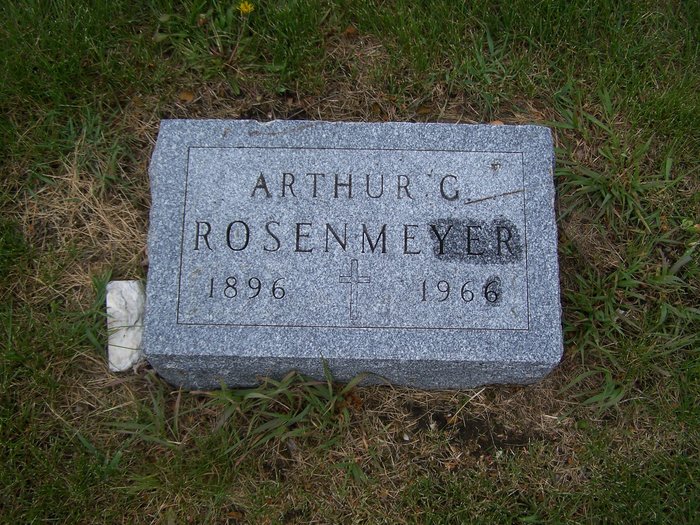
life. Rosenmeyer married in 1944 and had
eight children. He died in May of 1966
and is buried in the St. Benedict Catholic Cemetery.
So
what happened to “Two Gun” Henderson? He
had also been suspected of bootlegging when he resided on a farm near Blue
Earth, Minnesota, before he became a bank robber. At the height of the crime spree, local law
enforcement did all they could to track him down. Accomplices were arrested in Minnesota and
Sheriff Hovey and witnesses from the various bank robberies traveled to make
identities and to obtain information about the ring leader. Henderson, along with a pal, Clarence
Campbell, was finally arrested in Wichita, Kansas, in October of 1931 after
robbing the bank in Hayesville.
Sentenced to a maximum of 50 years at hard labor in Kansas, he was
released from prison in 1939 and brought back to Kossuth County. Henderson pled guilty to robbery with
aggravation for the robbery of the Exchange State Bank in Wesley. He was sent to the Iowa State Penitentiary at
Fort Madison to serve 25 years. Court
records reflect his release in September of 1945.

From
that point on, his information trail runs cold.
Did he ever answer for any other robberies or crimes he may have
committed? Or did he turn his life
around after serving his time? Most
likely, we will never know. Hillary “Two
Gun” Henderson was finally laid to rest in Mount Sherman, Arkansas following
his death on August 28, 1969. Although he is gone, his legend
lives on.
Until
next time,
Jean,
a/k/a KC History Buff
If you enjoyed this
post, please don’t forget to “like” and SHARE to Facebook. Not a Facebook
user? Sign up with your email address in the box on the right to have
each post sent directly to you.
Be sure to visit the
KCHB Facebook page for more interesting info about the history of Kossuth
County, Iowa.
Reminder: The posts on Kossuth County History Buff are ©2015-17 by
Jean Kramer. Please use the FB “share” feature instead of
cutting/pasting.


