Wednesday, April 18, 2018

COL. T. F. COOKE

From his birth at Center Grove near Dubuque on January 29, 1863, to his death in Hollywood in 1941, Thomas F. Cooke lived a full and vibrant life in his 78 years.  Born while the Civil War was raging, he would never get to know his father, David Grant Cooke, who was killed in battle near Cottage Grove, Tennessee in December of 1864, at the age of 30.  Raised by his widowed mother, Thomas grew to manhood.


From the Upper Des Moines Republican
September 28, 1904

It is not known exactly when Cooke came to Algona, but as a young man he entered into the land business in the area.  By 1888 he had joined A.D. Clarke who had been in various aspects of real estate and insurance business since 1870 in Algona.  An article which ran in the Algona Republican on June 6, 1888 described the A D. Clarke & Co. partnership as follows:  “The present firm, consisting of Hon. A. D. Clarke and Thos. F. Cooke was organized in 1870 although Mr. Clarke has been in business here since 1866.  Their office is on Dodge street between State and Call streets and is nicely fitted up.  They do a general land business and have 50,000 acres on their lists, mostly in this county.  They can sell wild land at from $7 to $14 per acre, and improved farms at from $16 to $40 per acre.  They also have a complete set of abstracts to the lands of the county, pay taxes for non-residents, make real estate loans on long time at low rates of interest.  They are also large dealers of land on their own account.  Mr. Clarke was a member of the assembly from Kossuth County last winter, and has a large acquaintance in this section of the state.  The firm represents the German-American, Continental and Queen Insurance companies and do a large business in that line.” 

NEW HOME

With business success came the need for a home large enough to entertain.  In June of 1886, Cooke purchased two lots from J. B. Jones for the erection of a new residence prior to winter.  They were located at 302 East Call. Local contractor Sam Plumley began the construction in July.  By late fall, the house was ready for occupancy.  Cooke continued to improve the look of his stately home, grading the lots and landscaping and in 1894 he installed concrete walks.  The residence was later featured in the book “Picturesque Algona.”


COL. T.F. COOKE - kossuthhistorybuff.blogspot.com


COMPANY F, IOWA NATIONAL GUARD

In the spring of 1889 A.D. Clarke was notified that there was a vacancy in the Sixth regiment, Iowa National Guard.  The letter inquired as to whether or not Algona would like to become its home base.  Clarke passed the correspondence to Thomas Cooke who quickly organized a group of young men to join the proposed company.  A short time later, members of the group gathered in the G.A.R. Hall and were reviewed by Col. L. B. Raymond of Hampton who found favor and recommended acceptance.

A muster of Company F took place on the evening of July 2, 1889 in the courthouse hall.  The forty-nine men present took the oath “to support the constitution of the United States and of the state of Iowa and to obey the orders of the commander-in-chief and of such officers as may be placed over you.”  The fiftieth man—Will Naudain—was unable to attend the muster and took the oath on his own three days later, bringing the total membership to an even fifty.

An election immediately followed the muster and Thomas F. Cooke was elected Captain by the men.  The recruits were required to purchase their own uniforms which consisted of a helmet; dark blue, single-breasted frock coat, piped with white; and sky blue trousers.  A fatigue cap could be worn in place of a helmet for drills and fatigue duty.  It wasn’t until the next year that the citizens of Algona joined together to raise money for the purchase of working uniforms consisting of blouses and leggings and to buy equipment for the rifle range.  The men were quite thankful to have working uniforms so that they no longer needed to wear their dress uniforms for drills and policing.

At the time of the muster the annual encampment was only six weeks away.  Most of the recruits had no formal military training so there was much to do.  Lieutenant Benjamin Haggard, who had been a member of the state university battalion, became the instructor in the manual of arms.  The group drilled almost every evening and was pleased to be second only to Company H of Sioux City when judged at the encampment.  Early in 1890, Sergeant Stahl of Second U.S. Infantry from Fort Omaha came to Algona and conducted a month-long special drill.  At the end of the month, Company F performed an exhibition drill in the courthouse which old timers declared had never been equaled in Algona.  Their drilling exhibitions were also well received at the Kossuth County Fair each year.

Captain Cooke must have been very good with firearms both in uniform and out.  He was an avid hunter who often traveled to Union Slough or other area hunting areas along with friends Otto Falkenhainer, Edgar Butler and Harry Wilson in search of game.  In 1892, Governor Boles appointed him general inspector of small arms practice for the state and his rank increased to lieutenant colonel.  Cooke would go on to hold this position for about ten years.

CAPTAIN COOKE MARRIES

By the time he reached his thirtieth birthday in 1893, Cooke was established in a profitable career, had built a beautiful home and was climbing the ranks of the National Guard.  The next year he erected a small two room cottage for use as a summer residence at Arnold’s Park.  The only thing that seemed to be missing was someone with whom he could share his life.  Once again his partner, A.D. Clarke, perhaps inadvertently, provided the answer.  Nellie Elizabeth Ford, a long-time friend of the Clarkes, came for a visit in 1894.  Was she invited specifically to meet Clarke’s young partner?  Or did Thomas hear of a delightful young female guest at the Clarke home and invite himself over for dinner?  We will never know, but Nellie and Thomas were eventually married on March 27, 1895 in her hometown of Whitewater, Wisconsin.  They settled into life in the house at 302 East Call where they would add a son, Edwin, and a daughter, Elizabeth, to their family.

With the outbreak of the Spanish American War, Company F was called to serve.  They were ordered to Camp Geo. H. Thomas at Chickamauga in Walker County, Georgia.  They would never be called to actual battle, but one of their own, Edgar Winkel, died of illness while stationed there.  Colonel Cooke himself almost lost his life to typhoid fever while stationed at Chickamauga.  It took several years for him to fully recover.

Cooke was a very active volunteer in the community.  One project near and dear to his heart was the establishment of a free public library.  His wife served as president of the Algona Women’s Library Aid Society and he himself spent more than seven years as president of the Algona library board.  He worked diligently on the committee for the erection of a Carnegie Library in the city.  Without his guidance, it is likely that Algona would not be the home of a Carnegie library building.  He continued to build his business interests as well.  Cooke organized the Algona Deposit & Loan Association serving as its president, and also helped to organize the Algona State Bank, Burt National Bank, and the Whittemore, Lone Rock and Fenton state banks.


LEAVING ALGONA

In 1902 Col. Cooke purchased a half interest in the Benham Garment Company which was located at Sixth Avenue and Center Street in Des Moines.  The family initially rented a home in Des Moines, but traveled back and forth to Algona frequently.  Elected Lieutenant Colonel of the 56th Regiment, Iowa National Guard in 1904, the family then permanently moved to Des Moines, selling their home in Algona to Professor Benjamin for $3,000.  One thousand dollars from the sale was donated to the library association for the new library.


House site in 2017

By 1907, Nellie Cooke’s asthma caused the family to seek residence in a better climate.  They moved to Hollywood, California.  Cooke headed several banks and also served as a Captain in France during World War I.  He was a member of the Hollywood Board of Trade which later became the Chamber of Commerce when Hollywood became a part of the city of Los Angeles.

The Colonel evidently had friends in the movie industry as he was accompanied by a film crew when he took a trip around the world in 1927.  It is said that the entire trip was recorded on “many reels of film.”  Wouldn’t it be delightful to view some of that footage?

He gained notoriety in 1928 as the foreman of a one of the most famous grand juries in the history of Los Angeles.  Under his guidance, indictments were brought against several prominent businessmen for bribery.  Cooke himself was described as “cool, courageous and determined to fight for honor in government.”  He was then elected to public office himself, serving as city councilman from the Hollywood district 1929-1931.

Colonel Thomas F. Cooke passed away May 14, 1941, and was buried at Hollywood Forever Cemetery.  His wife, Nellie, survived him by 32 years, dying at the age of 99.  She is buried beside him. 

From the Carnegie library building still standing today to bringing the National Guard to Algona in 1889, Cooke left his imprint on Algona.  A full and vibrant life indeed.

Until next time,

Jean


If you enjoyed this post, please don’t forget to “like” and SHARE to Facebook.  Not a Facebook user?  Sign up with your email address in the box on the right to have each post sent directly to you.

Be sure to visit the KCHB Facebook page for more interesting info about the history of Kossuth County, Iowa.


Reminder:  The posts on Kossuth County History Buff are ©2015-18 by Jean Kramer.  Please use the FB “share” feature instead of cutting/pasting.

Saturday, March 10, 2018

SAVING THE MUSEUM


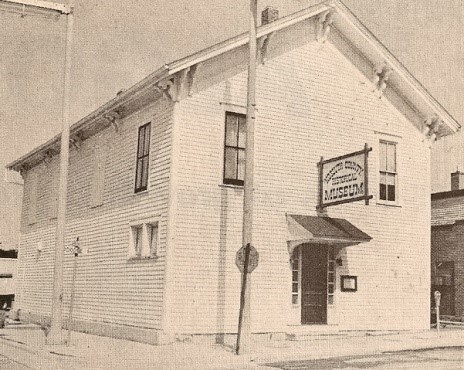
A few years ago I served a term on the board of the Kossuth County Historical Society.  One of our main concerns was the condition of the foundation of the main museum building.  The foundation dates back to 1887 when it was moved to its present location and it shows every bit of the wear and tear of those 130 years.  Large cracks, leaks and settling have compromised the entire structure.  The basement itself was never fully excavated adding to its problems. 

The museum building is located on Dodge Street which is being reconstructed by the City of Algona in 2018.  This street project will involve the removal of all sidewalks in the area.  Putting a new basement under the building will also involve removal of sidewalks, so it is a very appropriate time to give this grand building a new foundation.  Of course any project of this nature is expensive and a fundraising campaign is underway.    

The other day I came across an article I wrote for the 2013 autumn newsletter for the historical society.  We had just begun to raise funds with the hope of restoring the building to its original glory.  One day as I worked in the museum, I began to wonder what it would say if the walls could talk.  I was inspired to write a letter to Santa and although it is not the Christmas season, I hope its sentiments might inspire you as well.


Dear Santa:

It has been a while since you heard from me.  The last 20 years or so, although I have tried to be a good building, it seemed as though I had been forgotten.  Occasionally I would feel someone walking across my floors, but no one stayed for long.  Eventually my furnace was shut off and I was left dark and alone, a far cry from where I began.

Saving The Museum - kossuthhistorybuff.blogspot.com

Do you remember the first time you came to see me?  As I recall it was near Christmas in 1867.  Of course, I knew you as St. Nick back then.  I was the brand-spanking new school filled with young minds ready to learn.  As the holidays approached, the children worked for weeks preparing a program for their families.  When the big evening arrived, parents’ buttons were popping with pride as they watched their students (even though some were shaking as they stood to do their recitations and needed a little prompting from teacher).  Everyone joined in to sing the old Christmas hymns with gusto.  My rafters rang with music and laughter that evening.  And when you arrived at the close of the program and handed out gifts—well, let’s just say that my windows got a little foggy with happiness.

Saving The Museum - kossuthhistorybuff.blogspot.com

Time has a habit of moving on and soon a larger schoolhouse was needed.  I was worried what might happen to me but after Central school was erected, I was moved from that location to my permanent home here at 122 South Dodge.  Throughout the years you continued to visit me, Santa, as I served the community in many different ways.  The first library was located within my walls and I hosted services for the Methodists while they were building their church.  Later I was honored to be chosen as the home for the Grand Army of the Republic and the Women’s Relief Corps.  Oh, the stories those veterans told!  They were such brave men and generous to a fault.  They adopted your spirit and helped many families at Christmas with food and gifts for the youngsters.  I know you remember Santa because you helped with their cause.  My service to our area veterans continued as I was passed from the G.A.R. to the American Legion.  The lights from my windows guided you to many a Christmas party during those times as well.

Saving The Museum - kossuthhistorybuff.blogspot.com

By 1967 I was 100 years old, an age when most buildings have been laid to rest.  My outsides had undergone many changes, but my bones were still strong.  Many of the stately homes and business buildings of my early memory were gone.  The American Legion had moved to a more modern building and so I thought my days were coming to an end.  But to my astonishment, a new adventure awaited me.  An enterprising group of citizens who believed in preserving the past decided to purchase me.  A bright new sign was hung outside telling the world I was the “Kossuth County Historical Museum.”  They filled me up to the brim with interesting artifacts and historical information.  The hum of activity over the next few years just did my heart good.  Best of all, the children were back—I felt young again!

Saving The Museum - kossuthhistorybuff.blogspot.com

But then Santa, things changed.  The wonderful citizens who saved me passed on and no one came along to take their place.  Although a skeleton crew kept me from the wrecking ball, I kept wondering why did no one care? What will become of me and all the treasures that I hold?  I stood silently waiting for an answer. 

Two years ago about this time, I woke up with a start when I once again felt footsteps across my floor.  I thought I heard voices say it was important that I be opened again to the public.  Could I be?  I had to clean the dust out of my windowsills so I could hear more clearly.  It was true!  Another generation wants me to live again.

My new friends have been working so hard.  Through their fundraising efforts and generous contributors I have heat and air conditioning.  They have moved all of the photographs and documents that I held to the second floor of my sister, the Wells Fargo building, and created a document storage/research center.  Two very special people, Phil and RosaLee, have given me so much tender loving care—cleaning, painting and repairing—helping to make me ready for visitors.  With rearranged displays, I am becoming quite handsome once again.  My list of friends continues to grow as new members join and in next year’s Christmas letter I will be able to tell you that I am on the National Register of Historic Places. 

Saving The Museum - kossuthhistorybuff.blogspot.com

And so Santa we come to the reason for my letter to you.  Although I am still strong and sturdy, arthritis has attacked my foundation and it is cracked and deteriorating.  I may be old, but I still have an important job to do and need a good foundation to stand on.  It has been a long time since I asked you for anything Santa, but I know that with your encouragement your elves would come forward to help in my hour of need. 

Thanks to my new friends, I believe in the future again.  So, dear St. Nick, please spread the word that there is a fundraising drive to raise enough funds to take care of me.  A donation of any size would be welcome.  In fact I have a new mailbox all ready for the mailman to fill with contributions and membership applications.  Once I have my new foundation, I will be ready to serve as proudly as the veterans who used me for so many years. 

Saving The Museum - kossuthhistorybuff.blogspot.com

Thank you Santa and Merry Christmas to you!

Kossuth County Historical Museum


I hope you will consider a contribution to this very worthwhile project.

Until next time,

Jean

Sunday, February 18, 2018

FINDING GRANDMA


One of the first lines I researched almost twenty years ago as a newbie to genealogy was my maternal grandfather’s family.  I was lucky to find much local information because of their residence in Kossuth County, but after the death of my great great grandfather, John Kargleder, his wife, Selma, remarried and moved to South Dakota.  Her second husband’s last name according to marriage records here in Kossuth County was Beichlmair.  As you might imagine, over the years that name was spelled many different ways in official documents depending on who was writing it down.  Within a few years of her remarriage, I could not find a trace of Selma.

Over the last 10 years or so many historical newspapers have been digitized and placed online.  They are a gold mine for historians of every sort.  While researching I have found interesting articles here and there about many relatives and they are a primary source of information for my blog posts.  A few months ago through total serendipity, I happened across the obituary of Selma Kargleder Beichlmair.  Finding that gave me incentive to once again visit the information I had originally gathered on John and Selma and use what I have learned since then to flesh out their stories.  I am so glad I did.


KARGLEDER - HAAS UNION

John Kargleder was born in Bavaria, Germany on March 26, 1826.  In 1862 he came to America and the 1870 census finds him living in Milwaukee, Wisconsin, working as a brewer.  He evidently had his own company as the 1871 city directory lists “John Kargleder & Co. – brewers.”  The 1873 directory shows his business located at 624 Cherry Street in Milwaukee with his residence next door at 620 Cherry Street.  (If I ever get to Milwaukee, you can bet I am going to find Cherry Street to see what is there now).

Selma Haas came from Saxony where she was born in April of 1849.  According to census records, her family came to America when she was just a small child.  The 1860 census shows the family living in Milwaukee.  Her father, Carl (sometimes shown as Charles), was a tailor.  He and his wife, Constanze, resided with their five children. 

In either 1867 or 1868, Selma and John are married.  The 24 year age difference between the two seems vast to me.  At just 17 or 18, Selma was young enough to be John’s daughter.  He was actually older than her mother.  So many questions come to mind:  How did they meet?  How did her parents feel about her marrying someone so much older?  Did they encourage it?  It certainly would be interesting to know what brought them together.  Their oldest child, Charles, (my great-grandfather) was born in May of 1869.  They remained in Milwaukee until 1872 when they moved to Minneapolis according to John’s biography printed in the 1884 edition of the History of Kossuth County.


INFO FROM CENSUS RECORDS AND CITY DIRECTORIES

Census records and city directories continue to provide valuable information.  By 1875 John and Selma had two children.  Their second child, Mary, was born after their move to Minneapolis.  Land deeds at the office of the Kossuth County Recorder disclose that in March of 1876, John and Selma purchased 480 acres of farm land in Section 19 of Union (which they named "Willow Wave") and Section 24 of Lotts Creek Townships of Kossuth County.  What led them to choose Kossuth County?  I doubt that I shall ever know.

The 1877 city directory shows John Kargleder working as a foreman for Theo Hamm in St. Paul.  Three years later, the census shows John living alone and rooming with Theodore and Louise Hamm while continuing to work for them.  Records reflect that the Hamms loaned John $4,000 to use to purchase the farmland.  Although I have known about the mortgage to the Hamms for some time, it wasn’t until this last round of investigation that I had a “eureka” moment.  A research detour helped me to confirm that Theodore and Louise were the founders of Hamm’s Brewing Company.  It is amazing to think that my great-great grandfather helped the Hamm family establish their business.

Finding Grandma - kossuthhistorybuff.blogspot.com
Kargleder Farm located in
Union Township, Kossuth County, Iowa
1896 Kossuth County Plat Book

The 1880 census also finds Selma living as head of household in Kossuth County with her four children:  Charley, 11; Mary, 6; Ella, 3; and Arthur, 2 months.  Exactly when she moved to the farmstead located on the Union Township land is not known nor have I been able to determine when John joined them to live at the farm.  The couple did have one more daughter (Meta) after settling here.  John’s residence in Kossuth County was not to be long, however, as he suffered from Bright’s disease (a form of kidney disease) which resulted in his death in April of 1885 at the age of 59.

Just a few days before his death, John executed a Will leaving all of his property to Selma who was then 35 years old.  Her oldest child, Charley, was almost 16 when his father died and I like to believe that he was a great help to Selma.  She continued to run the farm utilizing hired men and appears to have prospered.  One of those hired men, however, almost took her life.


NEWS ARTICLES HELP TO TELL HER STORY

Evidently John used to tease the hired men about the fact that Selma would likely be a young widow due to their age difference and would be quite a catch.  One man, Martin Bader, took his words to heart.  By 1888 Selma had become close to another worker, Frank Beichlmair, who she would later marry.  Bader had made several attempts to court Selma, but she did not take him seriously and paid no attention to his advances. Her budding romance with Frank appears to have set him off.  On a Thursday morning in February, Bader was repairing the kitchen floor with Selma in the room.  When she took a cup and started to go in the pantry to make some coffee, he suddenly jumped up, drew a revolver and fired at her.  The bullet struck the cup, smashing it into a thousand pieces.  He fired a second time at her and the bullet whizzed past her ear.  She screamed and ran to the window to call for help.  Thinking he had hit her, Bader turned the gun on himself, firing three times.  None were mortal wounds.  He drug himself from the house and was later found lying in a haystack.  He was taken in by a family in Algona where he was treated by Dr. James Barr.  Laudanum was prescribed for pain.  Bader could neither speak nor read much English.  In pain and without realizing what he was doing, at some point he was able to reach the laudanum bottle at his bedside and he drank the entire container.  The overdose killed him.  An autopsy was performed and an inquest held after which the jurors determined that the deceased came to his death by an accidental overdose of laudanum.

Selma married Frank Beichlmair several weeks later and they continued to live at the Kargelder home in Union Township.  This time her husband was five years younger.  They would have a daughter, Alma, the next year.  By this time some of her older children were reaching adulthood and establishing lives of their own.  Charles married Anna Rammer in 1891 and apparently resided on a farmstead in Lotts Creek Township.  It is unknown whether or not this was on the property owned by Selma but he is shown as a renter on the census. Eventually the Kargleder farmland located in Lotts Creek Township was sold to Theo Chrischilles who held the mortgage on it.  Wherever Charlie lived, his residence was in the path of the famous 1894 cyclone that swept across the county.  The barn on the place sustained the worst damage, having one side completely removed.  There was no mention of injuries to any family members.

Oldest daughter Mary was married to S. P. (Pete) Christensen in 1893.  At the time of their marriage Pete managed a feed barn in Algona but would later go on to be elected Kossuth County Sheriff.  To this marriage two sons would be born.  Sadly, Mary passed away quite suddenly shortly after giving birth to her second child, Harold, in 1898.  She was buried next to her father in Riverview Cemetery.  The two little tikes were placed in Selma’s care.  Pete remarried in 1899 and the census taken the next year shows older son, Elmer, living with Pete and Harold still residing with Selma. 

It is believed that it was the lure of cheap land in South Dakota that caused the entire Kargleder/Beichlmair family to move near Big Stone City.  In 1902 Charles purchased 160 acres in Lockwood Township of Roberts County, South Dakota.  The farm was located within easy walking distance of Big Stone Lake.  One can only imagine how much fun his children must have had fishing and swimming there.


WHAT HAPPENED TO GRANDMA?

Finding Grandma - kossuthhistorybuff.blogspot.com
Kargleder graves in Riverview Cemtery, Algona
R to L: Mary, John and Selma

It was at this point that I was unable to find a trace of Selma.  Cemetery records indicated that she was buried in a plot next to John Kargleder, but gave no other details.  A stone was on the plot with the year 1909 carved into it, but the rest was unreadable.  Was Selma buried here or was a stone erected in her honor?  I exhausted my sources at the time, local newspapers weren’t available online, and even a friend on Ancestry was unable to find her.  I resigned myself to the fact that I might never find out what happened to Selma.

Several years ago while doing unrelated research on behalf of the genealogy society in the local historical newspaper website, a search request entry popped up with enough information to make me curious.  It appeared that it could be an article about the Kargleder family.  I clicked on it and there was Selma’s obituary.  She had died March 22, 1909, in her home near Clinton, Minnesota.  Sadly it stated “this death occurred after five months severe illness.”  Like John, she was just 59 years old at death.  Her body was brought back to Algona and laid to rest beside John and her beloved daughter, Mary.  

I had finally found Grandma.

Until next time,

Jean


If you enjoyed this post, please don’t forget to “like” and SHARE to Facebook.  Not a Facebook user?  Sign up with your email address in the box on the right to have each post sent directly to you.

Be sure to visit the KCHB Facebook page for more interesting info about the history of Kossuth County, Iowa.

Reminder:  The posts on Kossuth County History Buff are ©2015-18 by Jean Kramer.  Please use the FB “share” feature instead of cutting/pasting.

Sunday, January 7, 2018

THE ROVING ALGONA BOTTLING WORKS

This past summer a reader sent me a photo of a bottle she had acquired.  The container bears the imprint of the Algona Bottling Works and appears to be from the very early part of the 20th century.  Her curiosity about the bottle was infectious so I had to find out a little bit about the history of the company. 

THE ROVING ALGONA BOTTLING WORKS - kossuthhistorybuff.blogspot.com


THE FIRST ALGONA BOTTLING WORKS

I first did a little poking around in the newspaper archives without much success until I discovered that the Algona Bottling Works was often referred to as the Algona Pop Factory.  The History of Kossuth County which was published in 1913 reports that the Algona Pop Factory opened in 1891.  However, I was not able to find anything about the plant until 1897 when two articles caught my eye.

The first – published in the Upper Des Moines on June 30th of that year – reported the following: ”Algona’s new pop factory is in full blast and doing a rushing business.  The proprietor is Mr. J. F. Conlee, formerly of Manson, and he understands the pop-making business to perfection.  Algona welcomes this as another addition to its manufacturing industries.”  Just two weeks later on July 14th the Republican reported, “The plant of the pop factory was on Monday taken possession of by Mr. Vesper of the C. & N.W. railroad company, the proprietors having failed to pay the freight.  The success of the institution has been placed in doubt from the start by the disposition of the managers to neglect their own home manufacture for other drinks.”  What a difference two weeks (and editors’ opinions) can make!

HERE TO STAY

Algona wasn’t ready to give up on a pop factory yet.  In early 1898, Charley Stewart decided to open shop in a facility just north of the alley on the east side of North Dodge Street, at the address now known as 114 North Dodge.  Charley had the novel of idea of using distilled water from the Algona Milling Company and was the only factory in Iowa making pop in this manner.  By May of that year he was turning out 30 cases per day.

THE ROVING ALGONA BOTTLING WORKS - kossuthhistorybuff.blogspot.com


I have been unable to determine all the types of “pop” the factory manufactured.  Ginger ale bottled there was mentioned by one customer as having done him so much good that he thought Stewart should advertise it as a tonic and cure for summer complaint. However another article in August of 1898 from the Armstrong Journal reported “The police courts were busy in Algona last week.  Four drunks besides other matters demanded their attention in one day.  That pop factory must be doing a big business.”  This leads me to wonder if perhaps they bottled something a little more potent than ginger ale?

Stewart slowly and steadily built his business.  He sold 300 cases for the Fourth of July celebration the first year and could have sold another 500 had he been able to get them.  By September he employed three men full time.  He established a delivery route and was soon distributing his products all across northwest Iowa. By 1900 he had implemented a bottling machine increasing his output to the extent that it was necessary to order bottles two train car loads at a time.  One news article stated that he had used nine barrels of sugar within a six week period.

The bottling factory was experiencing growing pains and it became obvious that a larger, more modern facility was needed.  When the quarter block on which his bottling facility sat was sold to build a brick livery and feed stable, Charley decided to erect a 40 x 40 foot building that would house new, state of the art machinery.  He purchased a lot on the east end of State Street “nearly opposite the North-Western hotel” which according to the Sanborn Fire Maps sat on the northwest corner of the State and Phillips Streets intersection.  Another article says that plant was built near the Northwestern depot and still another states that it got its power from the Spurbeck & Lambert Company which stood on the east side of the Northwestern depot along Lantry Street.  A few years later an article describing the future location of the Athletic Park described that property as a tract of ground running 340 feet south from the alley in the rear of the bottling works and 460 feet west from Phillips Street.  In addition two corner lots east of the bottling works were to be part of the Athletic Park.

THE ROVING ALGONA BOTTLING WORKS - kossuthhistorybuff.blogspot.com
Perhaps the site of the Algona Bottling Works?

Charley Stewart’s personal life was also busy.  He had married his wife, Maggie Stockman, in 1896, and by 1902 several children had joined their family.  The scourge of his life, however, was diabetes.  In 1903 it almost caused him to go out of business, but he managed to keep going until 1905 when he sold the business to William F. Nierling of Waukon.  The Stewarts remained in Algona and Charley sought out diabetes specialists, but the disease ended his life in 1908 at the age of 46.  He was survived by his wife and four small children, the youngest of which was only a few months old.

OTHER OWNERS

Nierling was new to the bottling business.  Previously he had worked as a bank cashier and also deputy county treasurer for Allamakee County.  Several months after moving to the Algona area, he married Fannie Palmer Stewart at Ledyard.  It does not appear from my research that Fannie was related to Charley.  The two settled in Algona where they would start a family and become involved in community activities.

Under his ownership, the pop works continued to grow.  By 1911 the business had a capacity of about 600 cases per day.  Deliveries expanded as far north as Minneapolis.  In January of 1912, Nierling sold the business to Mark Sarchet and Jesse Staley.

Described as young and ambitious, the two were excited to lead one of Algona’s best known businesses.  They established a good reputation for having an up-to-date factory using thoroughly filtered city water for their products.  In addition to beverages, they began to manufacture bluing for washing purposes which could be found at any local grocery store.  They operated the company until December of 1916 when they sold their interest to O. J. Stephenson and L. A. Miner who planned to place the bottling plant in their new candy factory and ice cream parlor.

ALGONA CANDY KITCHEN & BOTTLING WORKS

Stephenson and Miner formed a corporation to hold the various entities.  Sarchet remained with the firm to operate the pop factory.  The future location of the new store was 15 East State.  Construction would not be completed until September of 1917.  The bottling works was to occupy the rear 30 feet of the first floor and as much of the basement as it needed. 

THE ROVING ALGONA BOTTLING WORKS - kossuthhistorybuff.blogspot.com


The new structure had large plate glass windows on each side of the center door.  The front section was to be used as a candy and ice cream parlor.  The interior was golden oak with fixtures to match.  It had tiled floors and a metal ceiling.  The beautiful new soda fountain was the main feature and served soft drinks, ices, ice cream, sodas, sundaes and other sweet delights.  The large glass counters displayed a large variety of candy and sweets made on the premises.  Two rows of white marble topped tables flowed through the space while custom-made oak seats lined the walls.

Soft drinks, soda waters, ciders and ginger ale, crushed fruits and syrups and gas for fountains were all manufactured in the bottling department.  O. J. Stephenson marketed the products within a 75 mile radius of Algona. 

The second floor provided space for a candy manufacturing room and a large store room.  One of the best features of the building was an elevator allowing maximum use of all three floors.  Six to ten people were employed at the business with a total payroll of around $250 weekly. 

THE ROVING ALGONA BOTTLING WORKS - kossuthhistorybuff.blogspot.com
From the Algona Courier, March 28, 1918

In 1923 L. A. Miner sold his interest in the business to Tony Goeders who had been operating the Burt Bakery.  Goeders converted a portion of the upper floor into a bakery moving his equipment from Burt and adding a new bread molder.

ANOTHER MOVE

The bottling works was moved once again in 1928 when O. J. Stephenson established it in the North American Engine Company building at the east end of East State Street where it struggled as several managers came and went.  In 1932 Louis Hoffbauer came here from Eagle Grove where he owned another bottling works.  He purchased the ailing company which he regenerated and went on to run successfully for almost 30 years.


And although the history of the Algona Bottling Company continues on, this seems a good place for my story about it to come to an end.  Thanks to Abigail Huff for sharing the bottle photos with me.  Some bottles have a magic genie inside—this one just happened to have an interesting story!  

Until next time,

Kossuth County History Buff


If you enjoyed this post, please don’t forget to “like” and SHARE to Facebook.  Not a Facebook user?  Sign up with your email address in the box on the right to have each post sent directly to you.

Be sure to visit the KCHB Facebook page for more interesting info about the history of Kossuth County, Iowa.

Reminder:  The posts on Kossuth County History Buff are ©2015-18 by Jean Kramer.  Please use the FB “share” feature instead of cutting/pasting.

Thursday, December 14, 2017

A CHRISTMAS TRAGEDY

Nancy Yeoman, a good friend and researcher, emailed me some articles she had come across while researching another matter that she thought might make good topics for blog posts.  I have to agree (and I am glad that someone else gets distracted from the research project at hand whenever another headline catches their eye and lures them in).  This particular story is a tale of love and marriage, unhappiness and parting, murder and suicide—a difficult story to tell, but a reminder that violence is not new to our society.

THEIR STORY BEGINS

Etta Campbell and Harry Adams were married November 25, 1895, at the home of Etta’s father, Zane Campbell.  The Campbells farmed just north of Woden in Grant Township, Winnebago County.  The two met when Harry was working for a crew putting up hay in the area.  He had grown up in Algona, the son of Mr. and Mrs. William Adams, long-time residents who lived south of town.

A CHRISTMAS TRAGEDY - kossuthhistorybuff.blogspot.com


The couple went on to have two daughters, Dora and Vera, and to all outward appearances, the marriage was a happy one.  Harry was a hard working young man despite a handicap.  Caught in a cyclone while living on the farm, his right arm had been badly broken. Due to the manner in which it was set, after it healed it was shorter and a little crooked.  This disadvantage did not slow him down though as he had jobs haying, driving teams, picking corn and cutting wood.  The nature of the work he performed was that of a laborer and it appears that the family may have struggled financially to some extent.

TROUBLES SURFACE

As we all know, appearances can be deceiving as no one knows what goes on behind closed doors.  The couple became estranged at some point and so by September of 1902, Etta Adams decided to leave her husband and children and did so in a way that caused criminal charges and public embarrassment. 

Her intention was to leave town and quietly make her way to Elmore, Minnesota, where she intended to find a job.  Sometime prior to her planned sole departure, she met a young girl by the name of Loretta Phillips who for whatever reason wanted to run away from home.  Etta consented to take her along even though she was only 13 years of age. Etta hired a driver by the name of Joe Fraser to take them to Elmore, Minnesota.

Leaving Algona on Monday, September 8, 1902, they traveled on back roads mostly at night to avoid being found.  During the day they would rest at hay stacks to avoid detection.  They reached Ledyard on Thursday, September 11th.  It was there that Marshal Fred Jenks spotted them, having been alerted of outstanding warrants for the two adults.  He arrested both Etta Adams and Joe Fraser who were charged with enticing away a child under the age of 14.  The three were transported to Algona by the 2 o’clock train.  All three appeared before Justice of the Peace Raymond.  Loretta was sent home to her parents and bond was set at $200 each for the two adults.  While in the court room, it was observed that none of the three seemed much concerned, especially Etta who chewed gum during the entire proceeding.  She did declare in open court that she never would go back to live with her husband again.  Shortly thereafter, her bond was posted by Harry and she did return to live with him.

In an affidavit filed the following week in the case against her, Etta stated that she had been having trouble with her husband because he got drunk and abused her.  She stated that she had told him that she was going to leave him.  Her affidavit, along with similar statements from Loretta, Loretta’s mother, Joe Fraser and Harry Adams, stated that neither Etta nor Joe enticed Loretta to leave her home and that she had accompanied Etta of her own free will.  All charges were dismissed against both Etta and Joe, but the damage had been done to their reputations.

SEPARATION AND A DIRE DECISION

Although they had reconciled, the young couple continued to have problems.  They were living in a house near the Milwaukee depot and Harry was making $35 per month working for the Algona Milling and Grain Company delivering coal.  Following the incident involving her arrest, Etta declared that the whole town was gossiping about her and she wanted to move.  Harry agreed, quit his job and sold off their furniture and belongs in preparation for the move.  Etta announced that she was leaving to look for a more desirable location.  She then left without telling Harry where she was going.  It is not known how much time passed, but eventually Etta was spotted in Fairmont and Harry went there immediately.  He brought her back to Algona where they rented a small home in the western part of town.  Etta was still restless and unhappy.  It was intimated that male callers came to her home while Harry was at work.

On Thursday, December 18th, Cora Whitson came to call.  Mrs. Whitson had quite a reputation as she, along with Blanch Ferguson, had been charged with prostitution the previous year and had been run out of town.  Cora had just recently returned.  How these two women met or formed a friendship is unknown, but they both must have been hungry for some adventure.  They hatched a plan to meet the next evening.  With her husband gone chopping wood for Ambrose Call, as soon as Etta had her two small daughters tucked in bed on Friday evening, she left.  Upon his arrival home and finding his wife gone, Harry woke his children asking where their mother had gone.  They stated that she had gone off with “jingle bells.”  Knowing his daughters used that term for the sound of sleigh bells, he took off for the livery stable where he found the two women preparing to leave.  Adams begged his wife to return home, but she rebuffed him and swore at him.  Etta set off with Cora and didn’t return until 2 a.m.  Where they had been and what they had done was unknown but upon her return Adams packed up his two little girls and all of the belongings he could carry and made his way to the home of his parents. 

Harry met with Cora several times over the next few days, begging her to come back and offering his forgiveness.  He asked to take her to see her parents for Christmas, but she refused, saying they all could go to hell and that she did not care for Harry or them.  After the final rejection, it appears that Adams decided that if reconciliation was not possible, he would bring a conclusion to his suffering by ending both of their lives.

DAY OF RECKONING

Harry and his daughters were living with his parents whose home was south of town across the river.  Etta moved in with Cora Whitson who was living with her two small children in a couple of small dirty rooms in the old college building which had been turned into a rooming house after its move to the corner of Dodge and Nebraska streets.  It was there that Harry came with his shotgun on his shoulder after having Christmas dinner with his family and writing his suicide note.


A Christmas Tragedy - kossuthhistorybuff.blogspot.com
 The site today where the old
college building sat in 1902

He confronted her one more time asking that she come home and change her mode of living, but she refused.  The two began to argue loudly and Mrs. Whitson looked in to see that Adams had his wife on the floor and was hitting her. Etta cried out, “Harry I will go home if you let me loose.”  A moment later Whitson heard a shot and again looked in to see Etta lying face downward on the bed, shot to death.  She ran to get help and then heard a second shot.  When she returned she saw Harry’s dead body sprawled on the floor. 

The news articles of the day were quite graphic in their description of the bodies and the crime scene, leaving little to the imagination.  The suicide note was printed in the newspaper in its entirety including his last words to his children:  “Poor little Vera and Dora.  I hate to leave you.”

Harry’s body was taken to his parents’ home where a funeral was conducted by Rev. R. T. Chipperfield the following day.  He was buried in Riverview Cemetery.  Etta’s father, brother James, and brother-in-law Dick Gibson came down from Woden.  They took her remains on the midnight train as far as Burt where they had a team waiting for them.  By early Saturday morning Cora Whitson had also left town.

Newspapers often took advantage of tragedies such as these to wax eloquently on moral turpitude and this instance was no different.  In the January 2, 1903 edition of the Algona Courier, the following was written:

“It would be difficult to imagine a scene from which a more impressive lesson could be drawn as to the value of virtue and right living than the scene of that tragedy.  The dirty little room; the two mutilated bodies; the spattered blood and brains; the wretched woman who was to some extent to blame for the extinction of the two lives in another dirty room with her dirty little children huddled about a stove.  It was such a place that Mrs. Adams preferred to her own humble home.  It has been truly said that virtue is its own reward.  No matter how poor the home is if fidelity and virtue abide there it may be in a measure happy.  Its occupants may have approving consciences and self respect and the respect of others.  Even in dire poverty children may be reared to reverence religion, truth and virtue and conscious of the rectitude of their lives they become strong, self respecting and wholesome members of society.  But in households where there is no religion or moral training there is seldom virtue and the ornaments which it bestows.
“Young women and young men too should be warned by the fate of Mrs. Adams and her husband and also by the fate of Mrs. Whitson and Mrs. Ferguson and all such unfortunates.  When the jewel of virtue is lost womanhood is degraded too low for contemplation.  Let her who would be happy, respected and love preserve that jewel from stain as she would preserve her life from danger.”


Until next time,

Jean


If you enjoyed this post, please don’t forget to “like” and SHARE to Facebook.  Not a Facebook user?  Sign up with your email address in the box on the right to have each post sent directly to you.

Be sure to visit the KCHB Facebook page for more interesting info about the history of Kossuth County, Iowa.

Reminder:   The posts on Kossuth County History Buff are ©2015-2017 by Jean Kramer.  Please use the FB “share” feature instead of cutting/pasting.