Sunday, November 24, 2019

COME INTO OUR KITCHENS


While filing some items in the genealogy room at the Algona Public Library recently, I found a cookbook that was out of place.  It had been donated to the gen society ten years ago by a person who purchased it at a used bookstore in San Diego.  At the time of our receipt it was in pretty rough shape.  Since it was falling apart, we placed each page in a page protector and put the book in a three ring binder to preserve it. 

Come Into Our Kitchens - kossuthhistorybuff.blogspot.com


The cookbook is entitled Come Into Our Kitchens.  There is no other information to indicate the date of publication, who compiled the collection or what organization profited from its sales.  I recall at the time we received it we did a little research trying to identify its source, but to no avail.  Rather than put it on the shelf next to the other cookbooks in our collection, I decided to give it another go.  Who knows?  At the very least I might be able to find some good recipes for the upcoming Thanksgiving dinner.

Come Into Our Kitchens - kossuthhistorybuff.blogspot.com


Come Into Our Kitchens - kossuthhistorybuff.blogspot.com


The publication contains advertising from many local Algona merchants which helps to date the period it was published.  There is an ad for the Call Theatre which led me to deduce that it was published prior to 1937 when that structure burned to the ground.  Other advertisers included Kent Motors, Pratt Electric, and The Hub Clothiers, among many others.  One of the most vexing aspects of the advertisements is that addresses are not given for most of the businesses.  That seems to be a recurring theme in advertising prior to 1970 or so.  Evidently no one back then considered the feelings of future local historians or family history researchers and their need for specific information.  Sigh . . .

The cookbook itself is thin – 50 pages or so – and specializes in sweets.  It begins with doughnuts, coffee cakes and breads, proceeds on to cakes and icings, has a section on cookies and bars and another on candies.  It then moves on to desserts and pies and ends with various salad recipes.  Thumbing through the book was nostalgic.  There is something about a well-loved cookbook with pages discolored and splattered, corners worn, and notes in the margins that is comforting. 

Come Into Our Kitchens - kossuthhistorybuff.blogspot.com
Roll and waffle recipes

Titles of recipes can be fascinating.  Today’s cakes might be called “Death By Chocolate” or “Ooey Gooey Butter” cake, but they had interesting names then too.  Here are some of the cakes from Come Into Our Kitchens:  Feather Weight Cake from Mrs. H.M. Harris, Light as Ducks Down Cake from Fern (Mrs. W.A.) Foster, and Yellow Feather Cake presented by Mrs. Homer Tuttle.  Angel food and sponge cake recipes were quite popular with recipes submitted by Marie (Mrs. William) Hawcott, Ruby (Mrs. Francis) Hawcott and Ella Mae (Mrs. Alvin) Weber.  I have always admired those talented bakers who could make an angel food cake from scratch, beating all those egg whites that are required.  And these fine ladies likely beat them by hand. 

Come Into Our Kitchens - kossuthhistorybuff.blogspot.com


Come Into Our Kitchens - kossuthhistorybuff.blogspot.com


Seeing the Chocolate Pin Wheel Cookies recipe from Mrs. Antone Johnson reminded me of the delicious ones my husband’s grandmother, Josie (Mrs. Aloysius) Eischeid used to make.  How we looked forward to that treat whenever we stopped by for a visit!  Other cookies such as Carmel Cookies (Mrs. Burton Thorpe) and Butterscotch Pecan Squares (Mrs. Ben Sorensen) sound delicious.  However, a few did not sound appetizing at all – Date Rocks (Mrs. Fred Frost) and just plain Rocks (Mrs. W. C. Steele) for example.  I don’t think I would enjoy eating cookies that are described as “rocks.”

Come Into Our Kitchens - kossuthhistorybuff.blogspot.com


Come Into Our Kitchens - kossuthhistorybuff.blogspot.com


There were several recipes in the candy section that I found intriguing.  I had never heard of Sea Foam candy before, but both Mrs. D. J. Mitchell and Miss Annie Ingersoll submitted recipes.  My favorite candy in the section has to be the one entitled “Patience” which again was contributed by Mrs. Mitchell.  After reading the directions, I certainly agree that one would have to have extreme patience to prepare it.

Come Into Our Kitchens - kossuthhistorybuff.blogspot.com


When it comes to pies, these women knew what they were doing.  I can almost picture them in their kitchens rolling out the crusts.  Lemon Chiffon (Mrs. Anna Gill), Washington Nut Pie (Mrs. Lillian Norton), Silver Cream Pie (Mrs. Walter Klamp), and Angel Food Pie (Mrs. Earl Moore) are just a few of the many varieties mentioned. 

Come Into Our Kitchens - kossuthhistorybuff.blogspot.com


While paging through the book, I started to study some of the names of those who contributed recipes for publication.  I began to notice that the majority of the surnames represented families who had been faithful Methodists through the years.  After spending some time on Find-a-Grave, I was soon able to confirm through obituaries that funerals for all but a very few of the women I was able to track were held from the Methodist Church.  The book itself belonged to Elizabeth Carlisle who I have been unable to find.  Her ownership could perhaps be another clue.

So as you can see, this post is part history and part mystery.  To any loyal readers who happen to be members of the United Methodist Church in Algona, does this cookbook look familiar to you?  Would it have been compiled as a fundraiser for the church or perhaps one of the women’s groups?  We would love to be able to date when it was published and confirm its origin. 

When Thanksgiving rolls around each year, I can’t help but think of some of the bountiful meals I have shared with friends and family throughout my life.  In that spirit, does anyone have memories to share of the culinary talent of any of the contributors that I have mentioned in this post or whose names appear on the accompanying photos?  If so, I would love to read your comments.

While counting my blessings this year, I want you to know that I am thankful for each of you that enjoy these posts and love local history as much as I do. 

Happy Thanksgiving!

Jean


If you enjoyed this post, please don’t forget to “like” and SHARE to Facebook.  Not a Facebook user?  Sign up with your email address in the box on the right to have each post sent directly to you.

Be sure to visit the KCHB Facebook page for more interesting info about the history of Kossuth County, Iowa.

Reminder:   The posts on Kossuth County History Buff are ©2015-2019 by Jean Kramer.  Please use the FB “share” feature instead of cutting/pasting.


Monday, October 14, 2019

A SOLDIER'S GOODBYE

Chris and Freda Kain stood at the train station.  His leave was coming to an end and it was time to return to duty.  The two found it especially hard to part this time.  Exactly one week before—on September 10, 1918—they had been married quietly in the Catholic parsonage with their friends, Frank and Segrid Kohlhaas, as their witnesses.  The wedding was the culmination of a long courtship. 

* * * * *

Chris Kain was born in 1881, the ninth child of Patrick and Anna (Wall) Kain.  He grew up on their farm in Plum Creek Township and graduated from Algona High School.  He began his higher education at Collegeville, Minnesota, but in 1899 transferred to Highland Park College in Des Moines from which he graduated with a pharmacy degree.  He had already been working at Sheetz Pharmacy in Algona when he passed his exam and became a registered pharmacist in late 1902.

By 1905 Chris was seeing an unknown young woman in the Minneapolis area.  How long their romance lasted or how serious it became could not be determined.  Did it end in heartbreak?  It is likely we will never know, but an article published on February 13, 1908 in The Algona Advance may give us a clue.  A humorous expose entitled “List of Eligibles – A Survey of Those Who Have No Wives, But Who Would Have Them if the Ladies Proposed,” gives a list of local eligible bachelors and their availability.  It states, “Chris Kain was once on the string, but the string broke.  He is open for sealed bids at the earliest possible date.”

A Soldier's Goodbye - kossuthhistorybuff.blogspot.com
Christopher Kain

For a time after that, Chris was somewhat footloose.  News articles place him working in Guthrie Center, Westgate and Sumner until March of 1915 when he returned to Algona and became employed at the Rexall drug store. 

* * * * *

Born in Bancroft in 1884, Freda Sjogren was the daughter of Peter and Caroline (Fehrm) Sjogren.  The family moved to Algona when she was a child and after completing her schooling, Freda began working at the Chrischilles Store as a cashier.  She also served as an organist at the Swedish Lutheran Church.

At the time Chris returned to Algona in 1915, Freda was working as a cashier at the Quinby & Krause store in downtown Algona.  Did she frequent the lunch counter at the drug store?  Did he shop at Quinby & Krause?  Whether his good looks caught her attention or her charming smile caught his, the two soon became an item.

* * * * *

When the United States entered the war in 1917, Chris was 36 years old—too old to be drafted.  Nevertheless he knew that medical personnel were sorely needed in the ranks.  He was at the time working in the Kraft-Misbach Store.  He and four other male employees of the firm heard the patriot’s call to serve.  In early December Chris went to Camp Dodge with a group of other local men to enlist.  Soon he was back home having sprained an ankle.  Determined, he returned to Camp Dodge when the ankle was healed and re-entered the service on December 24, 1917.

He was originally assigned to the ordnance division and in the spring of 1918 he was stationed at Camp Hancock which was near Augusta, Georgia.  That camp which had been established in July of 1917 was referred to as a “great city of tents.”  Because of the warm weather, it was decided that buildings to house the soldiers were not required.  The camp was a major ordnance training ground preparing its soldiers for the frontlines. The noise of gun and cannon fire filled the air throughout the day. 

Eventually, Chris did request a transfer to the medical corps which was granted.  The base hospital was housed in a succession of wooden buildings, but the field hospital—where many of the patients were housed—was a series of tents.

* * * * *

By September of 1918 when Chris came home on leave, the momentum of the war appeared to have shifted to the Allies who had pushed back the offensive of the Germans in the second battle of Marne in July and launched their own counteroffensive.  If this progress continued, there was strong hope that the war would soon end. 

Was this hope voiced between Freda and Chris as they said their farewells at the train station?  Did they speak of the plans they had for the life they would share when the war ended?  Or did they simply gaze at one another whispering endearments knowing that these memories had to last until Chris came home to stay?  All too soon it was time to board.  The two embraced each other one last time.  As Chris climbed on to the train, he turned and waved.  Freda raised her hand in reply.  She watched the train pull out of the station continuing to wave until it could no longer be seen and then she turned, her eyes filled with tears, and went home.

A Soldier's Goodbye - kossuthhistorybuff.blogspot.com
Private Christopher Kain

* * * * *

Since the spring of 1918, the H1N1 influenza (otherwise known as the Spanish flu) had been spreading worldwide.  While most types of influenza were dangerous for those under the age of 5 or 65 and older, this specific strain was particularly deadly for those between the ages of 20 and 40.  Overcrowded hospitals, poor hygiene and global troop movement caused the rapid expansion of the disease.  No vaccines or antibiotics existed at the time so treatment consisted of isolation, quarantine, use of disinfectants and limitation of public gatherings.  Many large cities closed theaters, schools and churches.  Funerals were limited to 15 minutes.

Some who died of the illness passed within hours of their first symptoms.  For others it was a slow, agonizing passage from pneumonia as their lungs filled with fluid, causing them to cough up blood and struggle for air until they suffocated.

On September 30, 1918, only two soldiers were in the Camp Hancock infirmary.  By the end of the next day, 716 reported with flu-like symptoms.  In just four more days—by October 5th—3,000 cases were reported and 52 soldiers had died.  Chris entered the hospital that same day.

Word of his illness was received by his wife late Thursday, October 10th. Freda, along with his sister, Mary, who was a nurse, left the next day for his bedside.  Upon reaching Augusta, they were informed that they were too late—Private Christopher Kain had died Saturday, October 12th, of pneumonia resulting from influenza.

* * * * *

His body arrived in Algona on Thursday, October 17th, and was immediately interred in Calvary Cemetery.  Open air services were performed graveside by Father Coffey of St. Cecelia’s parish.  He was buried next to his parents and two brothers, Patrick, Jr., and James.

A Soldier's Goodbye - kossuthhistorybuff.blogspot.com
The Kain family burial plot at Calvary Cemetery


A Soldier's Goodbye - kossuthhistorybuff.blogspot.com


For Freda, a widow after 32 days of marriage, the grief must have been almost unbearable as she stood by his grave that day.  She was now saying a permanent goodbye to the husband she had watched board a train exactly one month earlier.  She closed her eyes and pictured him so handsome in his uniform smiling and waving to her as the train pulled away from the station.  She would remember him that way always.


* * * * *

Epilogue:  Freda Kain did go on to marry again.  Three years later she married Sever Christensen who was a rural mail clerk in Algona and a veteran of World War I.  They were married a little over 15 years when Sever died suddenly while they were on vacation in California.  They had no children.  Freda died in August of 1962 after a long illness.  She is buried next to Sever in Riverview Cemetery.

My thanks to Barbara Darling, a relative of Chris Kain, for sharing photos and family history with me.

Until next time,

Kossuth County History Buff


If you enjoyed this post, please don’t forget to “like” and SHARE to Facebook.  Not a Facebook user?  Sign up with your email address in the box on the right to have each post sent directly to you.

Be sure to visit the KCHB Facebook page for more interesting info about the history of Kossuth County, Iowa.

Reminder:  The posts on Kossuth County History Buff are ©2015-2019 by Jean Kramer.  Please use the FB “share” feature instead of cutting/pasting.

Sunday, September 15, 2019

THE HOUSE ON BLACKFORD HILL


This summer we featured John and Mary (Call) Blackford in the Riverview Cemetery walk that is held each year during the Founders’ Day celebration.  The Blackfords were among the very earliest settlers of Algona.   As a part of that research project I was lucky enough to make contact with several of the Blackford descendants. They were so generous with the information they shared and even allowed us to scan and preserve dozens of photos from their collection to be preserved as part of our local history – a history in which the Blackfords played such a big part.
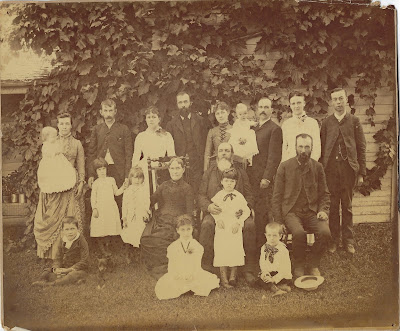

THE HOUSE ON BLACKFORD HILL - kossuthhistorybuff.blogspot.com
John and Mary (Call) Blackford Family

Even before they arrived in Kossuth County, a claim had been procured for the Blackfords to the west along the river, just outside the “city limits” of Algona at the time.  Their cabin was perched on what became known as “Blackford Hill” and it would later be replaced by the house that they would call home for the rest of their lives.  I was thrilled to find several photos of the Blackford home in the collection that was shared with us and the family has kindly given me permission to share some of the photos on my blog.

WHO WERE THE BLACKFORDS?


John Ellison Blackford and Mary Minerva Call Blackford were both born in Ohio.  When just a boy, John’s family moved to Indiana where he grew up.  His schooling was limited due to the frontier conditions, but he did attend the district school for two terms.  There he developed a love of reading and learning.


THE HOUSE ON BLACKFORD HILL - kossuthhistorybuff.blogspot.com


Mary was the fifth of eight children born to Asa and Mary Call.  Her father died when she was five years old, leaving her mother to raise the children on her own.  Left destitute, the family struggled to survive.  Due to her hard work and faith, their mother managed to keep them together. 


THE HOUSE ON BLACKFORD HILL - kossuthhistorybuff.blogspot.com


John and Mary were married September 28, 1845 in St. Joseph County, Indiana.  Their first two sons were born there.  In 1854, Mary’s two brothers, Asa and Ambrose Call, established a town located on the east fork of the Des Moines River in north central Iowa.  Soon after, the Blackfords received a letter from Mary’s brothers urging them to come and help settle the new town. 

John came from a long line of pioneers from whom he inherited a spirit of adventure.  He and Mary decided to answer the call of the frontier.  They began to prepare for trip during the summer of 1855.  They must have spent hours deciding what to take with them.  They started with a yoke of oxen and a canvas-covered wagon.  It had a good box, but no spring seat, which must have been uncomfortable for Mary who was expecting a child at the time.  The wagon carried a heavy load which included a cast iron stove, a large clothes chest made of cherry wood, and a solid wood bedstead made of beech and hard maple, along with clothing, bedding, dishes and food for the trip.  There also had to be room for them and their two boys, Edwin, age 9, and Ernest, age 3. 

The family began their journey of over 500 miles from northern Indiana in early September with a can of pine tar for the wheels swinging beneath the wagon and a long, single-barreled shotgun their lone protection.  They camped along the way and ate meals cooked over an open fire.  When they neared the Mississippi River, John traded the oxen for a team of horses and ever afterward said that he had made a very poor trade.  He had hoped to make better progress with the horses, but they did no better than the sturdy oxen.

After crossing the Mississippi near Lyons, Iowa, they began to travel by compass to the West and North, as dependable trails were scarce.  In some places John would have to go ahead to select a route along a ridge, to avoid sloughs, and when he had found it, he would place his hat on the barrel of his gun and hold it up so that Mary could see his location over the tall prairie grass and drive the wagon to him.  Their objective point was Clear Lake where they would get directions as to the best route to take to the Call settlement. 

SETTLING IN ALGONA


Although the Call settlement was almost directly west of Clear Lake, they were advised to go around the south end of the lake and across the flat country to avoid wetlands.  Near the current location of the town of Livermore, they began to follow the Des Moines River to the north, crossing the river just south of what we know as Irvington.  They finally arrived in Algona on October 10, 1855.  Although a cabin had been built for them on their claim in anticipation of their arrival, another family was living there while they were working on their own cabin.  An addition was hastily added to Asa Call’s cabin and the family moved in where they remained through the winter.  Their daughter, Ella Algona, was born there on January 18, 1856, the first white child born in Algona.   

That spring after a particularly severe winter, the family moved to their own log cabin.  Ambrose Call set up a saw mill that summer and John was put in charge as sawyer.  As new settlers came, he was kept busy providing lumber for construction.  In 1857 during the Indian scare following the Spirit Lake Massacre, he worked round the clock at the mill sawing planks for use on the fort built in Algona for protection of the settlers.  During this time he sent his family to stay with Asa and Sarah while he stayed at the mill, catching what little sleep he could.

He used to tell the story of an incident which occurred during this time.  At a meeting of area citizens, they had agreed upon the firing of two shots in rapid succession after dark as an early warning signal of the approach of Indians.  Two men who were close neighbors of the family had been away and knew nothing of the signal that had been decided upon.  While crossing the river, their guns got wet and so when they got home they fired them to clean and reload them.  John, hearing the signal, grasped his gun and told Mary to run with the children into the darkness of the brush surrounding the cabin and to remain there until he returned.

The youngest son, Ernest, refused to leave the house until his shoes were put on and laced.  Fearing an outcry which would alert the Indians, Mary held her nerves in check while kneeling on the floor, in the light of the fireplace, laboriously picking out the knots in the hard leather shoestrings and then putting on and lacing the little shoes.  Once that was done, she hurried out into the shelter of the brush until John arrived home and called to them to come out, that all was safe.

A BIGGER HOUSE


Their family continued to grow.  James Clarus was born in 1858, Mary Kate in 1862 and baby George in 1869.  To accommodate their growing family, a larger two-story home was built on the site where the log cabin had stood. 


THE HOUSE ON BLACKFORD HILL - kossuthhistorybuff.blogspot.com
Blackford Hill

The house was a large dwelling that stood majestically on Blackford Hill along with a barn, stable, and windmill.  Many large trees provided shade during the hot Iowa summers.  I was unable to determine the date the house was originally built, but we know that none of the pioneers remained in their log cabins for long, so I would estimate the house was constructed sometime between 1857 and 1860.

The center main section faced south with a wing on each side, all two stories in height.  A one-story addition was attached to the west wing of the structure.   We do not know if the house started smaller with additions added at later dates or if it always had the same floor plan, but the house shown in the pictures would have accommodated not only a large family, but many social gatherings as well. 


THE HOUSE ON BLACKFORD HILL - kossuthhistorybuff.blogspot.com


On the south side of the house were several porches separated by a sunroom with large pane glass windows.  During the long cold winters, it is likely that the sunroom provided much light and perhaps some warmth to the dreary days.  It appears that Mary was quite the gardener.  There is a picture of her standing in front of the house during the summer.  Much of the residence is covered with an ivy or a vine of some sort that grew clear up to the peak of the roof and many potted plants line the edge of the porches, soaking up the sunshine. 

The home was located on the north side of McGregor Street somewhat west of the drive now leading to Blackford Park which is on the south side of the street.  There was no entrance to the homestead from the south—in fact their drive began where West Nebraska Street ends and wandered back to their building site.  As a visitor, you would approach the house from the east, and after tying up your horse to the hitching post, climb up the steps placed in the side of the hill and then walk toward the house.  When greeted by John or Mary after a knock at their door, you would likely have been welcomed with the warm hospitality for which they were known. 


THE HOUSE ON BLACKFORD HILL - kossuthhistorybuff.blogspot.com


The sitting room is featured in one photo with John and Mary seated with a guest between them and George at the piano.  The room is tastefully decorated for the time with floral wallpaper, luxurious lace curtains and art work hung from the picture rail.  Mary has a large book on her lap which may be a photo album or perhaps a Bible.  From the wistful expressions on the women’s faces, I imagine George is playing a hymn or other ballad that brings them comfort or reminds them of days gone by.


THE HOUSE ON BLACKFORD HILL - kossuthhistorybuff.blogspot.com


Aunt Mary, as she was known to the community, was an excellent cook and housekeeper, so it is likely that she was always prepared for guests.  One can almost smell the aroma of fresh baked bread or cake coming from the kitchen.  Mary had a large garden and a flock of chickens as did most homemakers at the time and her jellies, preserves and pickles won many awards at the local fair.  Besides being a wonderful mother to her children, she helped to raise Asa’s youngest children after his wife died.  She also assisted Ambrose’s wife, Nancy, to learn the ways of homemaking after her marriage, since Nancy’s mother had died young and was not there to guide her.  Since Ambrose and Nancy’s home was nearby, whenever they needed help, they would hang a red blanket out the window and Mary would soon be at their side.


THE HOUSE ON BLACKFORD HILL - kossuthhistorybuff.blogspot.com


John was elected the first justice of the peace and from that point on became very involved in politics.  He served two terms as representative from this district in the Iowa Legislature.  He often commented that “My district at this time comprised seven counties and in making my canvass I frequently traveled 40 miles to see a single voter.”  He served one term as County Treasurer.  He was one of the members of the Iowa delegation to the national Republican convention that nominated Lincoln for president the first time, although he was not able to attend in person.  John was a charter member of the Grange and served as Worthy Master of the Iowa State Grange for about 10 years.  He also ran a store in Algona called “The Grange.”  It is easy to imagine that these positions did require the couple to entertain constituents or groups in their home often. 

The location of the home was a wonderland for their children.  They spent many hours running through the woods, sledding down the snow covered hills, fishing in the nearby river and playing with the other children in town.  In later years the Blackford children often spoke of the wonderful memories they had growing up in that house. 


THE HOUSE ON BLACKFORD HILL - kossuthhistorybuff.blogspot.com
The Blackford family relaxing


Both John and Mary were able to remain in their home until their deaths, despite failing health.  Mary died on March 30, 1905 at the age of 77 as the result of a stroke.  John passed from this life on August 20, 1911.

FAMILY LEAVES THE COMMUNITY


After the death of their father, the Blackford children who had remained in Algona gradually left the area.  Mary Kate had died of cancer in 1910 and one by one, the others moved to other locations.  In August of 1915 the Presbyterian Church held a special gathering bidding George, Ernest and Ella goodbye.  An article in the August 11, 1915, edition of the Upper Des Moines newspaper describes the message given by Ben Reed at the event. “He spoke of the social and political leadership of the father of the family in the early days and the sterling character of the mother, who sympathized with all pioneer enterprises, and expressed his regret that the Blackford family was at last to leave the community with which in had been uninterruptedly connected since 1855.”


THE HOUSE ON BLACKFORD HILL - kossuthhistorybuff.blogspot.com


The property on which the family home was located was sold to George Platt who resided there for a few years before selling it to Dr. J.O.F. Price, a local veterinarian, in 1920.  Dr. Price eventually razed the Blackford house and built a new home for his family.  Thus, the Blackford era in Algona came to an end – well, except for Blackford Park which still lives on, but that is a topic for another day. 


I want to thank Blackford family members, Donna and Larry and Dennis and Janice, for their desire to see the Blackford name live on in Algona and their generosity in sharing photographs and documents of great historical value to our community.  Rest assured, they will be lovingly cared for.

Until next time,

Kossuth County History Buff


If you enjoyed this post, please don’t forget to “like” and SHARE to Facebook.  Not a Facebook user?  Sign up with your email address in the box on the right to have each post sent directly to you.

Be sure to visit the KCHB Facebook page for more interesting info about the history of Kossuth County, Iowa.

Reminder:  The posts on Kossuth County History Buff are ©2015-19 by Jean Kramer.  Please use the FB “share” feature instead of cutting/pasting.

Saturday, August 24, 2019

A (FUNNY) STORY OF EARLY PIONEER DAYS


I love a funny story, don’t you?  I came across the following article that was published in the Friday, March 18, 1903 edition of the Algona Courier and have to confess that it really tickled my funny bone.  The story clearly illustrates how much our ancestors loved pulling pranks and tricks on each other.  So sit back and enjoy a tale of marriage proposals and high jinks.


A STORY OF EARLY PIONEER DAYS

It is one that Should be Preserved in the Archives with those
Of Little Crow and Inkpadutah

Many interesting stories of the early days of Kossuth have been written and published, for which the people generally are grateful to the historians and no doubt future generations will also pay the tribute of gratitude to them.  They will read with consuming interest the stories of Little Crow and Inkpadutah, the Spirit Lake massacre, the hardships of early settlers from the inclemency of the weather, and their hair-breadth escapes from the scalping knives of the savages and the fangs and claws of wild animals.  But we think historians are too much inclined to magnify battles and warriors and to overlook the social side of history.  They should not neglect the growth of society and social life of the people, for in those features their history consists as well as in their struggles with human and animal enemies.  It is, then, to fill in between the sanguine chapters of Kossuth county that have been written, a short chapter of social life, that we essay this truthful and unvarnished tale.


A (FUNNY) STORY OF EARLY PIONEERS - kossuthistorybuff.blogspot.com
From History of Kossuth County
published in 1913

Among the sturdy early settlers of Kossuth county there was none more sturdy or better fitted to grapple with the condition of frontier life than Samuel Reed who in early day moved from Illinois to Kossuth county and settled in Irvington township on the “Ridge” about six miles south-east of Algona.  He came to get good cheap land for himself and his several boys who were then quite young, some of them but children.  Mr. Reed was strong of body and of mind and being industrious and frugal he soon established one of the best country homes in the county.  He was known to all the settlers in the county at that early time and to many far outside its borders, and at about the time of which we write he was the sheriff of the county.  At that time there was but a small settlement about Irvington and Algona, one at Emmetsburg, at Estherville, and a few perhaps at Armstrong Grove.  Aside from those dots of civilization the country to the west and northwest was an unoccupied prairie.

As is the case in all new countries marriageable women were then very scarce in Kossuth, and distance was not as much of a barrier between neighbors and settlements as it is now.  Neighbors who lived ten or fifteen miles apart were quite intimate with each other, and some persons in the Algona settlement knew every person in the Emmetsburg settlement, and vice versa.  Under such conditions it is not surprising that Sam Reed was known far and near, and it is not surprising either that a good looking young marriageable woman was heard of a long distance from home.  And when the marriageable young woman was in the home of Sam Reed it is easy to understand how she was heard of even at Estherville.  The young lady that we refer to was a school teacher who was then teaching on the “Ridge” and was boarding at Mr. Reed’s.  It is not necessary for the purpose of this story to mention her name nor the name of the gallant who came all the way from Estherville, or somewhere in that neighborhood, to propose marriage to her.

It was one evening in midwinter in the year 18~ that a team with a lone man holding the reins drove up to Sam Reed's, and the man made enquiry as to whether he was at the right place, and being assured that he was he asked if he could stay overnight.  The Reed home was a hospitable one at which no traveler was refused food and shelter, and the man was made welcome.  When he had an opportunity he confided the object of his visit to Mr. Reed.  He said he was a widower and well-to-do for those times, and that he heard of the lady teacher and came there to propose marriage to her, though he had never seen her before.  Mr. Reed, always good-natured and willing to assist to every worthy enterprise, assured him that he would put no impediment in his way and wished him success.

The traveler was ushered into the house and introduced all around and presented with a little more formality to the school ma'am then to the others.  By some sort of mind-reading or mental telegraphy it was soon understood by the whole family what the object of the stranger's visit was, and no doubt the school ma'am's mind was as acute to the prevailing impressions as any one.  The family had supper as usual and after it matters and things in general were discussed, and the visitor being quite an intelligent man sustained his share of the conversation very creditably.

Among the very interested observers of all that was going on was the hero of this tale, B. F. Reed, a son of the old gentleman, then a promising youth in his teens, late editor of the Advance and not unknown to fame in other ways, and a hired man who was then working for Mr. Reed. They sized up the situation and enjoyed it.  Finally when the usual bed time arrived, Mr. Reed, after showing the stranger where he might retire when he got ready, quietly motioned all the others off to bed, leaving the stranger and the school ma’am sole occupants of the sitting room.  Ben and the hired man slept upstairs, and in order to utilize space the stairway intersected the partition or the partition intersected the stairway, so that the three lower steps projected into the sitting room. When Ben and the hired man were going to bed they left the door on the stairway a little bit ajar, and retired to bed in good order.  They listened intently to catch the thread of the conversation that they knew was going on below, but could not.  Finally the hired man suggested that they get out of bed and sneak down the stairway to the door and listen and peek there.  So out of bed they sneaked and down the stairway, Ben in the lead.  They did not bother to dress, and be it remembered that farmer boys in those times did not wear the long night robe that is so popular with some gentlemen now-a-days, nor did they even wear drawers.  Ben got his eye to the opening to see and his ear alert to hear, while the hired man stood above him and peeked also or obtained the situation second handed from Ben.  Ben saw the anxious and business-like suitor hitch his chair over nearer and nearer to the coy maiden, and he caught snatches of the story that he was pouring into her ear.  They maintained their position on the stairs several minutes, Ben all eyes and ears to what was going on below, but it seems that the hired man was beginning to feel cold or that Satan tempted him to pay a trick on his unsuspecting confederate, for while Ben was stooped over to catch every syllable that was spoken, he put his foot on Ben’s back and gave him a shove that sent him through the doorway and sprawling on the floor at the feet of the astonished couple. Their surprise and indignation may be imagined as may Ben’s shame and discomfiture.  He sprang to run upstairs, but lo, that fiend of a hired man was holding the door closed on the inside and he could not get upstairs or out of sight.  He looked in every direction for a place to hide as he tugged frantically at the door, but saw none and wished the ground would swallow him, when his friend finally took pity on him and let him up.

A (FUNNY) STORY OF EARLY PIONEERS - kossuthistorybuff.blogspot.com
Benjamin F. Reed in a later, more dignified pose


What might have been the fate of the gallant widower’s suit had not this unexpected incident occurred at the crucial moment cannot be told, but certain it is that he utterly failed, and it is not improbable that to this day he is cursing the fellow who so unexpectedly and in such undress uniform broke in upon his eloquent and pressing plea to the object of his devotions.  The suit was all off for that night and the suitor went to bed in no very pleasant mood.  But he was not a man to retreat at the first repulse, and the next day he visited the school and took part in the recitations.  The class in arithmetic was reciting in mensuration, and he talked learnedly of acute and obtuse angles and of perimeters and diagonals, but all to no avail, for the fair teacher was obdurate and would give him no countenance.  He gave up the siege and returned to whence he came, and has since been lost to Kossuth people.  The young lady got married to another and lives not a thousand miles away, having reared a fine family.

When the news of this incident reached Algona it set the little town roaring with laughter, and so tickled was the last O. E. Palmer that he hitched up his team and took his friend W. H. Nycum, now also deceased, down with him to see the stairway from which Ben was shot as from a catapult into the presence of the lovers, and laugh it out on the spot.  


The writer of the article is not identified, but I agree with his observation that when we look back at the early pioneer days, we sometimes dwell on the obstacles faced rather than contemplate the humorous situations encountered.  All the photos I have ever seen of Ben Reed show him as an adult in a very dignified pose.  It is delightful to think of him as a teenage boy caught up in such a shenanigan. 

A (FUNNY) STORY OF EARLY PIONEERS - kossuthistorybuff.blogspot.com


If you want to learn more about the Reeds and others who are buried in Laurel Hill Cemetery in Irvington, I cordially invite you to attend the monthly meeting of the Kossuth County Historical Society on September 4th.  We will be conducting a mini cemetery walk during which you will hear some of the stories of the residents who rest there.  It all starts at 6 pm at the cemetery which is located on the south side of Irvington.  So bring your lawn chair and join us for a walk through Laurel Hill.

Until next time,

Jean

If you enjoyed this post, please don’t forget to “like” and SHARE to Facebook.  Not a Facebook user?  Sign up with your email address in the box on the right to have each post sent directly to you.

Be sure to visit the KCHB Facebook page for more interesting info about the history of Kossuth County, Iowa.

Reminder:  The posts on Kossuth County History Buff are ©2015-19 by Jean Kramer.  Please use the FB “share” feature instead of cutting/pasting.

Thursday, July 4, 2019

KOSSUTH COUNTY'S FIRST 4TH OF JULY CELEBRATION


Today we celebrate the 243rd birthday of America.  It is a day to acknowledge and give thanks for the freedom we enjoy, won by the blood of many brave patriots.

KOSSUTH COUNTY'S FIRST 4TH OF JULY CELEBRATION.kossuthhistorybuff.blogspot.com


The first celebration of 4th of July in this county occurred in 1856.  The small group of citizens who had settled here gathered together around a flag pole made from a tree, flying a flag pieced together from a sheet and a dress.  Can you picture this small group of strangers who had come to this area from various places and for various reasons who now circled around this sturdy wood pole as neighbors and pledged their allegiance to this great country? 

Page 307 of Ben Reed’s History of Kossuth County describes the first July 4th celebration in the county like this:

        “July 4, 1856, was celebrated in Cresco Township.  The gathering was at a spot about a half-mile southwest of the Brown cabin.  A tall, slender oak tree was set up for a flag pole, and on it floated a flag Mrs. Brown had made by tearing up a sheet and her daughter Jennie’s (Mrs. Altwegg’s) red dress for stripes.  The settlers enjoyed the first celebration dinner in the county.  The flag pole stood there for many years before it was removed.  Some old settlers who were here at the time are of the opinion that on this same day a celebration was held in Algona.  Mrs. Jane Thompson and Miss Emma Heckart who came in the spring of 1856 are of that opinion, and narrate events to justify their conclusions.  Mrs. Stacy who was present at the celebration on July 4, 1856, is certain that from what was said at the time that no celebration in Algona had occurred the year before.  This is also the opinion of Lewis H. Smith, who came to Algona, July 4, 1855.”


And the memories of Florence Call Cowles in the same book at page 415:

        “Another liberty pole which excited my childish imagination and which seemed almost a living thing, stood in Cresco township, ‘near the lone tree.’  Here, my father told me, Cresco people held a celebration, in 1856, when the flag staff was erected.  For over thirty years it stood alone on the prairie, at first proudly erect, a solemn monument of the intensity of feeling of our people in the North, which in 1856 was crystalizing and concentrating for the impending struggle.  With the weight of years the old liberty pole bent lower and lower, and when in the ‘90s it fell crumbling on the prairie, with no eye to witness its dissolution, it seemed a fitting symbol of the passing of that sectional bitterness which it seemed so difficult for us to give up, but which we realize must go, if we are to exist as one great family with common interests and a common future.”

In the late 19th century, a collection of historical memorabilia was collected by a Mr. Pettibone and put on display in the courthouse.  Among the souvenirs was a remnant of that first flag pole.  It was given to him by Alex Brown, a descendant of Mrs. Brown who made the flag. 

KOSSUTH COUNTY'S FIRST 4TH OF JULY CELEBRATION.kossuthhistorybuff.blogspot.com
A portion of the first flag pole
in Kossuth County erected July 4th, 1856.
On display at the Kossuth County
Historical Museum.

A piece of the first liberty pole is owned by the Kossuth County Historical Society and on display in the museum.  Could it be the one that was part of the Pettibone collection?  We may never know.  But we can be sure that no flag pole was ever loved so much for what it represented.

Happy Independence Day to you!

Until next time,

Kossuth County History Buff


If you enjoyed this post, please don’t forget to “like” and SHARE to Facebook.  Not a Facebook user?  Sign up with your email address in the box on the right to have each post sent directly to you.

Be sure to visit the KCHB Facebook page for more interesting info about the history of Kossuth County, Iowa.

Reminder:   The posts on Kossuth County History Buff are ©2015-2019 by Jean Kramer.  Please use the FB “share” feature instead of cutting/pasting.