Thursday, August 31, 2017

Happy 100th Birthday Dad!

My dad, Bill Prothman, passed away August 29, 1995.  It is hard to believe that he has been gone 22 years.  If he had survived, he would celebrate his 100th birthday today (August 31, 2017).  He and Mom are never far from my thoughts, but with this milestone approaching, he has been on my mind even more frequently. 

Bill pictured with family
home in the background
Dad was born many miles from here near the tiny town of Adanac, Saskatchewan, Canada.  His grandparents had immigrated to Arkansas from Prussia and their son Carl (my grandfather) operated a general store along with his brother-in-law, Paul Reiss.  The two heard stories of cheap land in Saskatchewan so they sold the store in Arkansas to seek their fortune there.  Paul went ahead and soon established himself in a general store and post office in the town of Salvador.  When Carl arrived with his family in 1913, he discovered that Paul had purchased a farm for him to operate, keeping all of the retail business for himself.  Carl had never farmed before and, to make matters worse, the broken down house on the place consisted of only four rooms.  At that time the couple had five children and would go on to add six more.  As the boys grew, they would often sleep in the granary during the summer months to make more room in the house.

Dad often spoke of his Granny Amelia Prothman who also came to live with them when she was not happy living with the Reiss family.  She was a hard worker and helped the growing family in many ways.  Granny slept in the girls’ room and would often use her cane to grab whoever walked by her bed to get their attention.  Her English was not good and the children learned some German to converse with her. 


Salvador, Saskatchewan, Canada

As you might imagine, times were hard.  Dad never seemed to complain about his childhood though and had many happy memories.  The children enjoyed ice skating—hockey in the wintertime—riding horses and playing ball in summer.  He talked of walking three miles each way to attend school in Salvador, with occasional buggy or bobsled rides.  He was able to complete 8th grade and had begun high school when his father kept him out to do fieldwork and he never went back.  His lack of formal education did not slow him down at all.  He became a voracious reader and was virtually self-educated.  I always admired my father’s intelligence and knowledge. 

When he was 16, he and other boys from the area began to work the wheat run.  They would hop on a freight train (illegally) and follow the harvest.  The majority of his earnings would be sent home to the family.  My Uncle Greg (dad’s youngest brother) once told me with tears streaming down his face that he saw dad and several other young men horse whipped by a train worker when they were discovered stowing away on a freight train near their home.  Dad never spoke of that incident to me.  Despite all of the hard work of both my grandparents and their children, due to drought, the economic downturn that occurred during the depression and likely my grandfather’s inexperience at farming, they finally lost the farm.

Dad’s oldest brother, Carl, entered the priesthood and was sponsored financially by a family from the Wesley area by the name of Roadinger.  They corresponded with my grandparents and, learning of their large family and economic constraints, invited dad to come to Wesley and sent him bus fare.  He arrived there on October 13, 1938 to visit for six weeks.  Little did he know that six weeks would stretch into 67 years!

Bill and Evelyn
on their wedding day
After arriving in Wesley, dad began to work on farms around Wesley, Sexton and Woden. He started to make friends in the area, one of whom was a gentleman by the name of Bernard.  It just so happened that Bernard was seeing a young woman from Algona by the name of Evelyn Rammer.  Bernard invited Bill and a date to accompany them to a dance.  Bill and Evelyn really hit it off.  It wasn’t long before Bernard was out of the picture and Bill and Evelyn became a couple, marrying June 8, 1940.  Dirt poor, the couple began their marriage with all of their worldly possession piled in the back seat of a used Model A.

In front of his Model A
They moved in with Mom’s aunt who was debilitated due to a stroke and cared for her until another family member was able to assume that responsibility.  They then moved to an apartment for a short time, then into a newly constructed Quonset which had been intended for use as a chicken coop while dad was employed for the farmer owner.  Their oldest child, Kathryn, was born while they lived in the Quonset and Mom often had to sit outside with her during the hot summer as it became too warm inside the metal building.

Dad worked various jobs early on, including a year and a half at an egg produce plant.  In late 1943 he began working as Assistant Fire Chief at the prison camp.  By this time, the couple had added an infant son, Michael, to their family.  When “Greetings” arrived from Uncle Sam, dad decided to enlist rather than be drafted.  Before he entered boot camp in May of 1944 in Camp Sibert, Alabama, the young couple purchased a house so that mom and the kids would have some security in his absence.  Once through boot camp, he was then transferred to Camp Butner, North Carolina, and then served in the Pacific Theatre on Saipan in the Mariana Islands.

Bill in his Army uniform

It was such a happy day when dad returned home after his service.  My mother often described the scene.  She knew that he would be returning at any time and so every day she would run to her back window as the train would pull into the station.  She would watch for a glimpse of his silhouette disembarking, hoping to tell the kids that daddy was home.  Dad however was intent on surprising the family and on the day of his return, managed to get off the train without detection.  He walked the short distance to the location of their house, quietly opened the door, and then rolled his dress hat across the floor, loudly announcing, “Daddy’s home to stay.”

Regretfully, I never spoke to Dad in depth about his experiences in the service.  I do know my mother said he came back a changed man.  He struggled with alcoholism to varying degrees for many years following, but later became involved in A.A. and served as a sponsor for many recovering alcoholics through the years.  In fact we would often find an extra plate at the dinner table for a “friend.”  I now realize that most of the time those “friends” were fellows who needed a good meal and a helping hand to get back on their feet.

After returning from the war, his job as a fireman at the P.O.W camp no longer existed, so dad found work in the construction field.  The economy was booming after the war, especially in the building trades.  Eventually dad struck out on his own, opening his own masonry business in 1947. He became well known for his skill at brick laying and many homes and business buildings in the area stand as a testament to his talents, including the V.F.W. Hall, the Kossuth County Courthouse, and the Algona Post Office.


Daughter Connie standing in
front of Dad's truck in the mid 1950s

Four more children were added to the family with 22 years between the oldest and youngest.  My parents never became wealthy in worldly goods, but dad often stated that he wouldn’t trade any of his kids for a million dollars.  And we knew he meant it.

In 1957 my parents purchased a house and property that had been in my mother’s family for several generations.  They fixed up the big old house which we called home for many years.  In the early 1970’s they decided to build a new split-level house on the site.  It was constructed of brick that came from the building that once housed Hub Clothiers and Finn's Bakery.  Following the fire that brought down the building on Labor Day of 1970, many truckloads of debris were brought to our building site.  I and a brother spent numerous hours sorting brick and knocking off mortar so that the bricks could be recycled into the new house.  We moved into the partially completed house in late summer of 1972, just as I was starting my senior year of high school. 


House lost in tornado of 1979

Dad worked on finishing the house in his spare time.  It contained cabinets, woodwork and trim that he constructed out of native Iowa walnut and had both a brick fireplace in the lower level and a stone fireplace in the living room on the upper level.  It took many years to complete, but only a few moments to destroy when it took a direct hit from the devastating tornado that passed through Algona on June 28, 1979.  My parents and youngest brother, Bill, Jr., were home at the time and all survived one of the most harrowing experiences of their lives.  Although thankful that all were safe, Dad nevertheless found himself at age 62 needing to start over once again.

He retired from his business then but would go on to build one more house, this time at Oak Lake where he and mom would reside until they downsized in 1994 and moved into Algona.  Dad enjoyed his retirement, taking on simple projects, helping family, and volunteering—such as helping the Algona FFA build the welcome signs which greet you at the entrances to our city.  Eventually his heart condition worsened and he passed two days before his 78th birthday following bypass surgery.

So many happy memories remain—his endless supply of jokes and funny stories, his patience teaching me how to drive a stick shift, quiet companionship while fishing on the dock, his silliness with my kids when they would comb his hair into kooky styles, and the love and pride he had for his family.


Dad on the front porch of their final home

So dad—here’s to you!  Happy 100th birthday!  I hope you have a great celebration in heaven with mom, brother Mike, and the rest of the extended family.  Love you always and forever.

Until we meet again,

Jean


If you enjoyed this post, please don’t forget to “like” and SHARE to Facebook.  Not a Facebook user?  Sign up with your email address in the box on the right to have each post sent directly to you.

Be sure to visit the KCHB Facebook page for more interesting info about the history of Kossuth County, Iowa.


Reminder:  The posts on Kossuth County History Buff are ©2015-17 by Jean Kramer.  Please use the FB “share” feature instead of cutting/pasting.

Friday, August 11, 2017

"TWO GUN" HENDERSON

During the depression years of the 1930s, bank robberies were quite common across the nation.  There were many notorious criminals--the names John Dillinger, Bonnie and Clyde, and “Baby Face” Nelson come to mind.  Several of them were alleged to have passed through or near the area.

However, the name that struck fear and terror in the hearts of local bankers and law enforcement here in northern Iowa was that of “Two Gun” Henderson.  Born in Arkansas, Hillary “Two Gun” Henderson came to this part of the country via Texas, Missouri, Kansas and Nebraska, leaving a trail of robbed banks in his wake.  It wasn’t long before he found some Kossuth County banks ripe for the picking.

Between the middle of August and the middle of November of 1930, four area banks were robbed—the Bank of Lu Verne, the Exchange State Bank in Wesley, a bank in Hardy, and finally the People’s Savings Bank in St. Benedict which was robbed twice in less than three weeks.

LU VERNE BANK ROBBED

Bank of Lu Verne
The robbery in Lu Verne occurred on Wednesday, August 20, 1930, at about 9:30 a.m.  Two men with guns drawn entered the bank and told the three employees – Consuelo Hanna, W.Scott Hanna, and Arthur Hof – to “stick ‘em up.”  With their hands in the air, the trio was then directed to lie down on the floor.  The younger of the two men was wearing a mask and guarded the bank
Consuelo Hanna
workers.
  His nervousness was palpable and the other bandit reassured him several times that there was little danger.  The older robber cleaned out the teller drawer and then ransacked the vault.  Once he had plundered all cash and bonds in sight, the three staff members were ushered into the vault and the door was shut and locked.  The two bandits escaped to the car where their accomplice, St. Benedict native Art Rosenmeyer, was waiting and they tore out of town to the north.  The two robbers would later be identified as “Two Gun” Henderson and Lawrence Dugan. 

Meanwhile, after giving the bandits sufficient time to leave, Mr. Hanna worked the inside combination to unlock the bank vault.  Once the door was open, he called Sheriff L.E. Hovey to report the theft.  The bank robbers had been spotted by a LuVerne youth as they left the bank with money bag in hand.  He did not enter the bank until they had disappeared.  It is interesting to note that a news article in the August 27, 1930 edition of the Whittemore Champion reporting the robbery chastised the young man by stating, “The youth was driving a Buick, and could have kept the robbers in sight if he had grabbed a companion off the street and chased them immediately.”  Later in the article further directions were given to the public.  “Proper procedure following a bank robbery, as suggested by Mr. Hovey, is to follow the bank robbers at a safe distance.  The important thing is to keep them in sight.  This forces the robbers, naturally nervous, to keep to the main roads in order to make speed.  In the meantime the surrounding country will be warned and be on the look-out.  The sheriff or other peace officers would then have a chance to waylay the car and its occupants.”

The getaway car was found two days later near a straw pile on a farm near Hanna Switch.  The vehicle had been stolen from F. B. Spangler in Janesville, Minnesota, and the plates came from a vehicle registered to a man near Buffalo Center.

EXCHANGE STATE BANK, WESLEY

Almost a month passed before the next robbery.  On the morning of Thursday, September 18, 1930, “Two Gun” Henderson, brandishing a revolver and swearing, entered the Exchange State Bank at Wesley.  His face had been smeared with grease to camouflage his appearance.  He demanded that the employees and a customer lie on the floor while he looted the till of about $700.  Henderson next herded the group behind a partition in the center of the bank and again made them lie down.  The bandit then demanded that the assistant cashier, John Hutchison, open the vault, but Hutchison convinced him that there was a time lock on the door which prevented him from opening it.  Knowing he would be unable to get to the more lucrative stash kept in the vault, “Two Gun” fled the bank.  He jumped into a gray coupe and headed west out of town at a high rate of speed.  Officers attempted to follow but eventually the driver eluded them. 

Exchange State Bank, Wesley, Iowa

After his escape from the law, Henderson met up with Art Rosenmeyer and another accomplice, Walter Baer.  The night before he had tried to talk them into helping him rob the Wesley bank but they had declined.  Now that he had boldly committed that robbery on his own, he convinced them to accompany him to the Hardy bank that afternoon. 

ROBBERY IN HARDY

Henderson and Baer entered the Hardy bank at about 3:30 p.m.  Following the same modus operandi used in the earlier robberies, an employee and a customer were ordered to lie on the floor while another employee was ordered to open the vault.  As the robbery unfold, a woman passing by observed what was happening and spread the alarm.  As the men fled the bank, Marshal Lewis Rasmussen fired, hitting “Two Gun.”  The two robbers made it into the car which quickly sped out of town.  Although law enforcement followed in hot pursuit, the robbers’ car was no match and soon outdistanced their pursuers. 

Although the marshal was able to get a shot off at the fleeing bandits, State Agent J. E. Hronek who investigated the case, expressed his disappointment that area merchants had not taken action.  Having been warned by the observant woman, the merchants, armed with shotguns, took positions on the roofs surrounding the bank.  He stated that they could have fired into the engine or tires of the vehicle to block escape or actually fired at the bandits while they made their getaway.  A carload of local men actually pursued the getaway vehicle out of town.  It eventually turned into a dead end road.  Hronek was upset that instead of blocking their escape path, the locals allowed their quarry to turn around and speed by them without firing a shot.

As the robberies became more common, bank robbers were wanted more dead than alive.  In September of 1930 the Palo Alto County Bankers Association offered a reward of $1,000 for “the first dead bank robber brought in by any person or any member of the vigilante committee.”  Many local communities organized vigilante groups to provide additional protection which, from the comments of the sheriff, appears to have been encouraged.

It was said that had an attempt been made on any Algona bank, anywhere from 10 to 20 shotguns would have gone into action on State Street.  The courthouse was also heavily armed.  Clerk of Court Clark Orton kept a deer hunting rifle in the second floor southeast corner room ready to spring into action.  In reality Algona was most likely protected by its traffic problem.  At that time cars were double parked on each side of State Street making it difficult to make a quick getaway.

The three robbers involved in the LuVerne, Wesley and Hardy crimes were not able to be tied to either of the robberies of the Peoples’ Savings Bank of St. Benedict although Art Rosenmeyer was suspected of being involved in the first robbery that occurred there.  Three other men were later arrested for the second robbery.  They were identified as Myron Martin of Renwick, Clarence Perry of Clarion and Harris Damon of Holmes.

PAYING THEIR DEBT TO SOCIETY

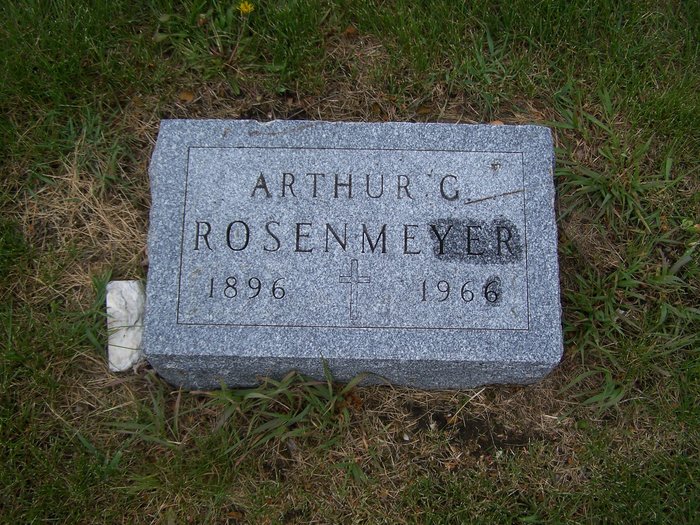
The only local man involved, Art Rosenmeyer, was apprehended and charged with aiding and abetting the two men who robbed the Bank of LuVerne, Iowa, by acting as the getaway driver.  He was sentenced to an indeterminate term not to exceed life on October 30, 1930 and sent to Fort Madison.  He was paroled on February 12, 1936 and returned to the St. Benedict area where he lived the rest of his life.  Rosenmeyer married in 1944 and had eight children.  He died in May of 1966 and is buried in the St. Benedict Catholic Cemetery.


So what happened to “Two Gun” Henderson?  He had also been suspected of bootlegging when he resided on a farm near Blue Earth, Minnesota, before he became a bank robber.  At the height of the crime spree, local law enforcement did all they could to track him down.  Accomplices were arrested in Minnesota and Sheriff Hovey and witnesses from the various bank robberies traveled to make identities and to obtain information about the ring leader.  Henderson, along with a pal, Clarence Campbell, was finally arrested in Wichita, Kansas, in October of 1931 after robbing the bank in Hayesville.  Sentenced to a maximum of 50 years at hard labor in Kansas, he was released from prison in 1939 and brought back to Kossuth County.  Henderson pled guilty to robbery with aggravation for the robbery of the Exchange State Bank in Wesley.  He was sent to the Iowa State Penitentiary at Fort Madison to serve 25 years.  Court records reflect his release in September of 1945. 


From that point on, his information trail runs cold.  Did he ever answer for any other robberies or crimes he may have committed?  Or did he turn his life around after serving his time?  Most likely, we will never know.  Hillary “Two Gun” Henderson was finally laid to rest in Mount Sherman, Arkansas following his death on August 28, 1969.  Although he is gone, his legend lives on.

Until next time,

Jean, a/k/a KC History Buff


If you enjoyed this post, please don’t forget to “like” and SHARE to Facebook.  Not a Facebook user?  Sign up with your email address in the box on the right to have each post sent directly to you.

Be sure to visit the KCHB Facebook page for more interesting info about the history of Kossuth County, Iowa.


Reminder:  The posts on Kossuth County History Buff are ©2015-17 by Jean Kramer.  Please use the FB “share” feature instead of cutting/pasting.

Wednesday, July 26, 2017

REMINISCING WITH GEORGE BLACKFORD

I was doing research recently for the WWI project of the Kossuth County Genealogical Society and I happened to stumble on a letter that was written by George Blackford in January of 1918.  His letter is filled with memories of places in and around Algona, the names of some of which I had heard before and others I had not.  Do you know of Hodgman Pond, Walnut Slough, Toboggan Hill, Big Spring, Lilly Hill, Windflower Hill, or Maple Grove?  Alas, he only mentioned them in passing and did not specify locations.

George was a son of John Blackford and Mary (Call) Blackford who came to Kossuth County in 1855.  His oldest sister, Ella Algona, was the first white child born in the county and was named after the city of her birth.  George was born in 1869 after the area had become just a bit more civilized.

After finishing his schooling, he had taken up photography.  First by taking over the business of J. F. Nicoulin and then eventually moving from Algona, living in places such as California and Missouri.  When he wrote the letter in January of 1918, he was residing in San Jose, California.  I can almost picture him sitting by the fire reminiscing and penning his memories.


        As I sit here in my room and watch the firelight in the open grate, my thoughts go back to Algona and the old home.
        It does not seem so very long ago since I was a boy there, but, as Browning says,

        “We live in deeds, not years, in thoughts, not breaths,
        In feeling, not in figures on a dial.”

        I think of all the old familiar places, and picture them in my mind.  I wonder how many of the younger generation of Algona boys are familiar with the localities in and around Algona with which I was so familiar in my boyhood days.  I suppose some could locate Henderson’s Bluff, Hodgman Pond, Walnut Slough, or Toboggan Hill, but I dare say none could locate the Big Spring, Lily Hill, Windflower Hill, the Maple Grove, or the site of the pioneer cabin of the Blottenberg family.


REMINISCING WITH GEORGE BLACKFORD.-kossuthistorybuff.blogspot.com


Early Indian Scare Recalled.
        This cabin was the scene of an incident of early Algona history, the recital of which has often thrilled me. 
        At the time of the Spirit Lake massacre, while the nerves of the handful of settlers were keyed to a high pitch of tension and an attack by the Indians was hourly expected, a meeting for defense was held, at which it was agreed that two shots, fired in rapid succession, after dark, should be the signal of the approach of the Indians.
        Two men, living at this cabin, were away from home, to bring in provisions and ammunition, when this signal was agreed upon, and therefore knew nothing of it.  Crossing the river, they had got their guns wet, and on their arrival at home, after dark, fired them off, to clean and reload them.  My father, hearing the signal, grasped his gun, and, telling my mother to run with the children into the darkness of the brush surrounding the cabin, hastened, as did the settlers from the more distant homes, to the Blottenberg cabin, to resist what all thought was the expected attack.

Perverse Child Delays Flight
        It so happened that my older brother had that day been playing in the wet grass, and had got his shoes wet, and, in childish perversity, he refused to go out of the house unless his shoes were put on and laced, and, fearing an outcry, my mother had perforce to hold her nerves in check, and, kneeling on the floor, in the light from the fireplace, laboriously pick out the knots in the hard leather shoestrings and put on and lace the little shoes, before hurrying out into the shelter of the brush.  Soon after, my father returned, with the welcome news that it had been a false alarm.
        I have often wished I could have a picture of the Maxwell cabin, as it stood among the sturdy oak trees, on the site of the old home, now owned by Geo. Platt, on that October day in 1855, when my father and mother and two elder brothers arrived there, after their long and perilous journey from the east.  The place has since been named, “The Oaks.”  I can recall at least a dozen oak trees near the house that died.  The number of grand old trees in and near Algona is rapidly diminishing, as are the pioneers they sheltered.

Scenes Now Gone Forever
        How many Algona boys know that the courthouse square was once enclosed by a wooden fence, and that what is now Maple Park was once a yard for the “town herd” of cattle, given to the prairies west of town to range?
        And speaking of the prairies reminds me that no more do we see the waving grass and beautiful flowers of the virgin prairie sod.  The march of civilization has obliterated it.  As Bryant so beautifully expresses it,

“The Hand that built the firmament hath heaved
And smoothed these verdant swells, sown their slopes with herbiage
And hedged them around with flowers; fitting floor
For this magnificent temple of the sky,
With flowers whose beauty and whose multitude
Rival the constellations.”

The Age of Black Walnut
        I believe it has been suggested to the Park Commissioners that suitable marker be erected in Blackford Park to mark the site of the first sawmill in the county, which was opened by my uncle, Asa Call.  I hope this can be done.  This mill and one owned by my father which cut nearly all the lumber from which the earlier frame buildings in Algona were constructed.
        Black walnut trees were worth no more at that time than any other kind, and many are the fine walnut boards I have seen used in the barn and sheds of the old home place, as well as walnut fence posts and rails.  This amount of material would represent a tidy sum of money at the present time.

The Old White Schoolhouse
        It was not my fortune to attend school in the old “town hall,” which was surrounded by a stockade, as did my brothers and sisters, but well I remember the rambling white schoolhouse that stood just south of the Central building, shaded by a number of fine soft maple trees.  The school grounds at that time occupied only the south half of the block, and the Congregational church, a plain frame building about as large as a country schoolhouse, was on the west side of the same block.


REMINISCING WITH GEORGE BLACKFORD.-kossuthistorybuff.blogspot.com
Algona's First Schoolhouse
(now the Kossuth County Historical Museum)

        The water for the school was supplied by a well in the yard with a wooden pump and three or four tin cups.  These cups, when not in use, were supposed to be hung on nails driven into the side of the pump, but far more often they were down on the platform, or even on the ground.  On hot summer days it was a much-sought privilege to “pass the water”; a pail of water, with one cup, being carried around the room, all the pupils drinking from the same cup.  The exponents of modern sanitation would have held up their hands in horror at such practices, and if microbes and bacilli were one-half as deadly in those days as we have been led to believe they are now we ought to have contracted all the diseases in the calendar; but as I remember, we were as healthy and husky a bunch of youngsters as you could find anywhere.
        I am not writing of conditions in the pioneer schools.  This was in the late 70’s and early 80’s.

Memories of Old Schooldays
        Not long ago, in looking over some old papers, I came across a subscription paper headed “Grammar School Organ Fund”; a paper started by pupils of the “Grammar grade” to raise money for the purchase of an organ.  I was elected secretary, and Robert Chrischilles, a brother of Julius Chrischilles, treasurer.
        It was interesting to read over again the names of my former schoolmates, and recall their faces to memory.  As the poet says, “I came to the place of my youth, and cried aloud, ‘The friends of my youth, where are they?’  And echo answered, ‘Where are they?’”
        In this list were the names of many who are now successful business men and women.  Others have passed into the Beyond, to stand before the Great Teacher.  Of the greater number I know absolutely nothing.

“Dudes” wore Paper Collars!
        Simplicity in dress was the order of the day in those times.  If a boy wore white paper collars, which cost, if I remember rightly, fifteen cents a dozen, he was considered very dressy, and calico dresses were thought plenty good enough for the girls to wear.
        While I had the Nicoulin studio in Algona, I found several negatives of my schoolmates of that period, and very odd and quaint they looked in their old-fashioned clothing.
        At this time we had no school yell, no school colors, and took part in no inter-scholastic debates or field-meets.  On Friday afternoons we sang songs, gave recitations (or “spoke pieces,” as it was called; they were not then dignified by the name of “readings”), or, as a special treat, chose sides and spelled down.  We had excellent teachers, and they made sure that none of our time was wasted.  For such of us as lived on farms there was always plenty of work to do, and we were always glad when Sunday came as a day of rest.

School Courses Now Overloaded!
        I think I am old-fashioned, but I believe the high school course now is greatly at fault in including too many studies, and I should favor eliminating some of them to allow a more thorough study of others.  It is very much better for a pupil to have a complete understanding of the “fundamentals” than a superficial knowledge of a greater number of studies.  A certain time only is now allowed for the study of any one branch, and when that time has elapsed it is dropped, and another taken up, leaving the rest a veritable “book of mystery.”
        I know, when I was in high school, I had to take several studies that have never since been of the slightest practical use to me, and I feel the time spent in their study would have been much more profitably spent in the study of something useful; and I believe the high school course is even more extensive now than it was at that time.
        I am glad the Alumni Association has been reorganized, and I hope now it will be a permanent institution.  I noticed, at the last few meetings of the association which it was my pleasure to attend, a seeming indifference and lack of interest on the part of the later classes graduated.

Plea for Alumni Association
        Fellow alumni, let me urge on you to stand by the association.  Its influence and existence do not rest with its officers, but with you, its members.  You may not realize it at the present time, but you will find the recollection of your school days dear to you and you will cherish the memory of the friendships you made so long ago more and more as the years go by.  Attend the annual reunions of the association whenever possible, and if not possible to be present personally, at least send a letter or telegram, showing you are there in thought.  Algona is bound to grow and prosper, and its schools will enjoy a still more enviable reputation.  I predict the time is not far distant when the association will adopt a distinctive device, to be worn as a button or pin, and every alumnus will be proud to wear it, showing himself a loyal member of the “A. A. A.”
        I do not suppose I shall ever live in Algona again, but there will always be a warm spot in my heart for the old town.  Even yet, when I register at a hotel I find myself unconsciously writing as my residence “Algona, Iowa.”  I shall always want to keep in touch with the news from Algona, and shall always be glad to hear of the continued and increasing prosperity of the town which has been the home of the Blackford family for so many years.


Although George predicted that he would never live in Algona again, he did find his final resting place here. Following his death on April 14, 1946, his body was brought back to Riverview Cemetery where it was interred near his parents.  He will forevermore rest beneath the soil of his beloved hometown.


Until next time,

Jean


If you enjoyed this post, please don’t forget to “like” and SHARE to Facebook.  Not a Facebook user?  Sign up with your email address in the box on the right to have each post sent directly to you.

Be sure to visit the KCHB Facebook page for more interesting info about the history of Kossuth County, Iowa.

Reminder:  The posts on Kossuth County History Buff are ©2015-17 by Jean Kramer.  Please use the FB “share” feature instead of cutting/pasting.


Tuesday, July 11, 2017

ST. BENEDICT CATHOLIC CHURCH

The feeling most often expressed by someone who has been a member or parishioner of a church that has closed is that the closure was almost like a death in the family.  When that church is the center of a community, those feelings run even deeper.  Such is the fate of the St. Benedict Catholic Church, nestled in fertile farmland a few miles east of Algona.


The Parish is Created

The parish itself was founded in 1877 by Father Eberhard Gahr, a native of Bavaria, who came here with the intent of establishing a Catholic Church in this locality.  He helped to settle many (mostly German) families in the area of Prairie and Irvington Townships, many of whom became faithful members of the parish.  A thriving community grew up around the church and included a bank, merchandise and drug stores, implement shops, creamery and a lumberyard.  The first church building was a small plain structure, only 20 x 36 feet.  It served the parish until 1894 when Father Anton Erdman, the pastor at the time, realized a larger church was needed.  The present church was built in Gothic style at a cost of $11,523.63 with the first Mass celebrated in the new church on Christmas morning. 


Last fall I made a trip over to St. Benedict when they had their final parish breakfast and while I was there, I couldn’t resist going into the church to look around.  It had already been announced that the church would be closing in 2017 and it seemed fitting to take some photos to document the building that had been a life line for so many people for generations.  I sat for a few moments and imagined the number of baptisms, weddings and funerals that had been celebrated in this quiet, reverent place.  I pictured the Christmas programs and first communion processions as well as the countless number of worship services that had been held there.  Holiness and history permeated every wall and surface in the structure.

Light filtered in through the stained glass windows, adding to the peacefulness of the moment.  I admired the beautiful designs and wondered how each had been chosen.  There are windows that feature saints such as Saint Joseph and St. Elizabeth and others that bear religious symbols and colorful patterns.  The St. Benedict Parish centennial book states that the many stained glass windows in the church were made from cathedral glass from Regensburg, Austria, at a total cost of $1600.  One of the interesting features is that each of the windows bear the names (in German) of the donors.  It occurred to me that day that they each represented a facet of a family genealogy preserved in this little country church.  When you dig a little deeper behind the names on the windows, you find that many of these families were related by marriage.  Let’s look at a few.

George and Joseph Ferstl


Born in Beaver Dam, Wisconsin, George and Joseph Ferstl arrived in Kossuth County in 1877 and both settled in Section 24 of Irvington Township.  George was married to Mary Germann and Joseph wed Caroline Faber.  They each had large families, lived the rest of their lives in the community and are buried in the St. Benedict cemetery. 


William Bolwerk and John Mulert


Natives of Bavaria, William Bolwerk and his wife, Adelheid, came to St. Benedict in 1878.  Their daughter, Mary, became the wife of John Mulert, also a native of Bavaria.  They came to St. Benedict two years after the Bolwerks and bought land in Sections 17 and 20 of Prairie Township.  They had six children.  Both the Bolwerks and the Mulerts are buried in the parish cemetery.


Martin and Joseph Rahm


Martin Rahm was another native of Bavaria.  He came to America in 1862 with his parents, settling in the Beaver Dam, Wisconsin area.  He first came to Kossuth County in 1870 to help lay tracks for the Milwaukee railroad.  He returned to Wisconsin in 1872 to marry his bride, Barbara Ferstl, and the two newlyweds came back to Kossuth County where they settled on farm located in Section 19 of Prairie Township. Of their thirteen children, only three daughters reached adulthood.  They also raised an orphan.

Joseph Rahm, Sr., Martin’s brother, arrived here in 1873.  He was married to Frances Arndorfer, also of Beaver Dam, Wisconsin.  They settled in Section 18 of Prairie Township where they raised four children.  They have numerous descendants still living in Kossuth County.


Many other area names grace the windows.  Studer, Immerfall, Erdman, Schaler and Rosenmeyer are a few. 


Soon to be gone, but not forgotten


Although the church will be torn down later this year, the windows will be preserved and used in other chapels or churches not yet identified.  It is hoped that wherever they are placed, their beauty will inspire others to seek a closer relationship with God while reminding the new owners of the immigrants who came half way across the world to make a new life on the prairie and, having succeeded, built a house of worship that stood for almost 123 years.


My thanks to the authors of the St. Benedict Parish 1877-1977 centennial book for preserving the history and memories of not only the parish but the community as well.

Until next time,

Kossuth County History Buff


If you enjoyed this post, please don’t forget to “like” and SHARE to Facebook.  Not a Facebook user?  Sign up with your email address in the box on the right to have each post sent directly to you.

Be sure to visit the KCHB Facebook page for more interesting info about the history of Kossuth County, Iowa.


Reminder:  The posts on Kossuth County History Buff are ©2015-17 by Jean Kramer.  Please use the FB “share” feature instead of cutting/pasting.

Sunday, June 25, 2017

ALGONA IN THE 1950's

Ever since the publication of yearbooks began, schools have relied on local businesses to purchase ads to help pay for production.  It wasn’t until 1953, however, that Algona High School began to include photographs of area enterprises in those ads.  While paging through an old annual recently, it occurred to me that the black and white photos in those advertisements were a window into the past—a series of snapshots of Algona around the time of the city’s 100th birthday.  I decided to share some of those pictures from the 1953, 1954 and 1956 AHS annuals.

SNAPSHOTS OF DOWNTOWN

I thought I would begin with two shots of downtown taken of the marching band parading down State Street.  The first was taken in 1953 and the second in 1954.  How many businesses do you recognize along the parade route?

ALGONA IN THE 1950's - kossuthhistorybuff.blogspot.com


ALGONA IN THE 1950's - kossuthhistorybuff.blogspot.com


STATE STREET ADDRESSES  

Here are a few businesses that were located on east and west State Street:


ALGONA IN THE 1950's - kossuthhistorybuff.blogspot.com

ALGONA IN THE 1950's - kossuthhistorybuff.blogspot.com

ALGONA IN THE 1950's - kossuthhistorybuff.blogspot.com


ALGONA IN THE 1950's - kossuthhistorybuff.blogspot.com

ALGONA IN THE 1950's - kossuthhistorybuff.blogspot.com

ALGONA IN THE 1950's - kossuthhistorybuff.blogspot.com

ALGONA IN THE 1950's - kossuthhistorybuff.blogspot.com


ALGONA IN THE 1950's - kossuthhistorybuff.blogspot.com

ALGONA IN THE 1950's - kossuthhistorybuff.blogspot.com

ALSO DOWNTOWN

Many businesses were less than a block off State.  Some of those include:

ALGONA IN THE 1950's - kossuthhistorybuff.blogspot.com

ALGONA IN THE 1950's - kossuthhistorybuff.blogspot.com

ALGONA IN THE 1950's - kossuthhistorybuff.blogspot.com


ALGONA IN THE 1950's - kossuthhistorybuff.blogspot.com

ALGONA IN THE 1950's - kossuthhistorybuff.blogspot.com

ALGONA IN THE 1950's - kossuthhistorybuff.blogspot.com

ALGONA IN THE 1950's - kossuthhistorybuff.blogspot.com


OTHERS

South Phillips was home to several businesses.

ALGONA IN THE 1950's - kossuthhistorybuff.blogspot.com

ALGONA IN THE 1950's - kossuthhistorybuff.blogspot.com


There are some advertisements that didn’t contain addresses and I have to admit that although I have some ideas, I am not totally sure where the businesses were located.  I know it won’t take long for my readers to enlighten me.  I will be sure to record those locations for future generations to reference.

ALGONA IN THE 1950's - kossuthhistorybuff.blogspot.com


ALGONA IN THE 1950's - kossuthhistorybuff.blogspot.com

ALGONA IN THE 1950's - kossuthhistorybuff.blogspot.com

ALGONA IN THE 1950's - kossuthhistorybuff.blogspot.com


TWO LANDMARKS

At the corner of Highways 18 and 169, two well-known businesses were located.  The first, Pioneer Hi-Bred, has been and continues to be a generous supporter of our area schools and other community activities.

ALGONA IN THE 1950's - kossuthhistorybuff.blogspot.com


The second was Van’s CafĂ©.  Many a good meal was eaten at the restaurant.  I would also bet that much local gossip was exchanged there over a cup or two of coffee.


ALGONA IN THE 1950's - kossuthhistorybuff.blogspot.com


That concludes the tour for today.  I hope these old photos bring back a few memories for you.  The annuals also contained some advertisements with photos taken inside several establishments, but I’m saving those for another stroll down memory lane.  Stay tuned.

Until next time,

Jean
            

If you enjoyed this post, please don’t forget to “like” and SHARE to Facebook.  Not a Facebook user?  Sign up with your email address in the box on the right to have each post sent directly to you.

Be sure to visit the KCHB Facebook page for more interesting info about the history of Kossuth County, Iowa.


Reminder:  The posts on Kossuth County History Buff are ©2015-17 by Jean Kramer.  Please use the FB “share” feature instead of cutting/pasting.