Thursday, July 4, 2019

KOSSUTH COUNTY'S FIRST 4TH OF JULY CELEBRATION


Today we celebrate the 243rd birthday of America.  It is a day to acknowledge and give thanks for the freedom we enjoy, won by the blood of many brave patriots.

KOSSUTH COUNTY'S FIRST 4TH OF JULY CELEBRATION.kossuthhistorybuff.blogspot.com


The first celebration of 4th of July in this county occurred in 1856.  The small group of citizens who had settled here gathered together around a flag pole made from a tree, flying a flag pieced together from a sheet and a dress.  Can you picture this small group of strangers who had come to this area from various places and for various reasons who now circled around this sturdy wood pole as neighbors and pledged their allegiance to this great country? 

Page 307 of Ben Reed’s History of Kossuth County describes the first July 4th celebration in the county like this:

        “July 4, 1856, was celebrated in Cresco Township.  The gathering was at a spot about a half-mile southwest of the Brown cabin.  A tall, slender oak tree was set up for a flag pole, and on it floated a flag Mrs. Brown had made by tearing up a sheet and her daughter Jennie’s (Mrs. Altwegg’s) red dress for stripes.  The settlers enjoyed the first celebration dinner in the county.  The flag pole stood there for many years before it was removed.  Some old settlers who were here at the time are of the opinion that on this same day a celebration was held in Algona.  Mrs. Jane Thompson and Miss Emma Heckart who came in the spring of 1856 are of that opinion, and narrate events to justify their conclusions.  Mrs. Stacy who was present at the celebration on July 4, 1856, is certain that from what was said at the time that no celebration in Algona had occurred the year before.  This is also the opinion of Lewis H. Smith, who came to Algona, July 4, 1855.”


And the memories of Florence Call Cowles in the same book at page 415:

        “Another liberty pole which excited my childish imagination and which seemed almost a living thing, stood in Cresco township, ‘near the lone tree.’  Here, my father told me, Cresco people held a celebration, in 1856, when the flag staff was erected.  For over thirty years it stood alone on the prairie, at first proudly erect, a solemn monument of the intensity of feeling of our people in the North, which in 1856 was crystalizing and concentrating for the impending struggle.  With the weight of years the old liberty pole bent lower and lower, and when in the ‘90s it fell crumbling on the prairie, with no eye to witness its dissolution, it seemed a fitting symbol of the passing of that sectional bitterness which it seemed so difficult for us to give up, but which we realize must go, if we are to exist as one great family with common interests and a common future.”

In the late 19th century, a collection of historical memorabilia was collected by a Mr. Pettibone and put on display in the courthouse.  Among the souvenirs was a remnant of that first flag pole.  It was given to him by Alex Brown, a descendant of Mrs. Brown who made the flag. 

KOSSUTH COUNTY'S FIRST 4TH OF JULY CELEBRATION.kossuthhistorybuff.blogspot.com
A portion of the first flag pole
in Kossuth County erected July 4th, 1856.
On display at the Kossuth County
Historical Museum.

A piece of the first liberty pole is owned by the Kossuth County Historical Society and on display in the museum.  Could it be the one that was part of the Pettibone collection?  We may never know.  But we can be sure that no flag pole was ever loved so much for what it represented.

Happy Independence Day to you!

Until next time,

Kossuth County History Buff


If you enjoyed this post, please don’t forget to “like” and SHARE to Facebook.  Not a Facebook user?  Sign up with your email address in the box on the right to have each post sent directly to you.

Be sure to visit the KCHB Facebook page for more interesting info about the history of Kossuth County, Iowa.

Reminder:   The posts on Kossuth County History Buff are ©2015-2019 by Jean Kramer.  Please use the FB “share” feature instead of cutting/pasting.

Sunday, June 23, 2019

NORTHERN IOWA NORMAL SCHOOL


One of the dreams of the early founders of our community was the establishment of a college in Algona.  Rev. Chauncey Taylor was the first to try when Northwestern College was founded in 1867.  One of its instructors, M. Helen Wooster, left the employ of that college in 1869 and opened Wooster Seminary, which advertised “Especial attention given to those preparing to teach.”  Miss Wooster was later convinced to join a movement to establish a permanent seminary and used her talents to assist in the creation of Algona Seminary and College in 1870 which operated until 1880.  Harvey Ingham wrote a book appropriately called “Algona College” which traced the brief history of that institution of higher learning.

Northern Iowa Normal School-kossuthhistorybuff.blogspot.com
The Normal School pictured with the
GAR Building which maintained a library in one corner

A NORMAL SCHOOL FOR ALGONA

Despite the failures of the earlier schools, another attempt to establish a college began in 1886.  Professor J. C. Gilchrist who had formerly served as president of the State Normal School at Cedar Falls, approached Algona city officials about opening another normal school.  A public meeting at the courthouse was quickly organized for July 14th and was enthusiastically attended.  Professor Gilchrist took the floor and presented his plan for starting a normal school.  His proposition included having the town provide a suitable building and guarantee $1500 per year for his salary.  The presentation was well received and a committee of well-known leaders and businessmen was formed to study the matter further.  It was soon decided to accept the Professor’s proposal.

Northern Iowa Normal School-kossuthhistorybuff.blogspot.com
Professor J. C. Gilchrist

It seems impossible that a proposal for a college could go from idea to actual existence in approximately eight weeks even with an experienced college administrator at its helm.  Gilchrist was determined to make the most of this opportunity, however, and so he wasted no time in hiring instructors Professor C. F. Reed, a graduate of the state agricultural school at Ames; Miss Kate Keith of Fort Dodge; Mrs. W. F. Wolf; and Miss Kate Bernard whose specialty was music.  Opening attendance numbers were estimated at 40 with students from almost every county in this section of the state. 

INTERIM HOUSING

While plans were being made for the construction of a proper building for the school, classes opened that fall in the old Algona College building.  J.J. Wilson had taken possession of the structure in lieu of payment and had moved it downtown to the corner of Nebraska and Dodge streets from its original site in southern Algona.  Mr. Wilson totally refitted it for its new use.  A room near the entrance of the main floor was made into a library where the professor arranged his personal book collection which was touted as being one of the largest and most valuable for school purposes in the northwest.

Northern Iowa Normal School-kossuthhistorybuff.blogspot.com
Algona College building was located at this site
when used by the Normal School.
The site is pictured as it looks today.
The private office of Professor Gilchrest was located to the left of the entrance where the business of the school was conducted and visitors were cordially received. Beyond the library were recitation rooms.  The old hall located on the second floor had contained a stage and scenery during its Algona College days.  They had now been removed so that the room could be used as both a study hall for students and be available for public use.  Fresh wallpaper and new blinds completed the renovation of that area and brand new Burlington desks were added for student comfort.   In addition, the hall now contained a piano that had been kindly furnished by J.J. Wilson. 

An “Inaugural Day” gathering was held September 14, 1886 to honor the formal opening of the Northern Iowa Normal School. The evening was filled with many speeches and musical tributes.  Col. J. M. Comstock delivered the main address which in part stated “I believe that I but voice the sentiment of the entire community when I say that the establishment of the Northern Iowa Normal School at Algona is an event which marks a new era in our history, and one which, as it goes on to its destined success and to state adoption, will grow into an institution that will not only be the pride of our city, but will have a reputation extending over the state and out into the national highways.”

Professor Gilchrist closed his remarks by saying, “Fellow citizens of Algona, you are laying the foundations of such a school today with your own hands and from your own purses.  Those who are engaged upon it—trustees and faculty—are keenly sensible of the responsibilities which they have assumed.  I believe that all are deeply anxious and that only pure motives and unselfish aims control the movement.  There lies before us no ordinary task.  The liabilities of human error are not removed from our path.  We ask forbearances of judgment, we ask friendly counsel and cordial support, we ask that all shall cherish the institution and foster it.”

According to an article published in the Upper Des Moines newspaper on September 29, 1886, some of the subjects taught at the school included geology, chemistry, art, penmanship and the classics.  The reporter had the good fortune of listening in on recitations in grammar, arithmetic and Latin as taught by Professor Gilchrist and one in algebra by Professor Reed.  He also discovered that one class was reading Cicero’s orations.  The public was encouraged to visit the school at any time to sit in on a class to see the merit of the institute’s “great and permanent value to Algona and the northwest.”

Northern Iowa Normal School-kossuthhistorybuff.blogspot.com

PLANS FOR A NEW BUILDING

Plans to construct a building for a permanent home for the Normal School were soon underway.  A location on a hill in what was then the eastern part of the city was chosen and a memorandum of agreement regarding the property was entered into between Asa C. Call and the trustees of the Northern Iowa Normal school.  Judge Call offered to give to the state of Iowa a fairly large plot of land (almost ten acres) for its use on which to locate and maintain a normal school.  However, the contract was subject to several conditions.  If the state of Iowa should fail to officially locate a school on that property by the close of the twenty-second general assembly on or before July 4, 1888, the contract would be null and void and the property would revert back to his ownership.  Further, it was up to the Independent school district of Algona to move a building to the site and have it repaired and ready for use no later than June 1, 1887, and the facility was to be furnished free of rent to the normal school.  

Northern Iowa Normal School-kossuthhistorybuff.blogspot.com
From 1896 Kossuth County Plat Book
showing location of Normal School near
the corner of Lucas and Wooster Streets
The agreement presented several problems.  Getting the state legislature to officially adopt and provide for a state-sanctioned normal school in Algona was a major step in and of itself.  If legislative approval was obtained, an appropriation by the legislature for the operations of the school seemed probable.  However, obtaining funding for buildings and the establishment of a campus was highly unlikely, at least in the same legislative session. 

Placing the burden on the Algona school district of furnishing the building rent free to the college did not seem feasible either.  The district was just completing the construction of Central School and so they were happy to donate the two wings from the former school to the construction project.  Moving them to the site and constructing a center section to join them together would cost several thousand dollars which the district did not have.  Then there was the question as to whether or not the district could legally levy a tax to provide quarters free of rent to any facility other than a public school. 

Many voices rose in opposition to further school taxes for this endeavor and instead spoke in favor of raising private contributions to achieve the relocation of the buildings and the new construction and renovation needed to make them useful.  It was their feeling that the state legislature would look well upon the private fundraising and therefore increase the chances of approval of the normal school as a state institution.

CONSTRUCTION BEGINS

Plans forged ahead and by April of 1887 the two wings of the old public school were moved to the new site which had now been nicknamed “Normal Hill.”  Shortly after their arrival, construction began on the center section which was 14 feet wide.  A square cupola was placed at the top and heavy cornices gave a distinctive look to the building. Because of its location on the hill, the view from the school was one of the most commanding in town, overlooking the surrounding countryside.

Northern Iowa Normal School-kossuthhistorybuff.blogspot.com

The division of the rooms were well designed and provided ample room for the needs of the institution.  The entire second story was left as one large hall which measured 81 feet long by 32 feet wide.  The area would comfortably seat 300 students.  The room was used for morning gatherings, as a study room and also for public meetings and programs. 

On the main floor two recitation rooms occupied the entire north half of the building, each room measuring 40 by 16 feet.  The south half was divided into a library on the west; a cloak room, vestibule and stairs in the center; and Professor Gilchrist’s office and a small recitation room on the east.  Coal sheds, outhouses, and sidewalks were added prior to opening day.

In early July of 1887, the school board inspected and accepted the condition of the building.  The cost of entire project came in at $1,686 which was below the $2000 appropriation that had been approved by the voters.

THE DOORS OPEN

When the new term convened, everything was ready.  The contents of the library, seats that were used in the College hall and all supplies had been transported to the new site and arranged.  Blackboards had been installed and the building completely cleaned.  Enrollment was around 80 students with an expectation of more than 100 by mid-term.

In addition to offering Bachelor of Scientific Didactics or Bachelor of Didatics degrees, the school also taught a commercial course from three to five in the evening in the essentials of business including shorthand and typewriting.

Curricula for the degree programs included mathematics, geometry, spherical trigonometry, geology, physical geography, English literature, Latin, German, and much more.  Each semester, the school would present a literary and musical production.  Students would perform orations and recitations such as “Shooting and Fixed Stars” or “How the Earth was regarded by the Ancients” along with vocal and instrumental music numbers.  The programs would often include readings from the school’s Literary or Shakespearean Societies.  

Northern Iowa Normal School-kossuthhistorybuff.blogspot.com
The newspaper published by
students of the school.

In March of 1888 thirty-two young ladies who were students at the Normal school gave a presentation in gymnastics set to music.  Four forms of drill were presented—marches, free hand, Indian club, and wand exercises—performed in full gymnastics costume to great applause from a crowded house.  The group had been training for some time and wanted to raise money to purchase more equipment to expand the program.  The community had never before observed such a program and it was the topic of conversation for days.

Northern Iowa Normal School-kossuthhistorybuff.blogspot.com

STATE ACCREDITATION DENIED

Great energy was extended to obtain legislative approval for the school.  After efforts failed in 1888, a delegation of local men again went to the capitol in 1890 to plead with legislators to make it a State institution, but it was to no avail.  Local representative C.L. Lund missed the vital vote because he had been told the bill would not be up for vote until the afternoon, so he was not present at the morning session when it came up on the roster.  Would his vote have saved the day?  We don’t know but the failure to pass the important legislation was the last straw for the discouraged Professor Gilchrest who resigned and took a faculty position with Morningside College.

The school struggled along for a few more years under the guidance of various administrators, but then closed in August of 1897.  Coincidently, its founder, J. C. Gilchrist, also passed from this life just a few days after what would be the final closing exercises were held at the Normal school.  He had spent the remainder of his working life at Morningside College, with the exception of returning to Algona for a brief time to serve as principal after the sudden death of public school administrator Professor Dixon.  His obituary in the Upper Des Moines opined, “Prof. Gilchrist was a strong man.  He did not possess the tact and all-round knowledge of the world to use his strength advantageously.  He had friction where it was unnecessary.  Countless worries fretted him that he should have known how to throw off.  But with all he was a strong man, and one who has left his mark on the educational work of Iowa.  He never lost interest in his Algona project, and from his bed of sickness anxiously awaiting the end he wrote a letter to The Upper Des Moines urging Algona to stand by the normal school.”

The Normal school building would serve the community in one additional capacity before its demise.  By this time Central School had already been outgrown and a new structure which would be known as Bryant School was under construction for use as a new high school.  For a brief time during construction of the new facility, high school classes were moved to the Normal school building and its halls were filled once again with the noise and activity of students.

In 1902 the Algona Independent School district sold the building to A. L. Belton who sold the center and east wing to John Peterson who tore them down to use the lumber for building his own residence.  Belton’s intention was to convert the west wing into an egg packing and poultry house.  However by April of 1903 the last remains of the old normal school had been removed and the foundation stones hauled away, leaving Normal Hill empty and bare—but not for long.  Houses filled with families would soon decorate the hill where a proud educational institution had once stood. 

Northern Iowa Normal School-kossuthhistorybuff.blogspot.com
Normal Hill today

It does make one stop and wonder—what would Algona look like today had the Northern Iowa Normal School been successful?

Until next time,

Jean


If you enjoyed this post, please don’t forget to “like” and SHARE to Facebook.  Not a Facebook user?  Sign up with your email address in the box on the right to have each post sent directly to you.

Be sure to visit the KCHB Facebook page for more interesting info about the history of Kossuth County, Iowa.

Reminder:  The posts on Kossuth County History Buff are ©2015-19 by Jean Kramer.  Please use the FB “share” feature instead of cutting/pasting.

Saturday, April 27, 2019

AUREL WOHNKE AND THE WOHNKE HOSPITAL


Hospitals today are large businesses with many departments, levels of care, and a multitude of employees—a big change from 70 to 100 years ago.  There was a time when most procedures were performed either in doctor’s offices or in the homes of patients.  Hospitals, when needed, could be a building dedicated for that purpose, but in many rural communities, the hospital could just as easily be a located in a residence with all care provided by one or two people.  Such was the case with the Wohnke Hospital in Bancroft.  During a time in the 1930’s, the home of George and Aurel Wohnke served the community well in that regard.

NURSE GARDNER

Aurel Gardner Wohnke dedicated her life to nursing.  The daughter of Ed and Sarah (Dotson) Gardner, she was born November 23, 1890 on the Gardners’ farm in Seneca Township, the oldest of seven children.  Although we know little about her early life, a major blow came to the family in 1912 when her father committed suicide, leaving her mother with several young children yet in the home.  At that time Aurel was 21.  She would go on to graduate from the University of Iowa in 1916 as a registered nurse. 

Aurel came back to the Bancroft area and put her degree to good use.  She took on private cases, staying in the patient’s home and caring for them throughout their illness and recovery.  This was more than a full time job—it was round the clock on-call service.  She attended at surgeries and deliveries, often remaining to nurse the patient back to full health or care for newborns.  During the influenza outbreak in 1918 the demand for her services was so great that she got very little rest herself.  Dr. Devine, a local physician with whom she often worked, stated that she was the best pneumonia nurse there was.

I picture Aurel as an independent woman.  I believe that she assisted her mother financially and must have set a good example as a nurse because her sister, Vera, followed in her footsteps.  Unmarried until her late 30’s, she was able to make decisions about how to lead her life that other women of the time could not.  Her travels in the county from medical case to medical case were featured regularly in the newspapers as was the purchase of a new Chevrolet automobile in 1925.  Quite an accomplishment for a single woman at the time.

MARRIED LIFE AND OPENING A HOSPITAL

It is unknown how she met her husband.  George Wohnke was a Chicago native born June 28, 1886.  Several of Aurel’s siblings settled in that city and she may have worked there for a brief time in the mid 1920’s.  George was a WWI veteran having served as a chief yeoman in the Navy.  After marrying in June of 1928, the couple remained in the Chicago area until around 1930.  They had purchased the house located at 329 W. Ramsey Street in 1929 and then moved there a year later. 

AUREL WOHNKE AND THE WOHNKE HOSPITAL - kossuthhistorybuff.blogspot.com
329 West Ramsey in 2005

George had served as a private secretary with the Department of Agriculture of the USDA and after his move he began to work at the CCC Camp in Bancroft.  Aurel settled back into the community quickly and soon opened their home as a hospital.  It is unknown how many patients the house could accommodate, but was often reported by the local newspaper to be full to capacity. 

AUREL WOHNKE AND THE WOHNKE HOSPITAL - kossuthhistorybuff.blogspot.com
Bancroft Register
January 5, 1933

Many surgeries were performed there.  According to an article written for the Bancroft Register by A. C. Tony Accurso and published February 4, 2009, local resident, Amanda Kollasch, recalled her emergency appendectomy at Wohnke Hospital.  She was just 16 years old and living in Lakota.  Her local doctor was not available so she was rushed to Bancroft in severe pain.  Dr. T. J. Egan performed the surgery which took place on the dining room table of the Wohnke home.  After a few days of post-surgical care, Amanda left the hospital fully recovered.

WORLD WAR II AND CHICAGO

By 1935 the CCC Camp had closed and George found work in the grocery department of Kennedy’s Store.  Aurel continued to operate the hospital until 1942.  With the outbreak of World War II, the Wohnkes moved back to Chicago where George got a job in the Elwood Defense Plant which made bombs and 105 mm shells.  He worked checking in materials at the plant.  Aurel worked 12 hour shifts at Elmhurst Hospital in Oak Park.  George roomed in Joliet during the week and traveled to spend time with Aurel on the weekends.

In 1948 the Wohnkes returned to Bancroft and settled back into their home which they had rented out during the war.  George went into partnership with Glen Cowing and the two opened the Cowing-Wohnke Food Mart where he would help feed the community until his retirement in 1955.

AUREL WOHNKE AND THE WOHNKE HOSPITAL - kossuthhistorybuff.blogspot.com
Bancroft Register
May 13, 1948


The couple were deeply invested in the area.  George served on the board of the Bancroft Community School District and was elected secretary.  He also played a prominent role in the local American Legion organization.  At times he would put on his old Navy uniform and speak at the schools about his service during WWI.  Both of the Wohnkes were on the board of the Greenwood Cemetery Association/ Bancroft Cemetery Association, hosting annual meetings in their home.

The First Baptist Church of Bancroft served as their home away from home.  Aurel was involved in the Ladies Aid Society of the church and the couple often hosted various mission groups and other activities related to the congregation in their home. George was given the right hand of fellowship on June 18, 1937, and was a faithful member of the congregation until his death.

The Wohnkes had always been avid gardeners and after his retirement in 1955, they began to focus their efforts on raising gladioli and orchids.  George became somewhat of an expert when it came to raising orchids and the couple won many awards for their magnificent glads.  Aurel used many to decorate for special services or funerals at their church.  Strangers would often stop by to admire the stunning beauty of their flower gardens. They had 35 to 40 varieties of gladioli and would sell from 6,000 to 7,000 blooms per year until around 1972 when it became too difficult for the two of them to manage.

50 YEARS TOGETHER

AUREL WOHNKE AND THE WOHNKE HOSPITAL - kossuthhistorybuff.blogspot.com
From the Bancroft Register


In 1978 the couple celebrated their golden wedding anniversary with a large reception at the First Baptist Church.  Friends, neighbors and former patients and customers from near and far attended the celebration.  That year the Wohnkes also made the decision to sell their cherished home and move to Heritage Apartments.  She was almost 88 at the time of the move and he was 92.  They moved in the fall and then in April of 1979, Aurel died unexpectedly.  George remained active in the community for several more years until he suffered a stroke at the age of 95 which took his life a few weeks later.

AUREL WOHNKE AND THE WOHNKE HOSPITAL - kossuthhistorybuff.blogspot.com
The house in 2018


WOHNKE HOSPITAL

The Wohnkes opened their hospital during the 1930s which was a difficult decade for the whole country.  With the Great Depression grinding on, it leads one to wonder how well Aurel was paid for the services rendered at her hospital.  Many physicians of the day recounted stories of taking chickens, eggs or other produce in lieu of cash payment and many just wrote off overdue accounts for those who could not pay.  It is likely that Aurel could have shared similar tales.  Despite the uncertain times, Aurel and George chose to make a difference by opening Wohnke Hospital which made an important contribution to the health care needs of Bancroft and the surrounding area.

Until next time,

Jean

If you enjoyed this post, please don’t forget to “like” and SHARE to Facebook.  Not a Facebook user?  Sign up with your email address in the box on the right to have each post sent directly to you.

Be sure to visit the KCHB Facebook page for more interesting info about the history of Kossuth County, Iowa.

Reminder:  The posts on Kossuth County History Buff are ©2015-19 by Jean Kramer.  Please use the FB “share” feature instead of cutting/pasting.

Thursday, February 28, 2019

HUNTING FOR THE BYSON HOUSES


When I started this blog I didn’t realize the number of requests that I would get from people researching their family trees.  Hardly a week goes by that I don’t get at least one request and, although I love doing research, I simply do not have the time to assist in most cases.  Every now and then though, a request comes to me that I find either so intriguing or challenging that I have to see what I can find. 

THE INQUIRY

This particular inquiry came from a member of the Byson family.  The Byson name immediately got my attention.  I was quite familiar with the family burial location in Riverview Cemetery and you may be as well.  Standing as sentinel at the west cemetery gate is a large obelisk bearing the name “Byson.”  It is placed right at the fork of the roads as you enter the driveway, demanding your attention.  I have often studied the monument, contemplating the lives of the people who lie beneath it and what stories they could tell. 

HUNTING FOR THE BYSON HOUSES - kossuthhistorybuff.blogspot.com


As a part of the request, names of the Byson relatives who had lived in Algona were provided along with very brief descriptions about their occupations and burial site which is all they had been able to find.  Photos of two homes were included with the request.  One photo was described as being in town and belonging to Christian Byson and the second one was identified as the John Byson farm home.  The inquirer did not know the location of the homes but was hoping I could help her find their location and if they were still in existence.  No addresses or legal descriptions were given so this would definitely be a challenge.  Since I was already intrigued by the towering family memorial, I decided to test my skills to see what I could find with regard to this particular research request.

HUNTING FOR THE BYSON HOUSES - kossuthhistorybuff.blogspot.com
  

THE SEARCH BEGINS

I began with the biography for C. Byson in the 1884 History of Kossuth County.  A native of Denmark, Christian Byson immigrated to America in 1869, settling in Pennsylvania.  When he arrived at Castle Garden, he had but $1 in his pocket.  It appears that he became a self-made man.

With pertinent dates from the tombstones, a little more searching led me to the obituaries of both Christian and his first wife, Anna Marie (Peterson) Byson.  Obituaries do not always contain completely reliable information, but they help to provide many clues to the life of the decedent. 

I found out that Anna and Christian had been sweethearts in Denmark and she followed him to America in 1870.  They were wed that same year.  Six children were born to this union, but only three would survive to adulthood—their sons:  John P., Kinney E., and Anthony.

The family resided in Pennsylvania for twelve years before coming to Kossuth County in 1882.  Christian Byson joined a real estate business for a few months before establishing his own firm in October of 1883.  At some point he located his business directly south of the courthouse in a structure which came to be known as the Byson building.  The property was later sold for use as part of the site of the Durdall Hotel.

Several news articles refer to the Bysons living north of Algona but do not pinpoint a location.  However we do know that in 1888 they purchased some farm land in Section 24 of Union Township.  A story published in April of 1894 states that the family had moved that spring to his farm on the Black Cat which Christian had christened “Oak Shade.” The tract had a long history already—on that same property in 1855 William Ingham and A. L. Seeley had built a log cabin, the first one north of the town of Algona.  It appears that Christian became a farmer, raising cattle and hogs in addition to his real estate venture.  He was a member of the Grange which promoted agriculture.  Proud of their Danish history, the Bysons hosted picnics for other area Danes in the grove located on the farm with a barn dance to close out the evening. 
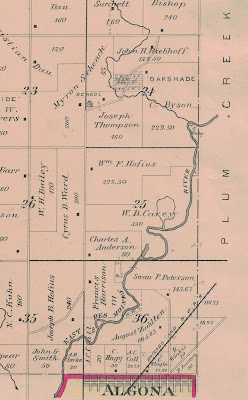
HUNTING FOR THE BYSON HOUSES - kossuthhistorybuff.blogspot.com
A portion of Union Township plat
from 1896 Kossuth County Plat Book

Having a legal description, I checked out courthouse records and then took a drive north of town.  A house is located on the farm site, the main part of which appears to date back to the late 19th or early 20th centuries, but it did not match either of the photos provided by the family.

THE FIRST HOUSE

While searching for the obituary of Anna Byson who died on July 4, 1913, I came across a news article about her final illness which stated that she was “lying low at her home on Nebraska street and slight hopes are entertained for her recovery.”  So now I knew that by 1913 they were living at a home on Nebraska Street—but where on Nebraska?

HUNTING FOR THE BYSON HOUSES - kossuthhistorybuff.blogspot.com
From Upper Des Moines Republican - June 11, 1913

Next stop was in probate records to see if either Anna or Christian had an estate.  Would the property be listed as an asset?  Nothing was found for Anna but an estate was opened for Christian following his death in December of 1922.  He had remarried in 1915 to Mrs. Ingeborg Jessen of Albany, New York, and, after selling his home in Algona, they had moved to Florida where his death occurred.  Unfortunately a review of the Report and Inventory filed in his estate did not disclose any real estate.  I thought perhaps that would be the end of the story, but an error made by the attorney when preparing the Final Report gave me the breakthrough that I needed. 

Christian had sold his Algona house on contract and so did not actually own any real estate in Iowa at the time of his death.  However, when the attorney drafted the Final Report for Christian’s estate, he inadvertently entered the real estate description that had been sold on contract as if it had been owned by the decedent and then, realizing that it should not have been there, crossed it out.  Thankfully it was very legible.  The legal description was for property located on Nebraska Street and courthouse records confirmed that it had been owned by the Bysons.  Census records for 1910 corroborated the location of the couples’ residence at 120 West Nebraska Street.  Although the house is no longer there, a person who grew up in the neighborhood remembered it well and estimated that the house was razed in the 1950s.  The City of Algona built a police garage in the location a few years ago.

HUNTING FOR THE BYSON HOUSES - kossuthhistorybuff.blogspot.com
Corner where Christian Byson home stood
as it looks today

One house location found, one to go.

THE SECOND HOUSE

The farm house in the photo had been identified as belonging to John Byson, the oldest son of Christian and Anna.  He stayed in the area and became a very well-known well driller. He dug wells for farmers and businesses across the county during his 40+ years in business.  I had already determined that the residence located on Christian’s farm did not match the photo of the farm house sent to me, so I knew that John must have purchased his own farm land.  The pictured house looked vaguely familiar—was it still in existence?

Without access to any plat books or farm directories for the period between 1901 and the mid 1940s, the search became a little harder.  I turned once again to the newspapers to see what I could find. I stumbled across the farm auction sale bill stating that John had sold his farm which described the property as located “on No. 18, just across from the Catholic Cemetery in the northeast 

HUNTING FOR THE BYSON HOUSES - kossuthhistorybuff.blogspot.com
Algona Upper Des Moines - December 8, 1942

part of Algona.”  Shortly thereafter I found the article which told of the sale of the property to a Sheldon farmer by the name of Ray Schilmoeller.  No wonder that house had looked familiar!  I had been in it several times as a child as Ray and his wife, Trudy, had been friends of my parents.  The house was completely re-sided a number of years ago by its current owners giving it a much different look, but it still maintains the original lines of the farm house in the photo.

HUNTING FOR THE BYSON HOUSES - kossuthhistorybuff.blogspot.com
Former John Byson home as it looks today

SUMMING UP

Along the way, I discovered many things about the Byson family.  Christian and Anna were members of various Union Township clubs including the East Union Literary Society as well as being active in the Association of United Workmen, Democratic party, and other social groups.  The family was very patriotic.  The American flag was displayed over their door every holiday.  They made a grand return to Europe in 1896, spending three months visiting Denmark, Sweden and Germany. 

John too was well-known in the community not only for his skill in well drilling but also for his friendly and jovial demeanor.  According to his obituary, it was often said that the famous cartoonist, Ding Darling, used him as the basis for his portrayal of the Iowa farmer.  After selling his farm in 1942, he and his wife moved to San Diego, California, where he passed from this life in 1960.

It was satisfying to be able to find the answers to the inquiries made regarding the Byson families.  It is my hope that the stories contained in this research will bring to life the grandparents which heretofore have only been names on a family tree.    

So the next time I visit Riverview Cemetery I plan to once again stop by the obelisk bearing the Byson name.  As I gaze upon the tall pillar pointed to the heavens, I will know that it represents a memorial to two immigrants who traveled far from their homeland with nothing but determination and hope for a better future who then went on to achieve the American dream. 

This marks my 100th post of the stories of Kossuth County and its citizens.  I hope you have enjoyed reading them as much as I enjoy writing them.

Until next time,

Kossuth County History Buff


If you enjoyed this post, please don’t forget to “like” and SHARE to Facebook.  Not a Facebook user?  Sign up with your email address in the box on the right to have each post sent directly to you.

Be sure to visit the KCHB Facebook page for more interesting info about the history of Kossuth County, Iowa.

Reminder:  The posts on Kossuth County History Buff are ©2015-19 by Jean Kramer.  Please use the FB “share” feature instead of cutting/pasting.